The Ancient Flower
The same geometry we compute in a living birth chart was already set into the ground and the sky — in stone circles, temples, and solar enclosures raised thousands of years ago. This is where we gather what we found when we turned the instrument on the ancients.
A Research Project of Scalar Flower. With computational collaboration by the Hermes agent (Nous Research).
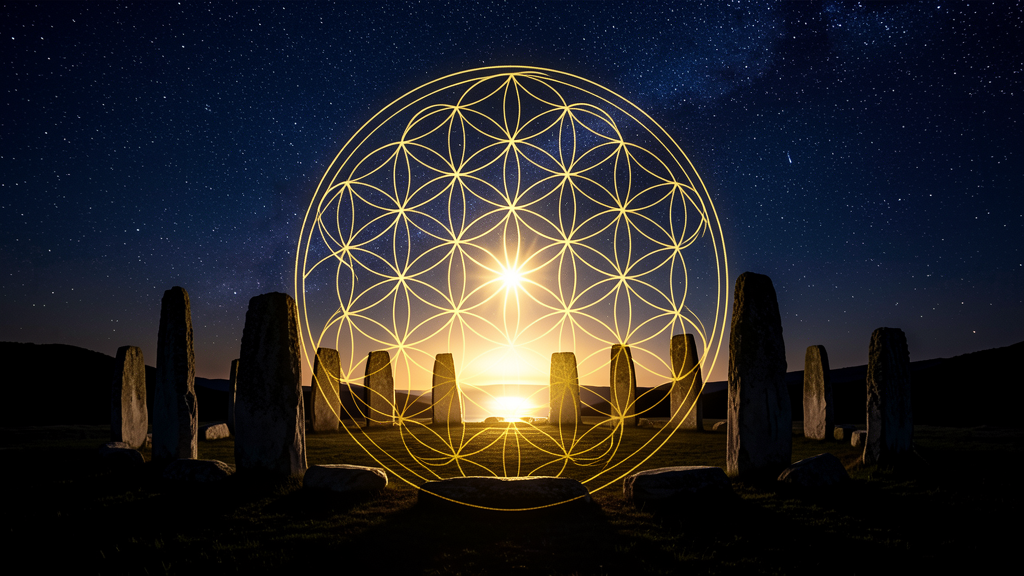
The Ancient Flower: the geometry of the sky, built into the stones that watched it.
Long before anyone wrote down an ephemeris, people lifted enormous stones and set them, with great labor and great care, to catch a particular moment of the sky — the midwinter sunrise through a passage, the Moon at the far edge of its eighteen-year swing, a southern star that rose only once a year over a temple's door. They were building instruments. And when we point our own instrument — a first-principles engine that computes where the real Sun, Moon, and stars stood at any moment in deep antiquity — back at their work, the alignments are there, to the arcminute. The flower we draw in a chart is the same flower they laid in the earth.
Everything below is tagged so you always know what you are holding: REAL measured and reproducible, ARCH a true structural correspondence, INTERP offered meaning that makes no prediction, and NULL — a claim we tested and honestly refuted, including our own.
What the ancients built into the sky
We ran fifteen pre-registered tests — hypotheses, null models, and pass/fail bands all locked before a single number was computed — across nine single sites and three whole populations of monuments. The engine confirms sound alignments, refutes artifacts, and, most importantly, catches its own mistakes. Here are the headline discoveries.
Göbekli Tepe — the oldest temple, on the solstice
The enclosure at the world's oldest known temple (c. 9500 BCE) faces the winter-solstice sunrise. Our engine reproduced the alignment to within 1.4 arcminutes — the tightest solar match in the whole series.
match 1.4′ · solstice sunrise · ~9500 BCESerpent Mound — and a myth put to rest
The great effigy's head aligns to the summer-solstice sunset to 0.04°. The same test cleanly refuted the popular deep-time dating: the fit is best at 1070 CE and worst in remote antiquity — not the ancient date the fringe literature claims.
match 0.04° · best-fit 1070 CE (deep-time claim refuted)Three sibling monuments, three different skies
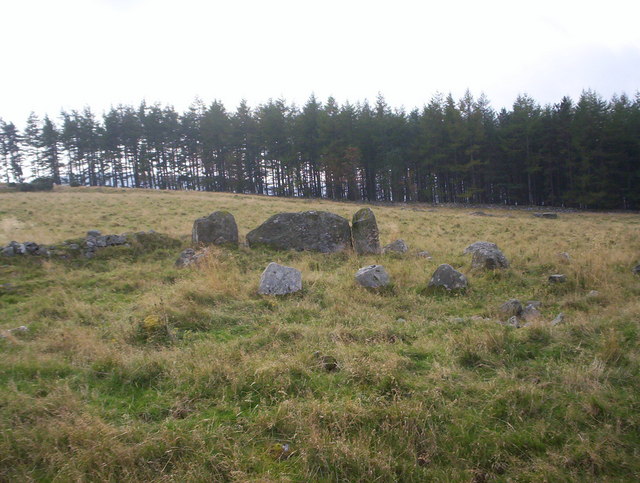
Run under identical rules, three monument populations resolved to three different targets — the strongest sign the engine reads the sky, not our wishes. Two neighbouring Scottish classes point at opposite things.
Recumbent Circles → southern lunar standstill (R=0.935) Clava cairns → midwinter Sun (R=0.911) Maltese temples → southern stars, Crux/Centaurus (R=0.913)Chankillo — a 2,300-year-old solar calendar
Peru's thirteen towers track the Sun's yearly march along the horizon. The engine reproduced the non-linear “hover” of the solar rising point near the solstices — the curve's exact shape, not just its endpoints.
solar-horizon curve reproduced · rate ratio 6.96Two famous claims that did not survive
An eight-site “Regulus rose due east” claim proved astronomically inevitable — a selection artifact, not intent. And Thom's “Megalithic Yard,” the supposed universal 2.72-ft unit, fit the data worse than 79 arbitrary units: a phantom of the method. We publish the refutations as proudly as the confirmations.
both refuted before we could fool ourselvesThat these monuments align to the real sky is REAL — measured, reproducible, arcminute-tight. That the ancients and we are drawing the same flower is a structural correspondence ARCH we find beautiful and worth naming. That this geometry carries meaning into a human life is our offered interpretation INTERP — never a forecast, never a claim of a force the sky transmits. The instrument registers the heavens; it does not channel them.
The instrument that catches itself
The point of the Ancient Flower is not to prove that everything ancient was astronomical. It is to hold a discipline. Our engine caught five of its own errors during the series — an over-tight band, a pole-rotation bug flagged by a sanity anchor, and a sign-dropping data corruption that would have inverted the Malta verdict. An instrument you can trust with the ancients is one you can trust with a birth chart. The same honesty runs through both.
The flower we compute, they built in stone — and the same rule governs both: the source outranks the wish.
Read the discoveries
The full record lives in the white paper and the Field Notes below.