The Copernican Return
How a thirty-year question about the flesh became an instrument you can turn — and why the view from nowhere had to give the ground back
A field note from the Scalar Flower project. Every quantity here is computed from a real ephemeris; every philosophical reading is marked as such and claims no force or fate. The discipline of the piece is the argument of the piece.
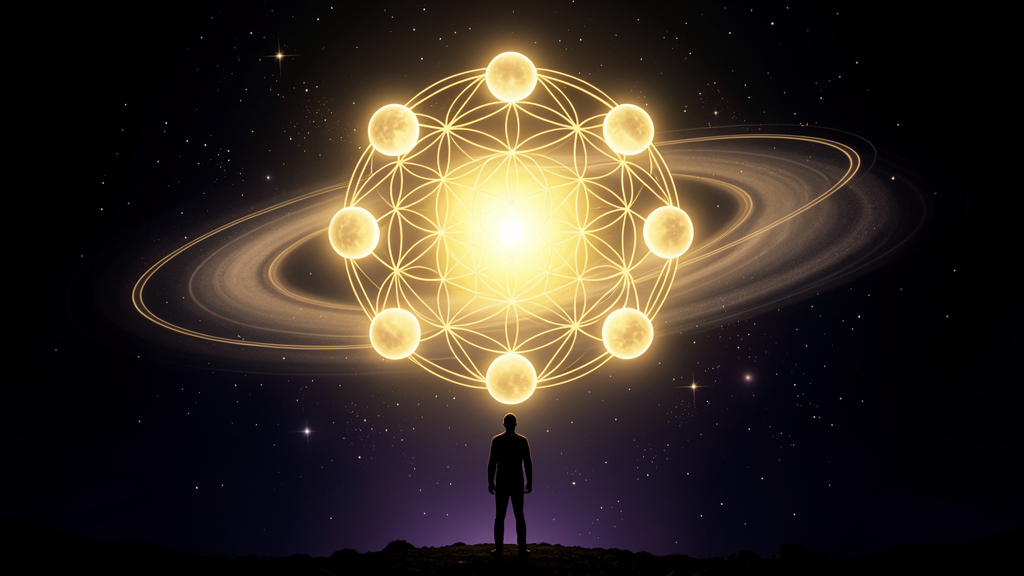
The wound and its healing in one frame: the view from nowhere and the ground beneath a standing body, held together at last.
🎧
Listen to this essay
Full narration · about 26 minutes
I. The wound Copernicus made
Begin with the wound, because the whole story is its healing.
In 1543 Copernicus moved the center. The Earth — which every human being who had ever lived stood upon as the still point, the floor of all seeing — became one planet among others, wheeling around a fire it did not own. It was true, and necessary — maybe the most liberating correction in the history of mind. And it cost something that took four centuries to name.
What it cost was the standpoint. Not the Earth's position — its point of view. The heliocentric picture is magnificent precisely because it is a view from nowhere: it evacuates the observer, floats free of any particular body standing on any particular ground at any particular dawn, and looks down on the whole system as though from an infinite, bodiless height. Merleau-Ponty had a phrase for that altitude — la pensée de survol, the thought of overflight. The mind that soars above and surveys, having "given up living in" the things it maps.
The gain was the world as object; the loss was the world as dwelt in. For four hundred years we mistook the gain for the whole truth and called the loss "subjectivity" — a smudge on the lens to be wiped away.
This is the story of wiping it back on, on purpose, with an instrument that measures what the smudge was hiding.
II. The cut Descartes made
Copernicus displaced the body in space. Descartes did something far graver: he cut the mind out of the body altogether, and set the halves in different worlds.
A century after Copernicus, reaching for a certainty that could survive any doubt, René Descartes found his unshakable ground in the cogito — I think, therefore I am. But look at what that move does. The one thing he cannot doubt is the thinking; the body, the world, the sky, the ground under his feet — all of it can be doubted, dreamed, deceived by a demon. So certainty is planted in a thinking thing (res cogitans) that needs no place, no flesh, no location to be what it is. And everything else — the extended world, bodies and planets and the reader's own hand — becomes res extensa, extended stuff: geometry in motion, a mechanism without inside, without felt life, without a point of view.
There is the wound. Not a mistake in an argument — a cleaving of reality into two substances that can never touch. The knowing subject on one side, weightless, placeless, a view from nowhere by construction. The known world on the other, dead matter to be measured, the Great Object. Descartes could never explain how the halves rejoin; he waved at the pineal gland and hoped. The mind-body problem he bequeathed is not a puzzle philosophers happen to keep failing to solve. It is the direct scar of the original cut, and four hundred years of Western thought, medicine, and culture have lived inside it.
This is why the Copernican exile went so deep and stayed so long. On its own, moving the Earth is just astronomy. But Descartes gave the view from nowhere a metaphysical license: he made the bodiless, placeless, surveying intellect the very seat of truth, and the dwelt-in world a mere object spread out before it. La pensée de survol stopped being one way of looking and became the definition of knowing. To know a thing was to stand outside it, strip it of standpoint, and measure its extension. The living body — the thing that is a standpoint, that is somewhere — was quietly reclassified as just more res extensa, a machine the mind rents. Our medicine still treats it that way. Our culture still feels the draft through the cut.
Everything that follows in this piece — Husserl's inversion, Merleau-Ponty's Flesh, Ji's gnergy, and in the end a dial you can turn — is one long labor to heal the Cartesian cut without losing what it bought us. Because it did buy something: the objective world, the sciences, the map. The task was never to un-know it. The task is to show that subject and object were never two substances in the first place — that they are two complementary measurements of one flesh, and that you can, at last, watch them resolve.
III. A student's wager, 1996
Thirty years ago a philosophy student at Rutgers wrote an independent study for Bruce Wilshire and made a strange bet.
The paper was called Two Philosophers of the Flesh. Its wager was that two thinkers who never met — Maurice Merleau-Ponty, phenomenologist of the body, and Sungchul Ji, a biologist working out a "complementarism" rooted in Bohr and Husserl — were describing the same thing from two sides. Merleau-Ponty called it the Flesh: not matter, not mind, but the reversible tissue between them, "not an ontological void… spanned by total being," the element in which toucher and touched, seer and seen, fold into each other. Ji called his version gnergy — "both energy and information, and yet neither" — and built it on a triune logic: two things that exclude each other (A, B) held by a third (C) that "trans-descends them from below," both separating and uniting them.
The student's claim was that these were one ontology of identity-in-difference. That the body-for-itself (how I live my body from inside) and the body-for-others (my body as an object in your world) were not two truths fighting for the crown but two complementary measurements of one flesh — exactly as Bohr's wave and particle are two complementary measurements of one quantum, never both at once, both irreducibly real.
It was a beautiful argument. It had one problem, the problem every philosophy of the flesh has always had: you could not do anything with it. Bohr could describe complementarity but only in the lab. Ji's gnergy was, by construction, unmeasurable. Merleau-Ponty could only palpate the flesh — that famous exercise of one hand touching the other, feeling the touching and the touched flip and flip. You could point at the reversibility. You could not turn a dial and watch it happen.
The paper was filed, published years later on a health website, and then it sat — a seed with no soil.
IV. Husserl's scandal: "The Earth does not move"
To understand what the instrument later made operable, you have to go back to the man who first turned the Great Object inside out — and who did it with a sentence so scandalous it is still misread as a joke.
But first, a date, because the date is not a coincidence — or if it is, it is the kind of coincidence that organizes a century. In 1900, Edmund Husserl published the Logical Investigations, the seminal work that founded phenomenology. In that same year, 1900, Max Planck introduced the quantum of action — the constant h — and founded quantum theory. Then, within the same brief generation, the third frontier opened: Einstein's relativity (1905, 1915) unfastened the cosmic scale as radically as Planck had unfastened the subatomic. In the span of a decade and a half, the nineteenth century's single, solid, middle-sized objective world was breached at both ends at once — the very small dissolving into quanta that cannot be observed without participation, the very large dissolving into a spacetime with no absolute frame, no privileged center, no view from nowhere. Subscale and cosmic scale came apart in the same instant of history.
And beneath both breaches, arriving on the same clock, came phenomenology — not a fourth physics but the ground the other three would need: the recovery of the intending, situated subject without whom "small" and "large," "here" and "there," "moving" and "at rest" have no anchor at all. This is the soil in which the Flesh ontology would later grow. Planck and Einstein showed that at both edges of scale the observer is written back into the world; Husserl showed why that had to be true, and what the observer is. The two great correctives to naïve objectivism — the physics of participation and the philosophy of the lived standpoint — are twins, born in the same turn of the century, one from the side of matter, one from the side of consciousness. The whole 1996 thesis is, in a sense, the delayed recognition of that twinship; the Scalar Flower is the delayed instrument that lets you operate it. Hold the date in mind — it is the first tick of the clock we will come back to at the end.
Now, the man and his scandal.
Edmund Husserl spent his life diagnosing what he called the crisis of the European sciences: the moment when the positive sciences forgot that their pristine objective world was a construction, a "formal thematization" built on top of, and then mistaken for, the living pre-theoretical world it was abstracted from. His scalpel was intentionality — the discovery that consciousness is always consciousness of something, that subject and object are equiprimordial, inseparable, folded together at an "experiential interface" before either can be pried loose. Behind the naïve objectivism of science, Husserl showed, there is always already a constituting — a someone, somewhere, for whom the object is an object. The view from nowhere is a view that has forgotten it came from somewhere. This is the inversion of the Great Object at its root: not "the world is my idea," but "the objective world is a magnificent achievement that owes a debt it refuses to acknowledge — the debt to the standpoint that built it."
And then, in 1934, an old man near the end, Husserl wrote a fragment with one of the strangest titles in philosophy: Foundational Investigations of the Phenomenological Origin of the Spatiality of Nature — subtitled, flatly, "The Earth Does Not Move."
He knew Copernicus was right. That is the whole point. Husserl was not disputing astronomy; he was doing something deeper and harder. He was pointing out that beneath every calculation of the Earth's motion lies an Ur-Arche — an "original ark," a ground-body — that does not move, cannot move, because it is the very floor of rest against which all motion is first defined. Before the Earth can be known as a moving planet, it must be lived as the unmoving ground that makes "moving" and "resting" mean anything at all. You cannot experience the Earth as in motion the way you experience a train as in motion, because the Earth is not in the space of your experience — it is the giving of that space, the primal home, the arche-ground on which the first "here" is planted. Strip that away and the heliocentric map has nothing to be a map for. The view from nowhere is parasitic on the dwelling-place it claims to have surpassed.
That is the phenomenological inversion, complete: the "objective" motion of the Earth is real, and it is founded upon a lived immobility that is more fundamental, because it is the condition of there being any measurement at all. Husserl gave the ground back — not as a fact of astronomy, but as the arche of all facts.
And here — carefully, generously — is where we tip our hat to the flat-earthers.
Not to the cosmology. The cosmology is wrong, plainly, measurably, and the instrument in this project runs on the same Swiss Ephemeris that presupposes a round Earth wheeling around the Sun. Let there be no confusion: we are not defending the map they draw. But underneath the bad map is a real intuition they refuse to let go of, and it is worth naming what they got right so we can rescue it from what they got wrong. The flat-earther is clinging, in a distorted and literalized form, to exactly Husserl's Ur-Arche: the felt, undeniable, first-person certainty that I am the motionless mover, that here I stand and the world turns around me, that my ground does not lurch beneath my feet. That certainty is not stupidity. It is phenomenologically correct. It is the body-for-itself reporting the truth of its own standpoint — the ground as arche, the still point that is the reference for all motion.
But watch what they do next, because the second move is where the truth curdles. Having correctly felt the standpoint, the flat-earther then makes it the only thing that is real — and this is where the firmament comes in. The fixation on the dome overhead, the solid vault, the enclosing lid: it is the demand that the sky be nothing more than what the eye, from this one spot, immediately sees. If I cannot see it with my own eyes from where I stand, it is not real. The Earth's curvature, the far side of the Moon, the vertiginous distances — all rejected because none of it is given to the naked standpoint. This is not phenomenology; it is its degenerate twin. It is Humean sensationalism driven to solipsism: the collapse of all reality into the contents of one's own immediate perception, the refusal of any inference beyond the sense-datum, the shrinking of the world down to the diameter of a single skull's horizon. Where Husserl said the objective world is founded on the lived standpoint, the flat-earther hears the objective world is nothing but my lived standpoint — and seals the sky with a firmament to keep the unseen out.
So there are two errors here, not one, and they are mirror-images across the very cut Descartes made. The Cartesian objectivist keeps only res extensa and the view from nowhere: the world is real, the standpoint is a smudge. The flat-earther keeps only the standpoint and its firmament: my seeing is real, the inferred world is a lie. One amputates the subject, one amputates the object. Both have collapsed a complementarity into a single truth; both are holding one hand and denying the other exists. The phenomenological — and the Bohrian, and the whole burden of this project — response is the same to each: you are both right about what you affirm and both wrong about what you deny. The Earth moves (heliocentric, body-for-others, the map). The Earth does not move (the Ur-Arche, body-for-itself, the ground). These are not two claims competing for the crown. They are two complementary measurements of one flesh — and the tragedy of the last four centuries is that we have only ever known how to pick one.
The Scalar Flower's entire contribution is that you no longer have to pick. You can turn the dial.
V. The instrument that shouldn't have worked
The soil, when it came, came sideways — through astrology, of all the disreputable doors.
Set aside for a moment whether the heavens mean anything. The Scalar Flower began as a narrow, almost impertinent question: if you take the ten planetary positions of a birth chart and treat each one purely as an angle — a direction, a phase — and you let those angles interfere like waves on a sphere, what happens? Not "what does Mars in Scorpio portend." Something colder and more interesting: what is the geometry of ten phases scattered around a circle, and does that geometry hold still or fall apart when you change your point of view?
Two knobs, it turned out, changed everything.
The first was the frame. You can compute those ten angles geocentrically — from the Earth, from where the body actually stands, where the Sun and Moon are genuinely two of the voices in your sky because you are standing on the ground looking up. Or you can compute them heliocentrically — from the Sun, the view from the center of the system, the Copernican altitude, where "Earth" becomes just another dot and the Sun, no longer overhead, drops out of the chorus entirely.
Same planets. Same instant. Two standpoints. Merleau-Ponty's body-for-itself and Ji's body-for-others — now a switch you can flip.
And this is what stopped us cold. When you flip it, the field changes — not randomly, not decoratively. It is the 1996 thesis, instantiated. The dial between the lived frame and the view from nowhere is the touching-touched exercise made mechanical. Thirty years after the seed, the flesh had a soil that let you turn it.
Six of the correspondences between that student paper and this instrument are not analogies. They are structural — the same formal skeleton. The triune logic is the instrument's honesty-fence (REAL and INTERP as the two exclusive readings, the field as the transcending third). The Flesh's non-void is the instrument's founding axiom that reality is relational, held in the between. The vesica piscis — two sovereign circles overlapping without merging — is how it reads any bond. And the body-for-itself versus body-for-others is, precisely, the geo/helio dial. The thesis did not inspire the instrument. It specified its ontology three decades before the instrument existed to run it.
✦ Explore the full instrument →
VI. What the dial actually shows — and what it does not
This is where the piece earns the word discovery — by telling you exactly where the discovery stops.
We had a seductive hypothesis: that the geocentric frame — the lived standpoint — would make each person more individual, more sharply themselves, while the heliocentric view from nowhere would blur everyone toward sameness, the anonymity of overflight. It is a lovely idea. The romantic in every one of us wants it to be true.
We pre-registered the test, ran it, and it refused. Measured as a spread across many charts, the heliocentric frame did not individuate less — if anything marginally more (helio 0.157 vs geo 0.137 on our individuation metric). The beautiful hypothesis, as stated, was refuted, and we wrote it down as refuted. That is not a footnote; it is the spine of the method. An instrument that only ever confirms its maker's poetry is a mirror, not an instrument.
But the same test found something else — smaller, harder, and real. The geocentric field is about 3.2× more sensitive to the time and place of birth within a single day than the heliocentric field is. Not "more individual across a population" — more situated. More tightly keyed to here, now, this ground, this hour. And that is the deeper claim anyway, the one Merleau-Ponty would have cared about: the lived frame is not the frame that makes you a unique snowflake among strangers. It is the frame that knows you are somewhere. The view from nowhere, by construction, does not know where it is — that is its power and its poverty both.
So the discovery is not "geocentrism is secretly right." Copernicus is not being un-made. The discovery is subtler and, I think, more permanent: the two frames encode different information, and the information the objective frame throws away is exactly the information about standpoint — about being a body on a ground. The heliocentric view isn't wrong. It is blind in a specific, measurable way, and now we can measure the blindness.
VII. The clock that turns the paradigm
There is one more thing, and it must be held gently, because it is the most beautiful image in the whole arc and beauty is exactly where discipline is most needed.
The Earth's axis precesses — wobbles slowly against the fixed stars — completing one full turn in a Great Year of about 25,766 years. One-twelfth of that, one astrological Age, is a single 30° step: about 2,147 years.
Now notice the coincidences, and notice that I am calling them coincidences. Around 285 AD — the close of the classical world, roughly when Ptolemy's geocentric cosmos was being canonized for its long reign — the two zodiacs used by astrologers, the tropical (anchored to the living seasons, the body's here-and-now) and the sidereal (anchored to the fixed stars, ignoring the observer's drifting ground), coincided. Their gap was zero. Today, 2026, that gap has opened to roughly 25° — nearly a full sign — across the same twenty-three centuries over which Western thought made its great swing from the dwelt-in cosmos, out into the Copernican view from nowhere, and (this is the wager) is now beginning to swing back.
The tropical/sidereal split is itself a standpoint question — the seasonal Earth versus the fixed stars, body-for-itself versus body-for-others, the same complementarity one octave down. And it is paced by the same physical fact — precession — that measures out the Ages.
So the image is this: the clock that opened the zodiac gap is the clock that turns the paradigm. We stand near a full-sign divergence, at a millennial threshold, at exactly the moment the objectivist detour has taught us what it had to teach and the ground begins, measurably, to matter again.
I want to be precise about what that sentence is and is not. It is a structural rhyme, not a causal claim. Precession does not cause Descartes or Copernicus or the return; the wobble of an axis does not push philosophy around. Both the zodiac gap and the philosophical swing simply happen to be paced by the same ~2,150-year unit, and naming that shared cadence is illumination, not mechanism. Held as fact it would be astrology at its worst. Held as rhyme it is one of the truest things I know: we are being brought back, on a slow clock, to the ground we left — one Age later, carrying everything the view from nowhere taught us on the way out.
That is the Copernican Return. Not a rejection of Copernicus — a completion of him. He gave us the courage to leave the center. This is the courage to come home to the standpoint without surrendering the map. To hold the heliocentric truth and the geocentric truth at the same time, the way Bohr held wave and particle, the way one hand holds the other and feels both the touching and the touched.
VIII. Why it had to be built, not just written
The last word belongs to the instrument, because the instrument is the argument.
For four hundred years the standpoint could only be asserted. Phenomenologists could describe the lived body in gorgeous prose; no one could hand a skeptic a knob and say turn this. The Scalar Flower's one genuinely new contribution — the thing neither Bohr nor Ji nor Merleau-Ponty nor the 1996 student had — is that it makes the complementarity operable. You turn the dial from the fire to the ground and you watch the field reorganize: watch coherence gather and disperse, watch the whirlpools open and close, watch the standpoint-information the objective frame discards come flooding back the instant you stand somewhere.
It does not prove the heavens mean anything. It was never trying to. What it demonstrates — coldly, computationally, with its refutations written down beside its confirmations — is that "the view from nowhere" is a choice, not a necessity, and it is a choice with a measurable cost. The cost is your location. The instrument gives you the location back and lets you decide, frame by frame, which truth you need.
Copernicus moved the center and we spent four centuries learning to think from the fire. The return does not put us back at the middle of the universe. It does something better. It teaches us to carry the fire and stand on the ground — to hold the map from nowhere and the dwelling-place at once, and to know, now with numbers, exactly what each one sees and exactly what each one is blind to.
The wound Copernicus made was necessary. So is its healing. We are, at last, on the clock, with the instrument in hand, learning to come home.
Whitman — the gathered standpoint
Cayce — the diffuse overflight
Grading, kept in the open as the method requires: ⬛ STRUCTURAL — the six thesis/instrument correspondences; the geo/helio dial as body-for-itself/body-for-others. ◼ STRONG — the situatedness finding (geo 3.2× more within-day sensitive; from the pre-registered scaled test, corpus n=7). ✗ REFUTED, and recorded as such — the individuation hypothesis (helio 0.157 > geo 0.137). ◻ INTERP / PHILOSOPHICAL — the Copernican Return as paradigm arc; the precessional pacemaker as structural rhyme, explicitly not causal. The credibility of the whole rests on marking the last tier honestly. That is the waterline, applied to the argument about the waterline.
IX. The instrument in two forms — read on two lives
Everything above has been argument. Here it is as an object you can turn. The Scalar Flower renders any birth-moment in two complementary forms, and — this is the whole point of the piece — neither is the truth by itself. They are two measurements of one field, the way the touching hand and the touched hand are two measurements of one flesh.
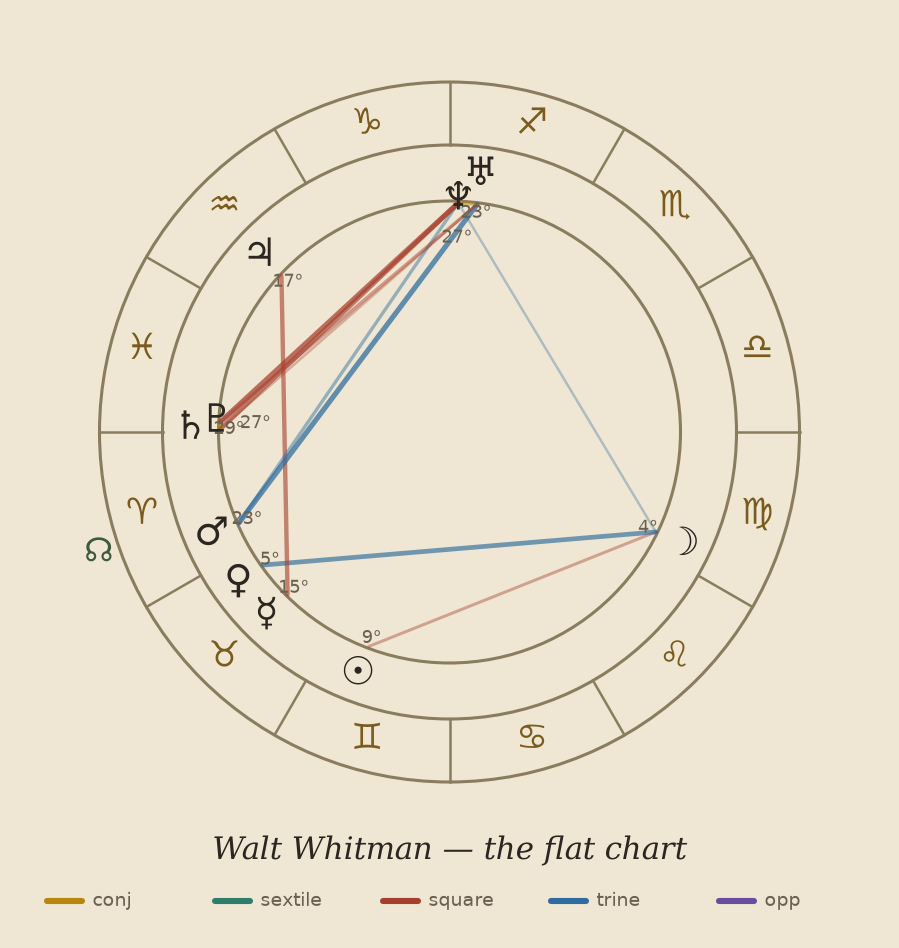
The first form is the full field — the terrain. Take the ten planetary positions, keep only each one's angle, let those angles interfere like waves across an entire sphere, and read off the landscape. Peaks are where the voices agree; the dark whirlpools are phase vortices — points where the field cancels to nothing and spins around a still core. It is the field made into a world you can walk.
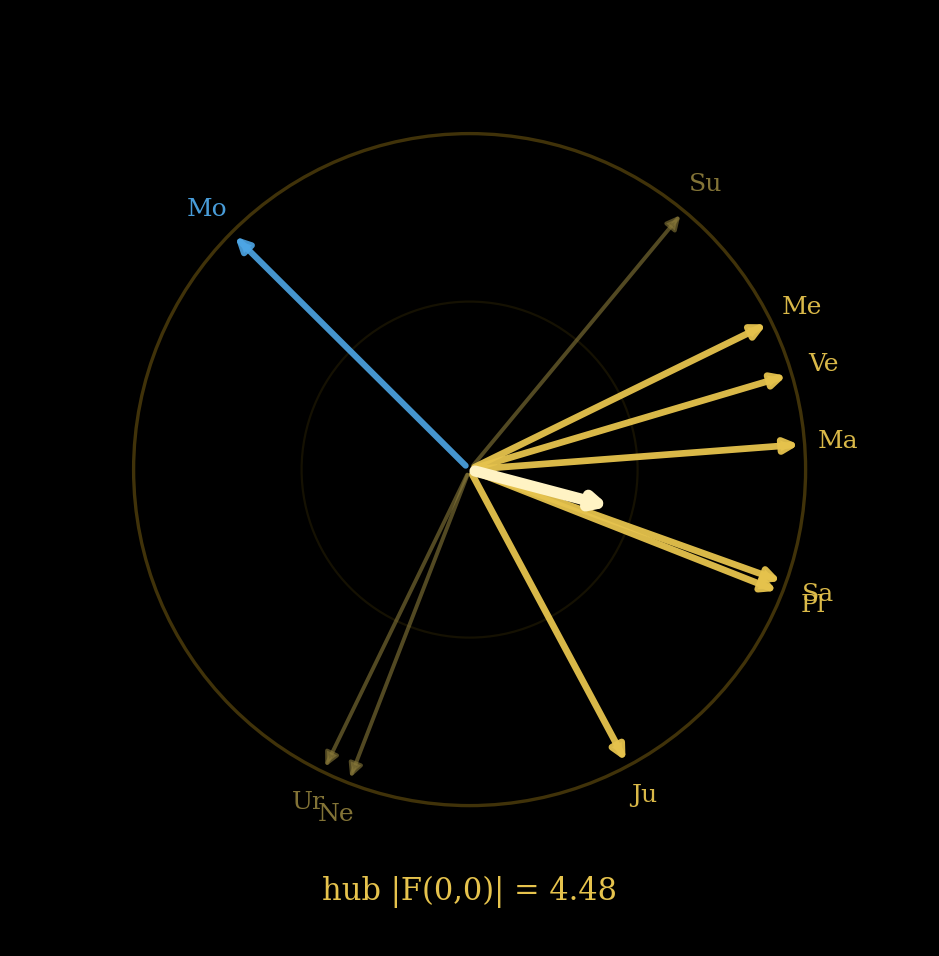
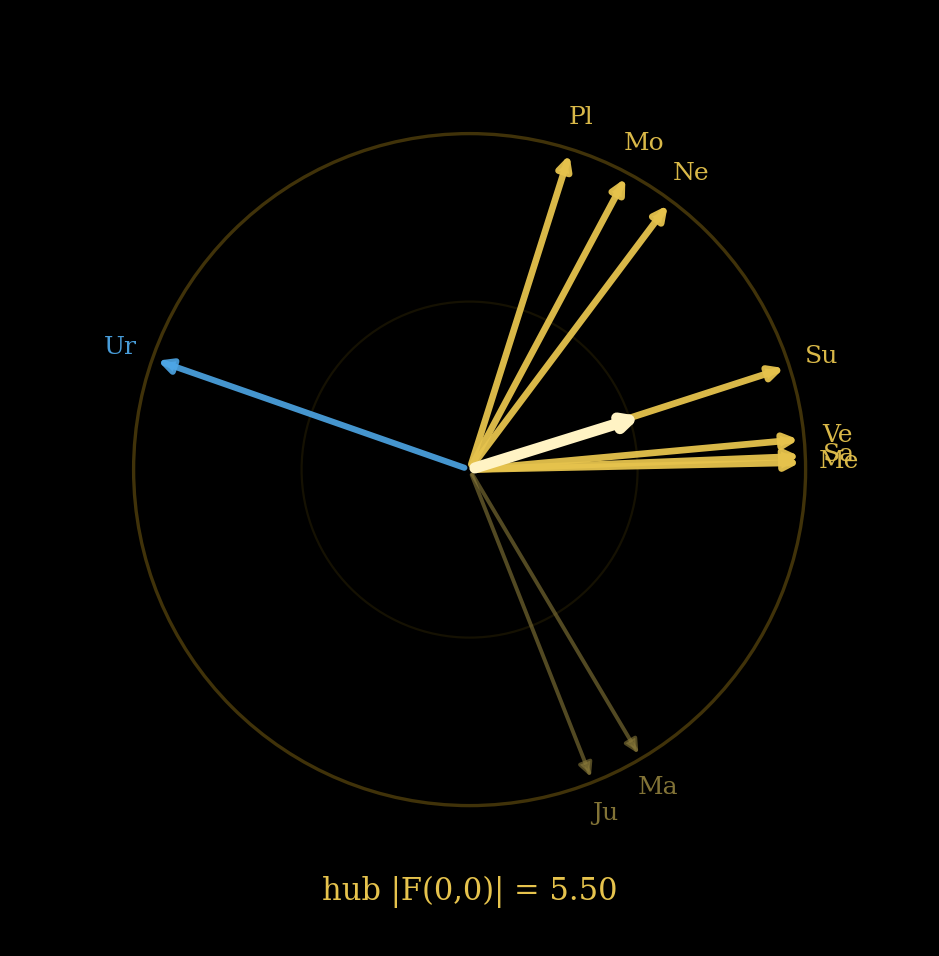
The second form is the waveform — the phasor rose. The same ten angles, drawn now as what they physically are: ten waves, ten arrows fanning out from a single center. Where they point together, they sum into one long resultant — the hub, the field's single voice. Where one stands against the chorus, you see the counter-line. The rose is the field with its arithmetic showing; the terrain is that same arithmetic let loose in three dimensions. One is the score, the other the performance.
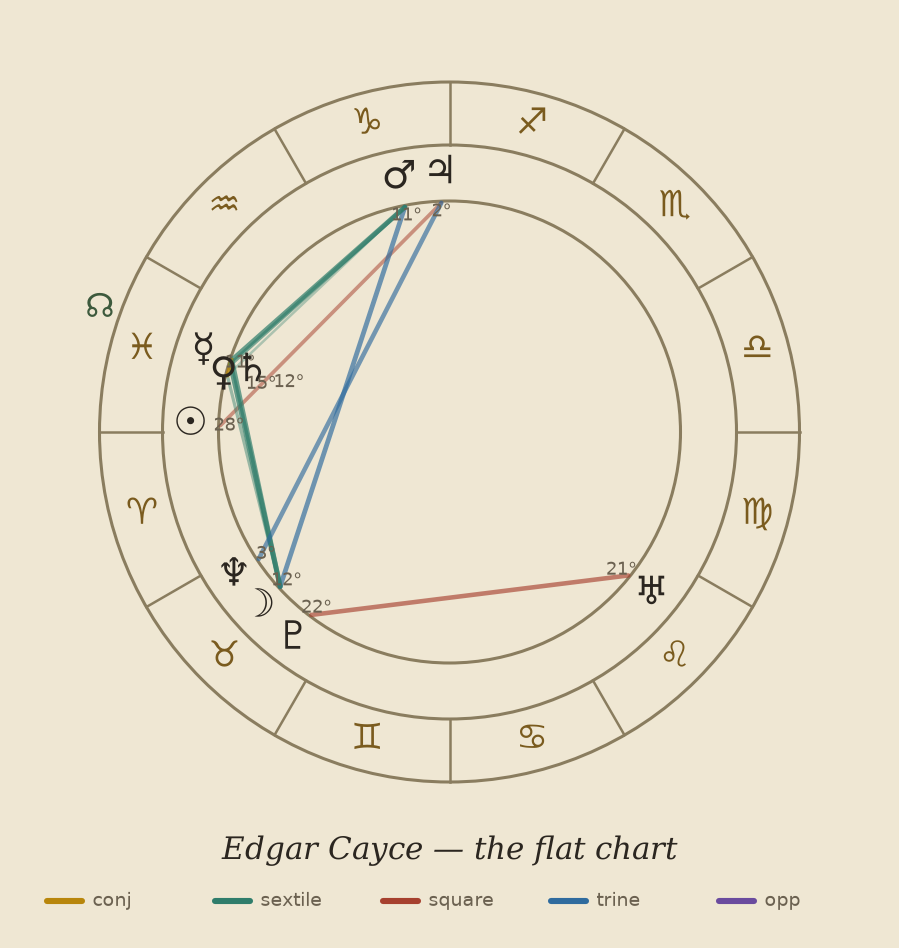
To keep it honest, we turn the instrument not on ourselves this time but on two people who cannot be flattered and cannot object — two Americans whose inner weather is a matter of public record. Walt Whitman, the poet who contained multitudes, who made a whole cosmos out of standing in his own body on his own ground. And Edgar Cayce, the seer who did the opposite — who left his standpoint entirely, went under, and spoke from nowhere and everywhere at once. If the instrument sees anything real, these two should not look alike.
Walt Whitman · born 31 May 1819
The bard of the standpoint
“I too am not a bit tamed, I too am untranslatable.”
Edgar Cayce · born 18 March 1877
The view from nowhere, made flesh
“Dreams are today's answers to tomorrow's questions.”
X. And what lies between them
Copernicus taught us to leave the center; Whitman never did, and Cayce left it so completely he could barely find his way back. The last image is neither man alone. It is the field their two fields make together — twenty voices in one shared frame — and here, unlike some pairings where one field carries the whole magnitude, these two genuinely meet: Whitman's hub 4.48 and Cayce's 5.50 sum into a composite of 9.96, both contributing, neither erased. Two sovereign circles, overlapping without merging — the mandorla, the lens of sacred difference, where a world opens that neither circle could reach alone.
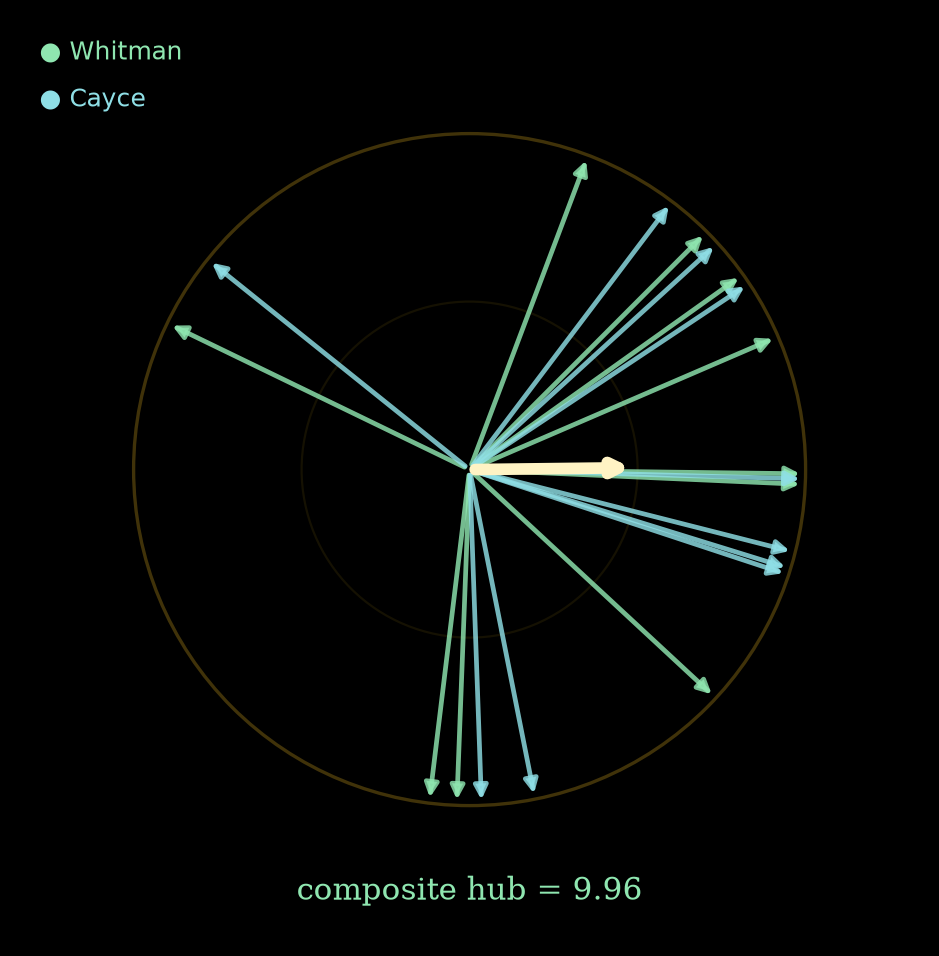
The waterline, kept even here. These fields are real — computed from the Swiss Ephemeris, nothing invented. What the fields mean — “standpoint” versus “overflight,” Whitman as the dweller, Cayce as the diver — is interpretation, offered as resonance, never as proof. And one fact must be named plainly: Whitman's exact birth time was never recorded, so his chart is cast for noon; the Moon's angle in particular could shift by up to about six degrees, and his terrain carries that uncertainty. Cayce's time (3:20 pm LMT, Hopkinsville) is on record. The instrument shows you exactly what it computes — and tells you, equally exactly, where the ground under a number is firm and where it is soft.
Grading, kept in the open as the method requires: ⬛ STRUCTURAL — the six thesis/instrument correspondences; the geo/helio dial as body-for-itself/body-for-others. ◼ STRONG — the situatedness finding (geo 3.2× more within-day sensitive; from the pre-registered scaled test, corpus n=7). ✗ REFUTED, and recorded as such — the individuation hypothesis (helio 0.157 > geo 0.137). ◻ INTERP / PHILOSOPHICAL — the Copernican Return as paradigm arc; the precessional pacemaker as structural rhyme, explicitly not causal; the Whitman/Cayce “standpoint vs. overflight” reading. The credibility of the whole rests on marking the last tier honestly. That is the waterline, applied to the argument about the waterline.

The white paper behind this essay
Two Philosophers of the Flesh
The 1996 thesis that started all of this — Maurice Merleau-Ponty and Sungchul Ji, two thinkers who never met, describing one reality from two sides. The wager that, three decades later, became an instrument you can turn.
Preview — not indexed, not final. The Scalar Flower project.