We Tried to Break Our Own Skeleton
A careful reader made the sharpest objection anyone has made to the last Field Note: the field is arbitrary — you picked ten bodies, weighted them equally, and chose to add them up. So we took the critique, aimed it at our own engine, and ran it. Here is exactly what bent and what held.
A Field Note from Scalar Flower. With computational collaboration by the Hermes agent (Nous Research).
The same skeleton from the last note — but this time we put it in the press and turned the handle. What follows is what the gauges read.
The last Field Note, The Skeleton Under the Signs, made a set of structural claims: that the field is invariant to the zodiac you choose, that the fourfold comes from the Earth's tilt, that twelve is the smallest harmonic container, and that a new vertical measure — the breath — is genuinely new. Then a reader did the most useful thing a reader can do. They granted the invariance argument, and then pressed exactly where it should be pressed: none of that is dictated by physics. You chose ten bodies. You chose to give them equal weight. You chose to sum them. Change those choices and you'd get a different skeleton. So how much of this is real, and how much is just the shape of your assumptions?
That is the right question, and it deserves more than a paragraph of reassurance. It deserves an experiment. So we built one — three of them — and ran them against the actual engine that computes every reading on this site, not a clean-room re-implementation that could quietly cheat in our favor. The scripts are linked at the end; anyone with the ephemeris can run them in an afternoon. This is the honest part, and it is the whole point of a Field Note.
What we found has a shape worth naming up front, because it is the real answer to the critique: the parts we called bedrock are bedrock, and the parts that are choices are honestly choices — and the story survives every reasonable version of the choices. Here is how each of the three tests came out.
IIs the invariance real, or just plausible?
The first note claimed that changing the zodiac — tropical to sidereal, one ayanamsa to another — leaves everything we measure untouched, and moves only the name-tags. That is easy to assert and easy to hand-wave. So we made it a measurement. We took two hundred real birth charts, and for each one we spun the entire zodiac six different ways: tropical, then four of the ayanamsas real astrologers actually use (Lahiri, Fagan–Bradley, Krishnamurti, Raman), and then one deliberately absurd rotation of 137.3 degrees, just to abuse the claim. For each, we recomputed the field, the hub, the direction it points, every angle between bodies, and the breath.
Then we measured how far each of those quantities moved from the tropical baseline. If the invariance is real, the movement should be zero. Not "small." Zero.
hub 3.6×10⁻¹⁵ · direction 5.1×10⁻¹⁵ rad
every angle 3.6×10⁻¹⁵ · breath 1.7×10⁻¹⁶
Those are not small numbers. Those are zero, in the only language a computer can speak it — the fifteenth decimal place, the floor of what double-precision arithmetic can even represent. The field did not move under any zodiac, including the ridiculous one. The reason turned out to be cleaner than the first note even claimed: the engine anchors every body on the Moon's north node, measuring each planet's angle from the node. When you change ayanamsa you add the same constant to every longitude — including the node's own. In the subtraction, that constant cancels, identically, every time. The invariance isn't a lucky empirical fact. It's an algebraic identity, and you can watch it hold to machine precision.
Meanwhile the labels move exactly as they should. The same chart's field points to 6.6° Libra in the tropical frame, 0.6° Scorpio under Lahiri, and 23.9° Aquarius under the absurd rotation. Same arrow, same shape, different name for where it lands. That is the whole thesis of the last note, now measured rather than asserted: the geometry is fixed, the vocabulary floats on top.
The scored field is identical across every zodiac, ayanamsa, and starting point, to within 10−15 — the numerical floor. This is not "close enough to argue about." It is the same number, provably, because a frame change cancels in the node-anchored angles. The signs are a naming layer; the measurement does not see them.
IIThe critique that lands: how much rides on the choices?
Now the real one. The reader was right that ten bodies, equal weights, and summation are decisions, not laws of nature. So we changed them, one axis at a time, over three hundred real charts, and watched what happened to the answer.
We varied the body set: dropped Pluto to run nine, added the true lunar node, added Chiron, added both. We varied the weights: equal, then by planetary mass, then by the log of mass, then by inverse distance. And for each variant we asked two separate questions that the critique tends to blur together. First: does the invariance theorem still hold? Second, and more honest: does the ordering of charts — the actual story the instrument tells — survive the change? We measured the second with a rank correlation: 1.0 means the variant ranks charts identically to the baseline, 0 means it has scrambled them.
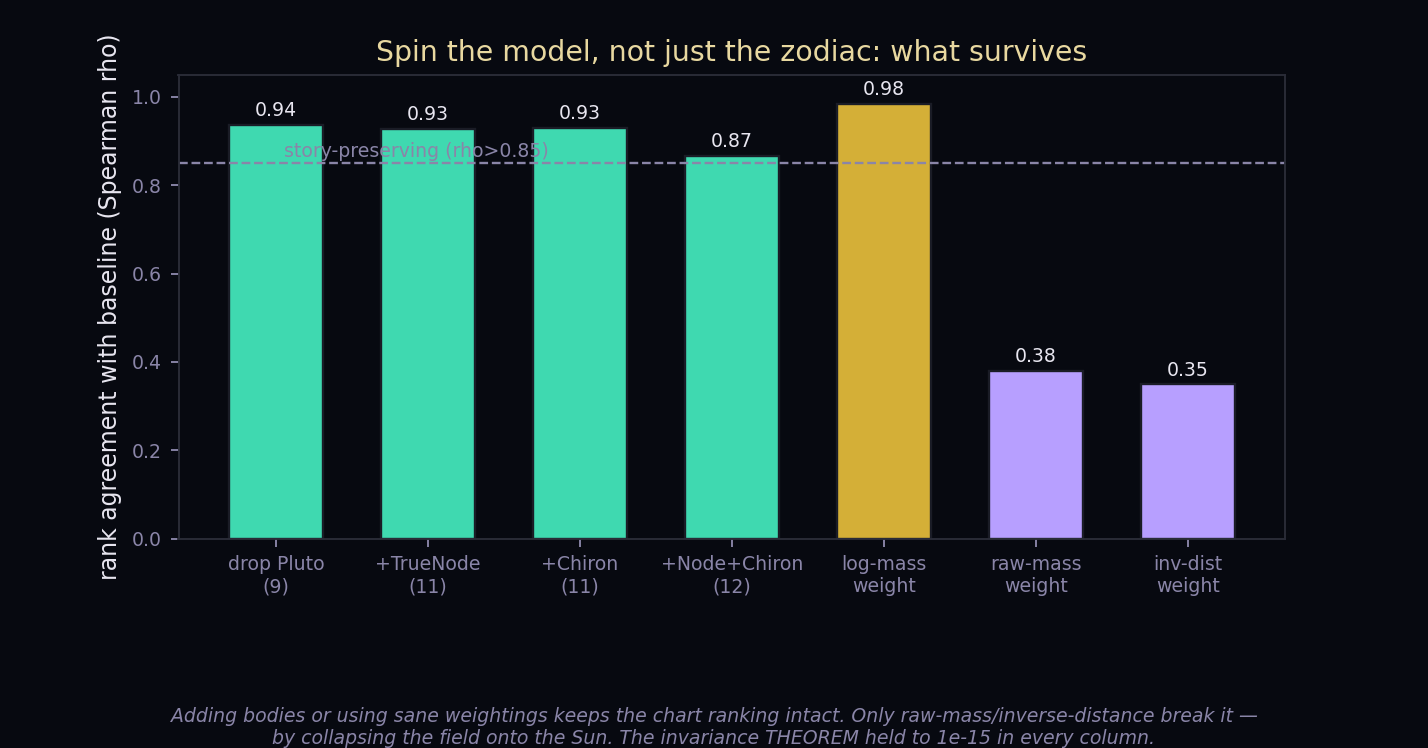
Two things fell out, and they are the honest two-part answer to "your modeling is arbitrary."
First: the invariance theorem survived everything. Twelve bodies, mass-weighted, arbitrarily rotated — the hub still didn't move past the fifteenth decimal. That makes sense once you see why it's true: invariance is a property of measuring angles from a common anchor, and it does not care how many arrows there are or how long each one is. It is structural, not tuned.
Second: the story holds under every reasonable choice, and only collapses under an unreasonable one. Adding the node or Chiron barely disturbs the ranking (agreement 0.87 to 0.93). Weighting by the log of mass leaves it almost untouched (0.98). The ranking only shatters under raw mass or inverse-distance weighting — and when you look at why, that turns into an argument for the original choice, not against it: the Sun is 333,000 times the Earth's mass, so raw-mass weighting simply deletes every other body and collapses the whole field onto the Sun. That's not a different skeleton. That's no skeleton — one bone where there were ten.
So the critique is half right, in the most useful way. The specific value of the field — its exact magnitude and heading — is a convention, and we should never pretend otherwise. But the invariance is a theorem, and the ordering the instrument produces is stable across every defensible version of the convention. Equal-weighting isn't the one true choice handed down from the sky; it is the choice that treats each body as a voice rather than letting the loudest instrument drown the orchestra. That is a stance, stated plainly, and it survives being poked.
IIIIs the breath secretly out-of-bounds?
The last note introduced the breath — the field's lift off the flat plane — and claimed it "barely correlates" with the tradition's old idea of a planet being out of bounds (straying in declination past the Sun's own yearly limit). That word "barely" was doing a lot of unearned work. So we put a number on it, across five thousand real charts.
We computed each chart's breath, and alongside it every reasonable version of out-of-bounds: how many bodies exceed the limit, by how much in total, and the raw spread of declinations. Then we simply correlated them.
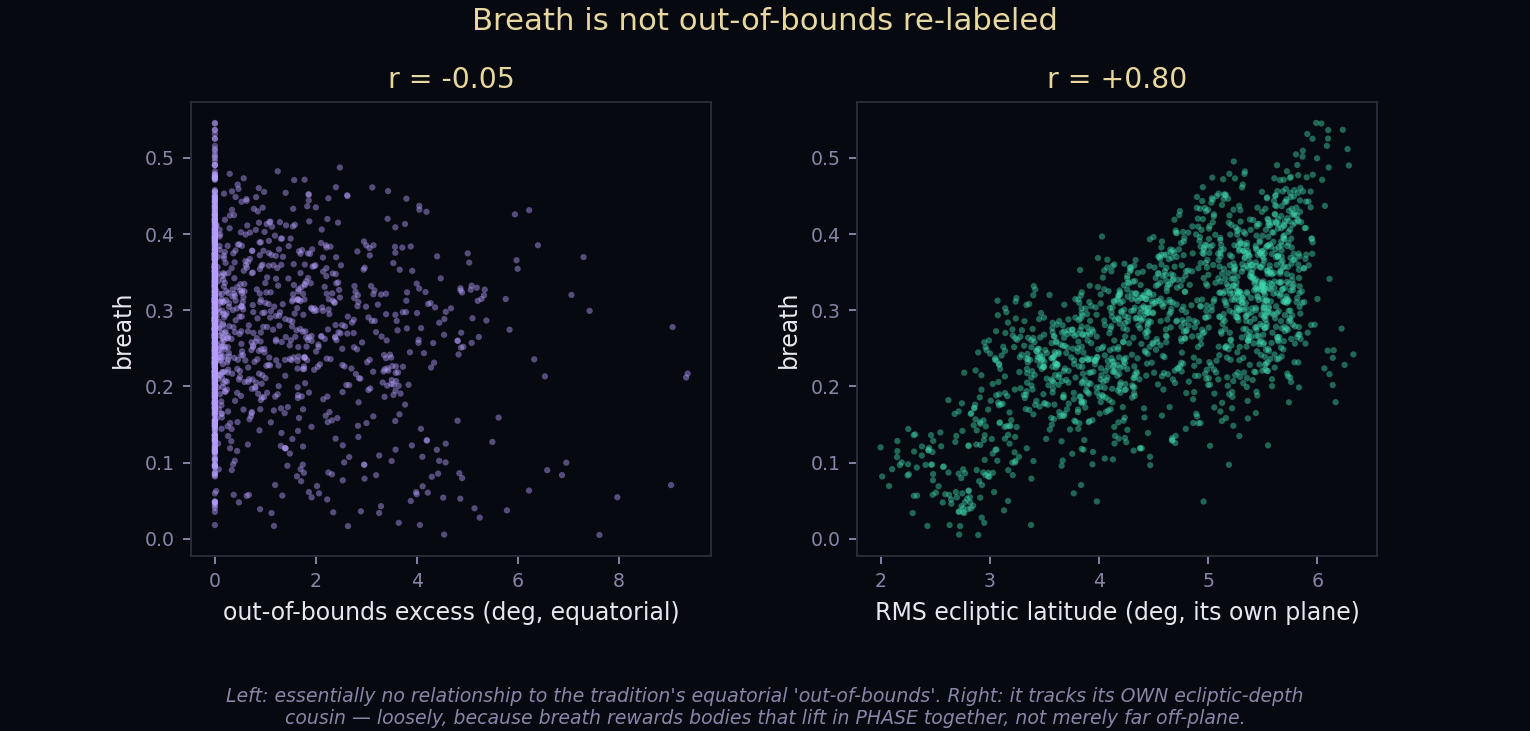
breath vs out-of-bounds excess r = −0.05
breath vs its own ecliptic depth r = +0.80
Against every flavor of out-of-bounds, the correlation is statistical nothing — three to five hundredths, the kind of number you get from unrelated quantities. But against its own natural cousin — the spread of the bodies in ecliptic latitude, its own plane — it tracks strongly, at 0.80. That is precisely the fingerprint of a genuinely new coordinate: it is unrelated to the thing tradition was measuring (declination, an equatorial idea), and related to the thing it actually is (latitude, an ecliptic one). And even the 0.80 is loose rather than total, because the breath rewards bodies that lift in phase together — a chorus — not merely bodies that stray far. Distance off the plane is necessary; coherence is what the breath actually scores.
Breath is uncorrelated with out-of-bounds (|r| < 0.05) and correlated with genuine off-plane depth (r = 0.80), across 5,000 charts. The tradition sensed a missing vertical and reached for it with out-of-bounds; it reached in the wrong plane. The breath is a distinct, frame-invariant quantity — and the last note's "barely correlate" was, if anything, understating it.
IVThe one thing the critique got wrong — and it's about us
The reader's headline worry was that we offer "no proof the field predicts personality or life events." And that is true. But it is aimed at a claim we have never made and will never make. This instrument is a mirror, not a forecast; the whole architecture reports null when it finds null, and refuses to dress reflection up as prediction. Faulting the field for not predicting your future is like faulting a poem for being a poor weather report. The register is simply different, and it is different on purpose.
But here is the part we take on the chin, because it is ours to fix. If a careful, generous reader came away still expecting the skeleton to double as a crystal ball, then the writing has not yet drawn the line brightly enough. That is not a hole in the mathematics. It is a hole in the prose — and the honest response to it is not a better proof, it is a clearer sentence, said more often: the geometry is measured, the meaning is offered, and the two never trade places. The measurement ends where the mirror begins.
We tried to break our own skeleton. The bones held to fifteen decimal places; the dials we could have set differently didn't change the story; and where something did crack, the crack was in our wording, not our bones.
VWhat this test settles
Stated as plainly as we can, here is the ledger from the three experiments.
- The invariance is a theorem. Confirmed to 10−15 across every zodiac and an absurd rotation. The signs cannot be the content; the measurement never sees them.
- The modeling choices are honest conventions. The exact field value depends on them — but the invariance survives all of them, and the chart ranking survives every defensible one. Only collapsing the field onto the Sun breaks it, which is a reason to keep equal weighting, not to abandon it.
- The breath is new bone. Uncorrelated with out-of-bounds, correlated with its own off-plane depth. A real coordinate on a plane the tradition wasn't looking at.
- The one real miss was ours, and it was verbal. A reader could still mistake the mirror for a forecast — so we say it louder: portrait, never prediction.
This is what we mean by an honest instrument. Not one that is never criticized, but one that hands you the scripts, runs the hardest objection against itself in public, and tells you which of its bones are stone and which of its choices are choices. The skeleton went into the press. Most of it didn't move. And the one place that gave way taught us something worth more than a win — it told us where to write more clearly.
Sensitivity across body sets and weightings — run_B_sensitivity.py
Breath versus out-of-bounds across 5,000 charts — run_C_breath_vs_oob.py
The only dependencies are the Swiss Ephemeris and NumPy. The invariance you can also check by hand: change the ayanamsa, and watch it cancel in the node-anchored angles.