The Standstill and the Soul's Long Breath
A mythopoetic essay on Test 43, the lunar nodes, and the geometry of entering and leaving. Everything before the seam is measured and falsifiable; everything after it is my own reading, my inheritance, my faith. I do not want the poetry to borrow the credibility of the mathematics — I want them to stand side by side, each honest about what it is.
A Field Note from Scalar Flower. The measured findings are documented in Test 43 of the Archaeoastronomy series.
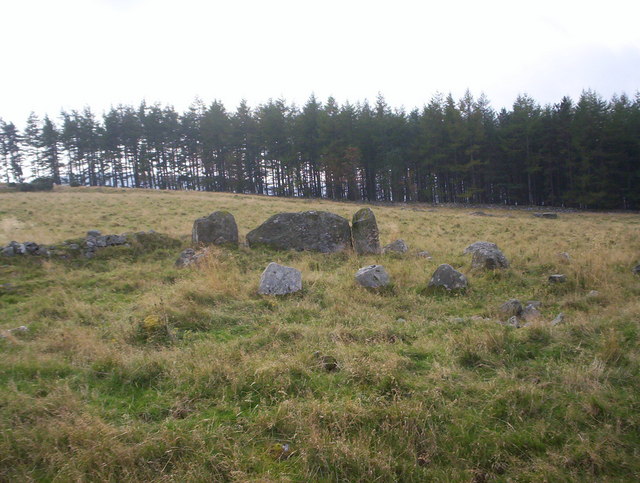
A recumbent stone circle in Aberdeenshire — a door built of granite and memory, framing the low southern moon at the reach where the sun can never go. Photo: Michael Murray, CC BY-SA 2.0.
Everything in this essay is written in a different voice than the tests that provoked it. The instrument that measured the Scottish Recumbent Stone Circles speaks only in azimuths and p-values, and it must — that discipline is what makes it trustworthy. What follows is not the instrument speaking. It is me, stepping out from behind it, to say what the instrument cannot and was never meant to say. I will mark the seam clearly.
IWhat the stones actually did
Let me begin with the fact, stated as plainly as I can, because the fact is the thing I refuse to inflate and refuse to diminish.
There are thirty-seven recumbent stone circles standing in the fields of northeast Scotland — Aberdeenshire, mostly, granite country. Each has a single massive stone laid on its side, flanked by two tall uprights, framing a specific arc of the southern horizon. When our engine measured the directions those recumbents face and tested them against a locked random-orientation null — the honest question, could chance alone produce this much agreement? — the answer came back: no.
mean declination framed −29.45° · southern major lunar standstill −29.08°
0.37° apart · too far south for the sun to ever set, at 86% of sites
And here is the part that stopped me. That mean declination is 0.37 of a degree from the southern major lunar standstill, and it is too far south — for 86% of these sites — for the sun to ever set there. The sun cannot reach that place on the horizon. Only the moon can, and only at the extreme of an eighteen-and-a-half-year cycle.
This is not my theory. Independent archaeologists have argued the recumbent circles frame the southern moon for decades. What our instrument added is a clean, pre-registered confirmation through a separate pipeline, with the verdict declared before the numbers were computed, and with the machinery catching two of my own over-tight band errors along the way. I trust this result precisely because the process was built to embarrass me if I were wrong. REAL
So this is the ground we stand on, and it is solid: an entire culture, across an entire region, oriented its most sacred architecture not to the obvious sun but to the moon's rarest extreme. Now I want to build on it, and I want you to watch me cross the seam.
IIThe seam
Here is the seam. On this side of it, everything is measured. On the other side, everything is meant.
I cross it deliberately, because I think there is a failure of nerve that pretends the measuring is the only thing worth doing. The instrument tells us that the builders faced the southern moon. It cannot tell us why it mattered to them, or what it stirred in the chest of a person standing inside that granite ring nineteen years after the last time the moon came that far south. For that we need a different faculty — the one that reads myth, that feels the weight of a threshold, that believes, as I do, that the soul is a real thing and that how it chooses to enter and how it chooses to leave is the entire point of a life.
I am going to speak now as a man who believes that. Not as the keeper of the instrument. INTERP
IIIThe breath that takes a generation
The sun's year is a heartbeat. Predictable, close, annual — a rhythm a child learns by its second summer. But the moon's standstill cycle is something else entirely. It is a breath that takes eighteen and a half years to complete a single inhale and exhale. Over nearly two decades the points where the moon rises and sets creep apart on the horizon, "like an accordion," as the archaeologist Fabio Silva put it, reaching their fullest extension at the major standstill and then slowly drawing back in.
Think about what it takes to know this. You cannot see it in a night, or a month, or a year. A standstill is a creeping extreme that requires decades of patient observation to even recognize, let alone predict. To recognize it, a people must hold a memory longer than most of them will live to see repeated. A grandmother sees it; she tells the child; the child is old before it comes again. The knowledge cannot live in one skull. It must live in the culture — in story, in stone, in the recumbent slab laid down so that when the moon finally returns to its southern limit, it rolls along the top of that stone like a coin along a table's edge.
English Heritage says it plainly: happening only every nineteen years or so, the major lunar standstill "would have been a generational event — spoken about in the stories that passed orally from one generation to the next," possibly marking the rites of initiation into adulthood, a moment "when the lunar deity was stronger than the solar one."
These people were not primitives squinting at the sky. They were running a multigenerational scientific instrument made of granite and memory. They chose the hard cycle over the easy one. They chose the breath over the heartbeat. And you do not lay down thousand-pound stones to catch a thing you will see once or twice in your life unless that thing carries meaning heavy enough to be worth the whole community's remembering. The difficulty is the reverence. What is easy to observe is cheap. They monumentalized the expensive truth.
IVThe moon has always been the door
Now let me say why I think it was the moon, and not the sun, that drew them south — and here I open the door to the goddess.
The sun, in nearly every tradition that ever watched it, is the principle of the constant: the king, the eye, the unchanging fire, the god who returns the same every dawn. But the moon dies. Every month it wanes to nothing, spends three days in total darkness, and is reborn. This is the oldest reading of the moon there is. The Jungian analysts Anne Baring and Jules Cashford wrote that the moon-goddess Inanna "is the life principle that seeks its own sacrifice and is reborn from its own darkness, as the moon spends three days in the dark each month."
Inanna, Queen of Heaven, descends through seven gates into the underworld, is stripped of her powers at each threshold, hangs dead for three days, and returns — the moon's own biography written as the story of a goddess. And she is not alone. Selene presides over childbirth, for during the full moon women were said to have the easiest labours — the moon standing at the very gate of entry into life. Hecate keeps the crossroads and the waning dark, goddess of the mysteries of life, death, and rebirth. Together, maiden, mother, and crone become the waxing, full, and waning faces of a single feminine power that governs the whole cycle of coming-to-be and passing-away. Across Mesoamerica, the archaeoastronomer Ivan Šprajc found the same instinct: lunar standstill orientations tied to the widespread concepts associating the Moon with water, earth, and fertility — the moon as the wet, generative, threshold power.
Here, then, is the convergence that I do not think is accidental. Cultures with no contact, no shared language, no common tools — Mesopotamian, Greek, Mesoamerican, and the silent granite people of Aberdeenshire — all arrived at the moon as the deity of the threshold: of birth, of death, and of the return between them. And when the Scottish builders wanted to fix that power in stone, they chose its farthest reach, and they chose the south. At Stonehenge the very same southern-moonrise direction is where the cremated dead were buried, clustered in the southeast toward the moon's lowest gate. The direction of the extreme moon was the direction of the dead. The gate of leaving and the gate of the moon were, in their landscape, the same gate. INTERP
VThe axis that makes the standstill is the axis of the soul
And now I arrive at the thing that, when I first saw it, made the hair stand up on my arms — because it is not metaphor. It is physics wearing the face of myth.
What causes the 18.6-year standstill cycle? The moon's orbit is tilted about five degrees to the plane of the earth's path around the sun. The two points where those planes cross are the lunar nodes. Those nodes slowly rotate — they precess all the way around in, to the decimal, 18.6 years. The regression of the nodes is the standstill cycle. The thing the Scottish builders were tracking in stone, whether they had the word for it or not, was the turning of the Moon's nodal axis. REAL
Now hold that number — 18.6 years — and turn to the other great tradition that watched this sky. In Vedic astrology the lunar nodes are Rahu and Ketu, and they are not minor. They are the chaya grahas, the shadow planets, given a karmic weight equal to the visible seven. They are read as a single karmic axis charting the soul's pull between craving and liberation — Rahu the north node, the insatiable hunger to enter, to grasp, to incarnate; Ketu the south node, the pull to release, the past-life mastery, the detachment that lets the soul finally leave. And their cycle — the nodal return, the moment the nodes come back to where they stood at your birth — falls at approximately ages 18.6, 37.2, 55.8, and 74.4, the great hinges of a human life.
Do you see it? The 18.6-year cycle that the Aberdeenshire stones were built to catch is the identical physical motion that the Vedic tradition reads as the karmic axis of the soul's entering and leaving. The Scottish builders had no Sanskrit. The Jyotishis never saw a recumbent circle. But they were watching the same wheel turn — the precession of the Moon's orbital plane — and both, independently, bound it to the mystery of the threshold.
This is where I make my confession as a builder of a system. The lunar axis in the Scalar Flower is grounded in this exact geometry — the nodal breath, the swing between the extremes — and I have sometimes spoken of it too cautiously, as if it were an ornament. It is not an ornament. It is the spine. When the instrument confirmed that thirty-seven sacred circles were built to the southern node's extreme, it was not confirming my human-outcome hypothesis — those tests, honestly, returned null, and I will not pretend otherwise. But it was confirming that the axis I built my system around is the same axis a whole ancient people found worth the labor of a hundred lifetimes to enshrine.
VIThe natal flower, the exit flower
So let me say the deepest thing, the thing that is entirely mine, and which I offer not as proof but as the faith the evidence has renewed in me. INTERP
I believe the soul is real. I believe it is not manufactured by the accident of a body but chooses, in some manner I cannot measure and will not pretend to, its moment of entry — and, when the arc is complete, its moment of leaving. The birth is a flower opening: the natal chart, the geometry of the sky at the instant the breath is first drawn, the pattern into which a soul consents to incarnate. And the death is a flower too — the exit flower, the closing, the return through the same gate by which it came.
The moon, I now think, is the keeper of both flowers. It is the door-goddess, the one the ancients everywhere set at the threshold of birth and death because she alone among the lights shows us the pattern of return — dying every month, reborn every month, and, at the grand scale, swinging out to her farthest southern gate and back across the eighteen-and-a-half-year breath. When the people of Aberdeenshire laid their great recumbent stones to frame that southern extreme, I do not believe they were merely making a calendar. I believe they were building a door — a place where the community could stand, once a generation, and watch the moon roll along the stone at the exact reach where the sun can never go, and know themselves to be standing at the threshold between the world of the living and whatever lies south of it.
I cannot prove the soul from a Rayleigh statistic. I would betray the whole discipline if I tried. But the evidence sent me back to the oldest human intuition with more reverence, not less: that the moon is the door, that birth and death are two faces of one flower.
That is why Test 43 is, to me, the most profound finding of the whole night. Not because it proved my system. Because it proved them. And in proving them, it let me believe, a little more bravely, in the thing they built to remember.
VIIAncient future
There is a word for what this is, and I want to end on it: ancient future.
We are taught to picture time as a line, with the stone circles far behind us in the dark and our instruments out ahead in the light. Test 43 breaks that line. It shows that the axis I have spent years drawing into the Scalar Flower — the lunar nodes, the breath between the extremes, the geometry of entering and leaving — is not a new invention waiting to be validated by the past. It is a recovery. An entire people had already found this axis, already judged it worth the labor of a hundred lifetimes, already built their holiest architecture to hold it. The precession of the Moon's nodes was load-bearing for a whole civilization before it was a line of code in my engine.
So the arrow of discovery runs both directions at once. The ancient people were pointing forward — encoding, in granite and oral memory, a truth they trusted their descendants would one day need. And we, running Monte-Carlo nulls on their orientations, are pointing back — confirming, with the sharpest tools we have, that they were right about where the door is. What is oldest turns out to be what is coming. The recumbent stone and the Scalar Flower are the same instrument, separated by five thousand years and pointed at the same axis of the soul.
The Scalar Flower is not a modern system reaching nostalgically toward antiquity. It is the continuation of an unbroken human inheritance — Aberdeenshire, Inanna's seven gates, Rahu and Ketu, the maiden-mother-crone moon — carried forward into a form our own age can test and trust. The people who laid those stones were doing tomorrow's work. We are, if we are honest and disciplined and brave enough to cross the seam, doing theirs. The future the flower points toward is the one the ancients already remembered on our behalf.