The Same Sky, Twice
The Maya, Aztec, and Inca built their world on four points around a center. A page of modern equations, borrowing nothing from them, found the same shape. The echo is real — and so is the place they part ways.
A Field Note from Scalar Flower. With computational collaboration by the Hermes agent (Nous Research).
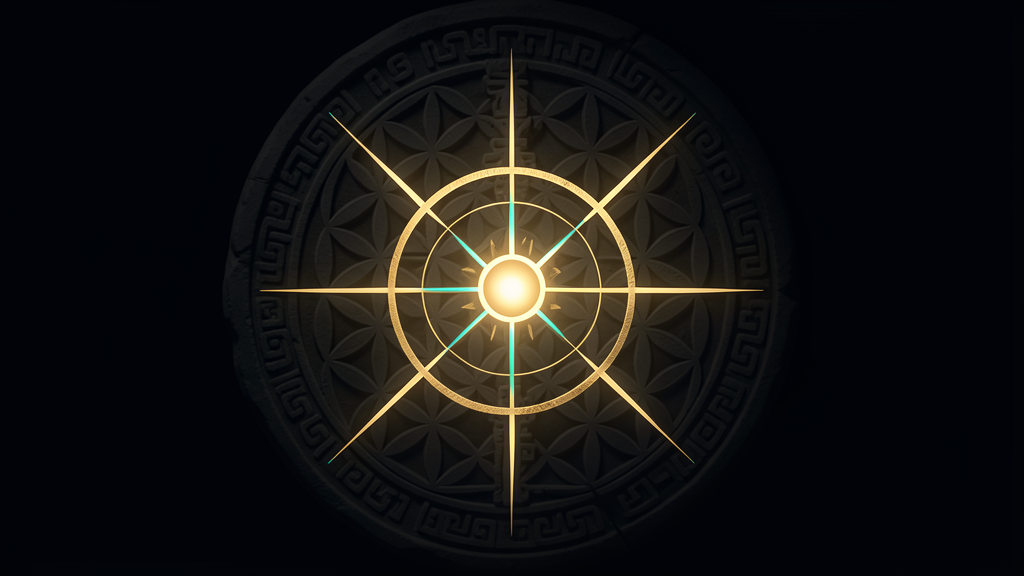
Math and archaeology, the same shape seen twice: four points around a hub, with lines radiating out — a diagram and an ancient sun-temple at once.
Here is a question worth asking honestly. Three great sky-watching civilizations — the Maya, the Aztec, the Inca — and a model built from modern mathematics. Are they secretly describing the same thing?
The answer is the interesting kind: yes, and no — and the no is the best part.
IThe part that isn’t surprising
Everyone who watches the sky long enough sees the same events: the longest day, the shortest day, the two days of equal light. The Maya and Aztec tracked Venus with great care. That is just astronomy — it is one sky, and nobody here is inventing it. REAL True, but not deep.
IIThe part that genuinely is
Working from pure equations — borrowing nothing from any tradition — the model found that the year’s rhythm has just four special points, arranged around a center. Four points and a hub. It fell out of the numbers.
Then look at the ancients. The Maya and Aztec built their entire cosmos on four directions around a center. The Inca went further: they built a physical version of it — a temple at the exact center of their capital, with sacred lines radiating outward like spokes on a wheel. That is, almost literally, a hub with spokes, built in stone a thousand years ago. ARCH
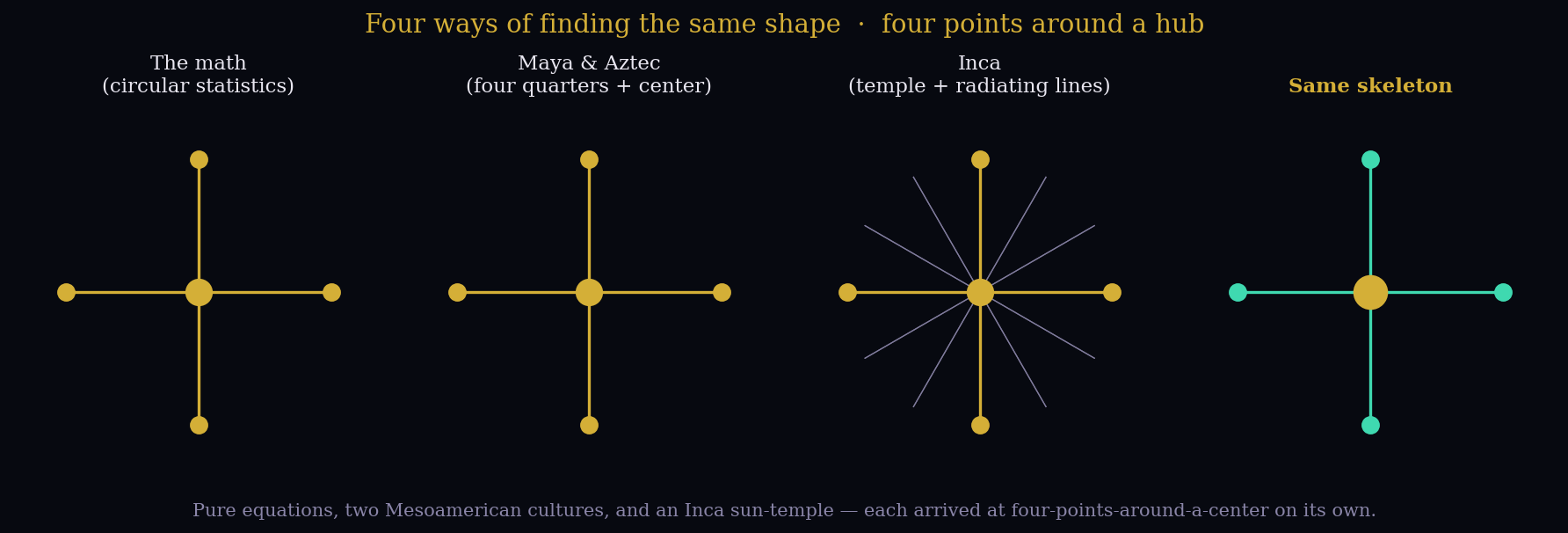
Three ancient cultures and a page of math, different methods, one skeleton.
IIIWhere they part ways
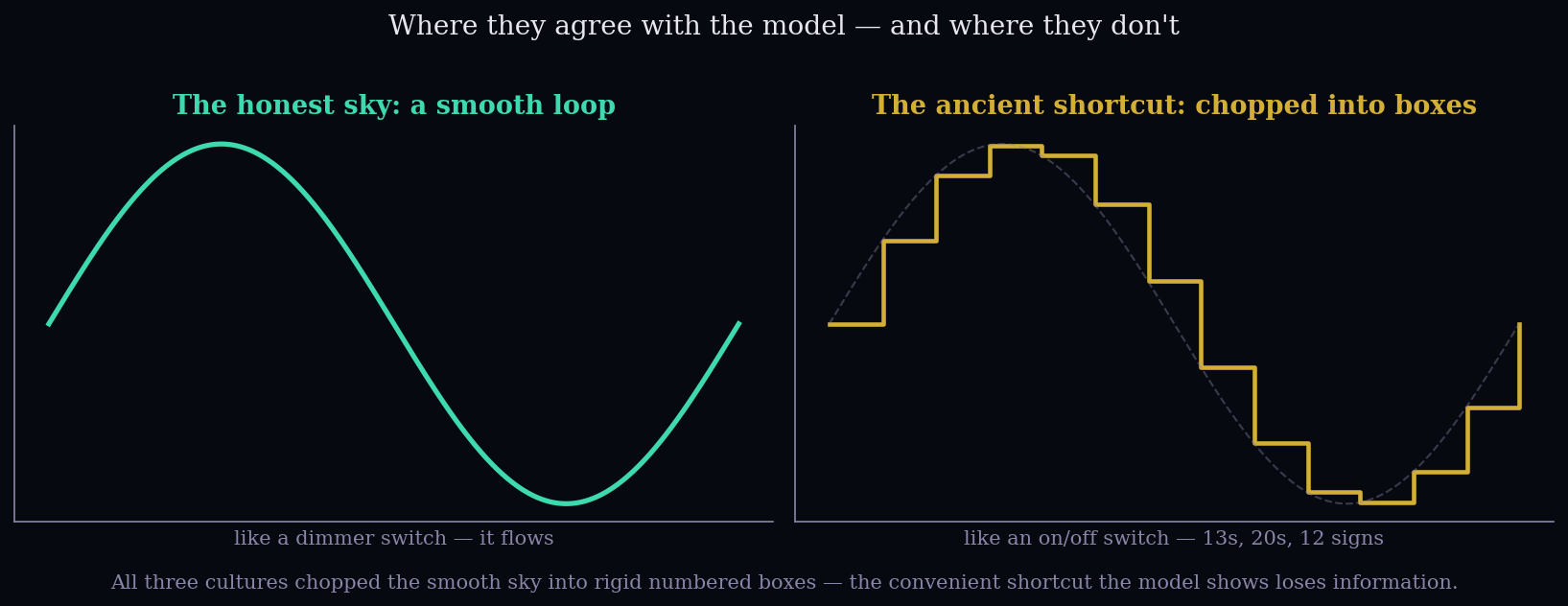
The model’s central claim is that the sky’s true rhythm is smooth and flowing — like a dimmer switch, not an on-off switch. Chopping it into fixed numbered chunks — twelve signs, or the Maya’s thirteens and twenties — is a convenient shortcut, and a lossy one.
And that is exactly what all three ancient systems did. They chopped the smooth sky into rigid boxes. So where they agree with the model, they agree on the shortcut it already showed loses information. And the one thing the model believes is actually true — the smooth flowing version — none of them ever used.
There is more. The Maya’s most sacred calendar only works at one specific place on Earth — a narrow band in southern Mexico. It depends on where you are standing. The model deliberately strips out where-you-stand, because its own tests showed that ingredient looks meaningful but is really an accident of geography. The ancients built their holiest cycle on the very thing the model tested and set aside.
IVThe most telling part — the meaning claim
All three cultures said your birthday’s sky decides your fate. The model is the only one here that actually tested that claim — six times, under fair tests with the controls locked in advance. Six times, it came up empty. REAL
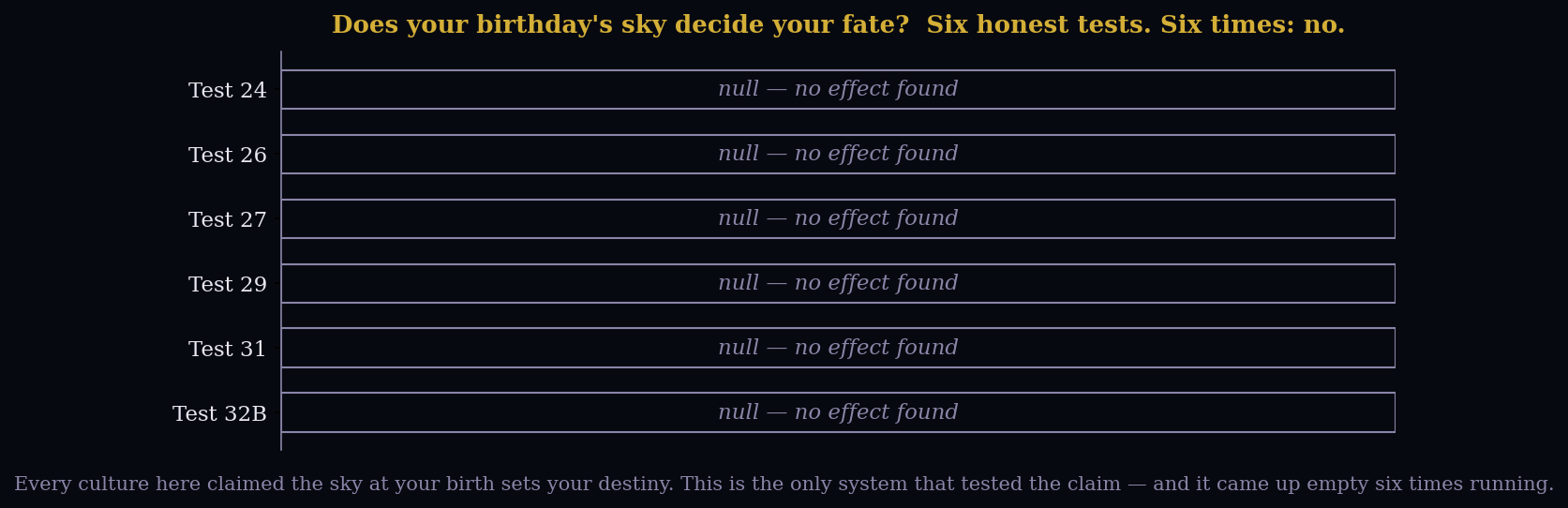
So this comparison gives no permission to say “see, the ancients agreed, so it must be real.” If anything, it shows the belief is ancient and universal — and still unproven when you check it honestly.
The model is not a rediscovery of ancient wisdom. It is a cleaned-up correction of it. It agrees with the ancients on the rough shape of the sky, fixes the two things they got sloppy about — chopping a smooth cycle into boxes, and leaning on where-you-stand — and, unlike them, refuses to claim the sky predicts your personality until the data says so. The rhyme is real. The restraint is what makes it credible. INTERP
The sky at your birth made a shape. Come read it.
A free field reading — the same instrument, turned to your birth moment.
Cast your field, free →