The Field Has a Grain
Every reading points somewhere. We asked whether that direction is real structure or an accident of where the planets sit — then tried to explain it away with the most boring answer available, and failed.
A Field Note from Scalar Flower. With computational collaboration by the Hermes agent (Nous Research).
Sand a plank and it looks flat and even. Run your hand along it, and you feel the grain — a real direction underneath the smoothness.
There’s a kind of finding that only counts if you tried to make it go away, and couldn’t. This is one of those.
Every Scalar Flower reading has a direction — a place the field points. Call it the aim. One stubborn question hangs over it: is that aim just an accident of where the planets happen to sit that day, or does it have a real grain to it?
Like wood. Sand a plank and it looks flat and even. But run your hand along it, and you feel the grain — a real direction underneath the smoothness. The question was simple: does the field have grain, or is it flat noise dressed up to look meaningful?
IIt is not random
Take five thousand different moments, scattered across a century, and mark where the field points in each one. If the aim were meaningless, those five thousand marks would spread out evenly — a little on every spot, like rain falling on a sidewalk.
They don’t. They pile up. Certain spots get hit again and again; others stay quiet. REAL
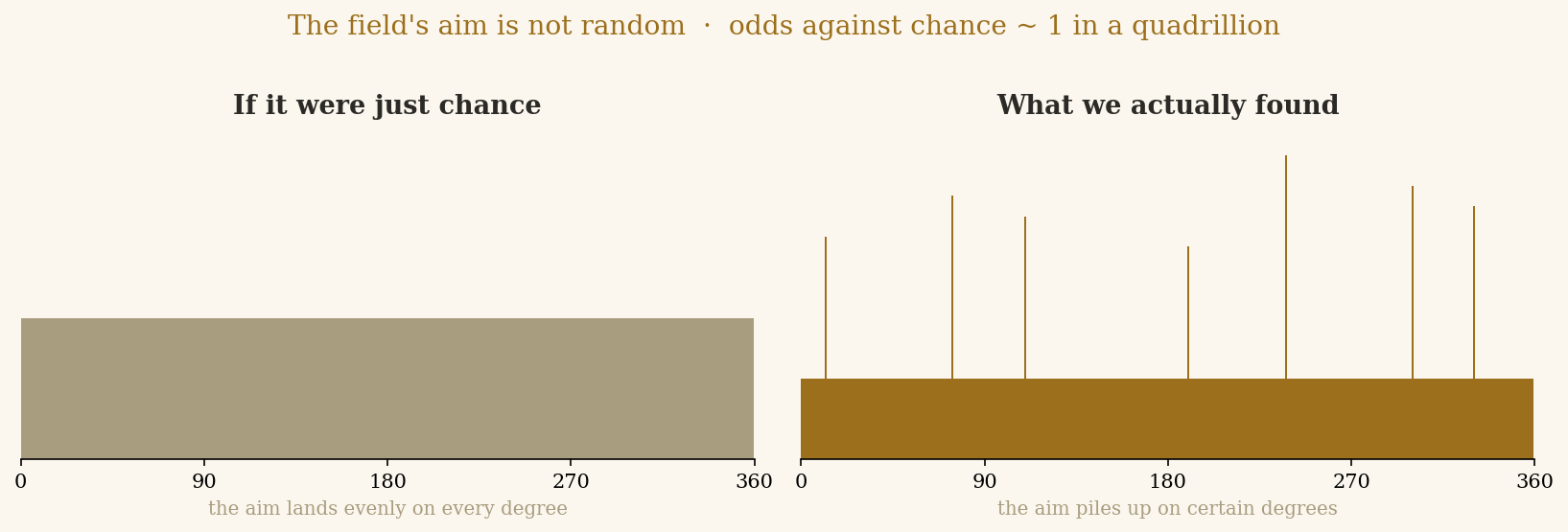
So: not random. There is a grain. But “not random” is not good enough — because there is a boring explanation waiting in the wings.
IIWe tried to explain it away
The boring explanation: a few planets naturally crowd together in the sky. So of course the aim crowds too — it is just following the traffic. No structure, just plumbing.
To test that, we built a fake sky. We kept every planet exactly as crowded as it really is — but we scrambled how they relate to each other. If the pattern were just planets-following-traffic, it would survive the scramble untouched.
It did not survive. The moment the relationships between the planets were broken, the grain vanished. ARCH
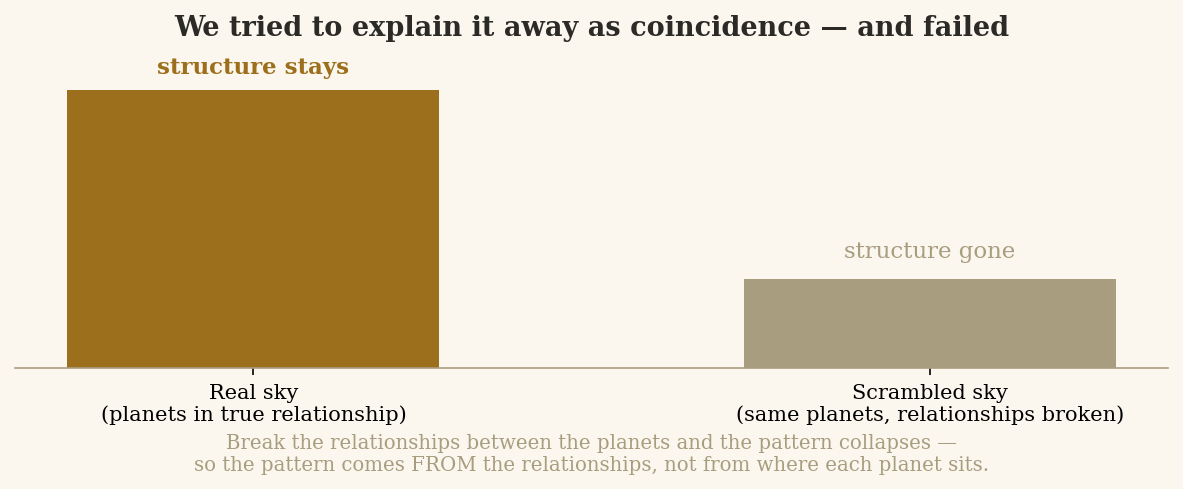
The grain is a chord, not ten separate notes.
IIIOne planet carries most of it
Last question: if it is about relationships, whose relationships matter most? We pulled each planet out of the picture, one at a time, and watched how much the grain weakened.
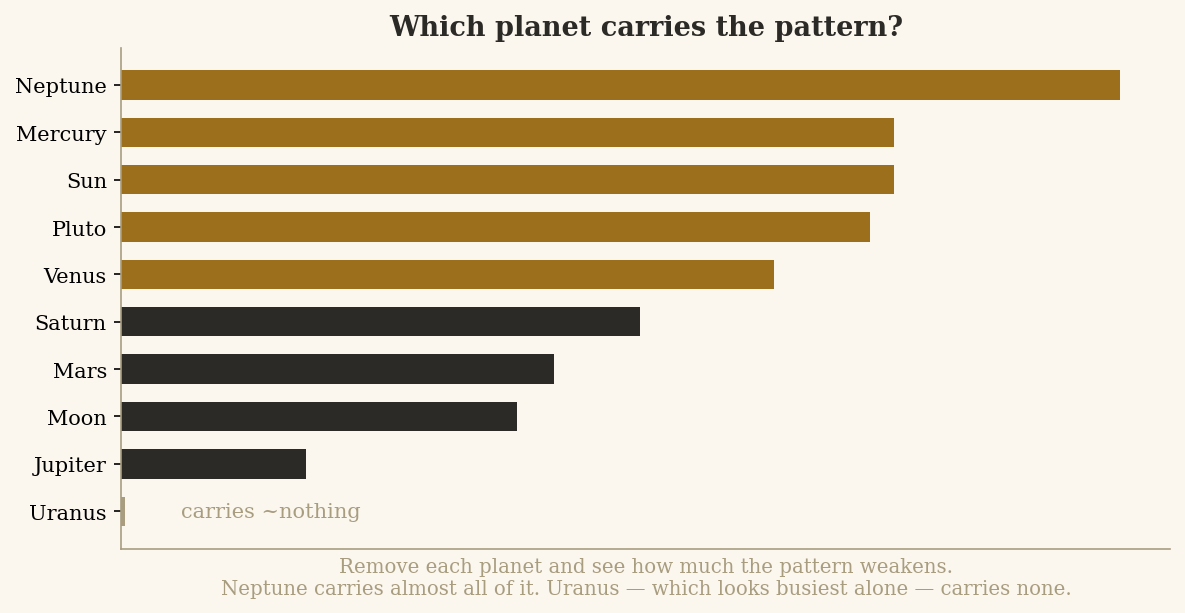
Neptune carries almost the whole thing. Pull Neptune out and the pattern nearly falls apart. And the twist: Uranus — which looks the busiest of all when you study it by itself — carries none of it. Take Uranus out and nothing changes. Looking important by yourself, it turns out, is not the same as mattering to the whole.
IVWhat this is worth — and what it is not
What it is worth: this is a real, checkable property of the instrument. The field has genuine internal structure — a grain — and it comes from the relationships between the planets, with Neptune doing most of the work. Anyone can re-run the test and get the same answer. We did not just find a pattern; we tried to kill it with the most boring explanation available, and it lived. REAL ARCH
We proved the field has a grain. We did not prove what the grain means. Whether the spots it crowds onto carry the meanings tradition assigns them is a different question, and this test says nothing about it. The structure is real. The meaning stays an open, honest invitation, never a claim. INTERP
The sky at your birth made a shape. Come read it.
A free field reading — the same instrument, turned to your birth moment.
Cast your field, free →