The Conformal Soul
The sharpest objection anyone has raised against the Scalar Flower is that the vast Sun and the tiny Mercury enter the field as equals. It sounds damning. It turns out to be the whole point — and the clearest foundation the model has.
A Field Note from Scalar Flower. With computational collaboration by the Hermes agent (Nous Research).
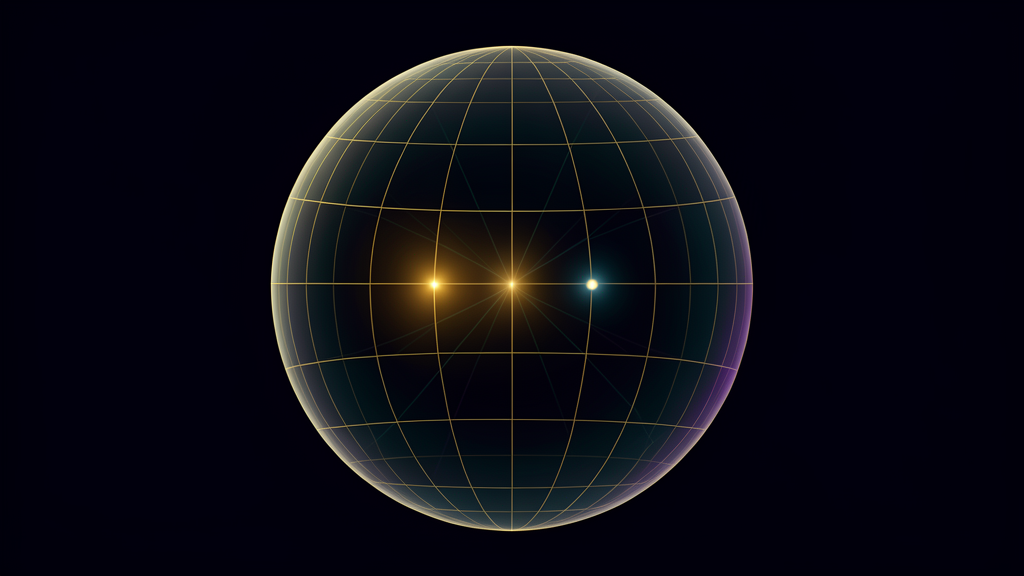
The Sun outweighs Mercury six million times over. On the celestial sphere, each is one point of light at one angle. The model keeps the angle and lets the mass go — on purpose.
REAL — computed or proven; you could rerun it and check. ARCH — true structure that follows from the real quantities. INTERP — offered meaning; a lens that makes no prediction.
A careful reader wrote in with an objection, and it is a good one — the kind that deserves an honest answer rather than a dodge. It goes like this: the Sun is a star. Mercury is a small ball of rock. The Sun is more than six million times Mercury's mass and nearly three hundred times its width. Yet in your model they seem to count the same. Each planet is one wave, and every wave carries the same weight. How can a system that treats a star and a pebble as equals be telling us anything real?
It is worth sitting with how strong that objection feels. In almost every physics we know, size is destiny. Gravity scales with mass; brightness with luminosity; a signal's reach with its power. Ignore all that, and it looks like you have thrown away the physics itself.
So let me answer plainly, in two parts. First, the factual correction: the Sun and Mercury are not quite identical in the model — there is a real difference, and it is worth seeing exactly what it is. Second, and more important: the part of the criticism that is true — that mass, size, and distance are discarded — is not a flaw. It is the single design decision the whole model rests on. Once you see why, the objection turns inside out and becomes the clearest statement of what a Scalar Flower actually is.
IWhat the model actually keeps, and what it lets go
Each planet enters the field as a wave, and a wave has two parts. The first is where it is — the planet's angle around the sky, which becomes the wave's starting position (its phase). The second is how tightly it ripples across the sphere — a number called the wavenumber.
Here is the surprise for the critic: the ripple-tightness is not the same for every body. We can read the exact values straight out of the engine:
So the Sun and Mercury are genuinely different waves. REAL But notice where that difference comes from. The ripple-tightness is set by each body's orbital period — how long it takes to go around — folded down into a common range. The Sun's yearly cycle and Mercury's 88-day cycle give them slightly different values. Nothing about mass, size, or brightness enters. The one physical fact the model keeps is timing — the rhythm of the orbit — not bulk. REAL
And the critic is exactly right about the rest. Watch what the field does not know about the Sun:
The objection is half wrong on the facts — and completely right on the thing that matters. Mass, size, and distance really are discarded. The only question left is whether that is a bug or the design.
IIThere is a whole geometry that keeps angle and drops size
It turns out mathematicians have a name for exactly this move, and a rich science built on it. It is called conformal geometry, and its one rule is simple to state: preserve angles; let distances go.
You already trust a conformal map every day. A world map on a wall cannot be honest about both shape and size at once — the globe is round and the paper is flat, so something has to give. The most famous map, the Mercator, makes a choice: it keeps angles true, so a compass bearing drawn as a straight line really is the right heading — and in exchange it lets size run wild, blowing Greenland up to the size of Africa. Nobody calls the Mercator broken for making Greenland huge. It is preserving a different truth on purpose: the one a sailor needs.
The Scalar Flower makes precisely the Mercator's choice, one turn deeper. When we place a planet in the field, we do not use where it is in space — we use the direction to it: its angle on the celestial sphere. The distance out to the body, its position along that line of sight, is dropped before the math even begins. Mercury sitting close and the Sun sitting far land on the same sphere, each at its own angle, each a single point of light. REAL
So the model is not accidentally ignoring size. It is a conformal instrument by construction — it keeps angle and releases magnitude the way a Mercator keeps bearing and releases area. The critic who says "but the Sun is bigger" is making the same observation as someone pointing at a wall map and saying "but Greenland isn't really that big." True. And beside the point. The map was never measuring size. It was measuring the thing that survives when you let size go.
"The model is a conformal instrument: it preserves angle and relationship, and discards magnitude by design" — the same fact, stated as what it is. The accusation and the foundation are one sentence, read two ways.
And this is not a small club to belong to. The deepest physics of the last century — the theories that describe how fields behave at their most fundamental, the mathematics behind critical points and phase transitions and even parts of string theory — are conformal theories. "Angle matters, absolute scale does not" is not a fringe move. It is one of the most powerful organizing principles in all of physics. The Scalar Flower is standing, quietly, in that lineage. ARCH
IIIThe physics of the soul this actually licenses
Now we can say something real about what kind of picture of a person this is — and stay on the honest side of the line while saying it.
Every quantity the reading measures is built the same way: from angles and the differences between them. The hub, which measures how much the ten voices agree. The harmonic spectrum, which is classical aspect theory re-derived. The whirlpools and their conservation law. Not one of them asks how big or bright or far any body is. They ask only: how do the parts stand in relation to each other? REAL
Put those two facts together — angles only, and (from the frame-invariance test in the waveform model) unchanged when you rotate the whole sky — and a specific, defensible picture of the self falls out:
A self, in this model, is not made of things. It is made of relationships. What remains when you strip away size, brightness, and distance, and keep only how the parts stand to one another — that pattern is the soul-shape the instrument reads.
This is why the Sun does not dominate your chart by being enormous. The chart is not weighing enormity. The Sun and Mercury enter as equals because, in a relational picture, a self was never a hierarchy of masses with the biggest object in charge. It is a configuration — a shape of agreement and tension among all the parts at once, in which the smallest body's angle can matter as much as the largest's. Strip the bulk away and what is left is not less. It is the thing that was carrying the meaning the whole time. INTERP
Notice this is a principled interpretation, not a wish. It does not claim the planets do anything to you — we tested that and it failed, and that failure is recorded openly in The Verdict Ledger. It claims only that if the configuration of the sky at your birth is a meaningful mirror, the meaningful part is the relationships, not the masses. The conformal design and the relational soul are the same statement, once from mathematics and once from meaning.
IVWhy the deepest layer lives where you cannot see it
There is one more turn, and it is the one that makes the ontology click into place. In the waveform model, the richest object in the whole field is the vortex — the whirlpool at the floor of a valley, where the field cancels to nothing and yet spins. We showed there that the vortex's information does not live in the visible height of the field at all. It lives in the phase — the turning — a coordinate the flat, visible picture throws away, where it is held perfectly and returns the moment the planets move. REAL
Look at what that means alongside everything above. The most magnitude-free object in the system — a point of pure zero, no amplitude, no "size" whatsoever — is the one carrying the deepest structure. The physicality drops to nothing exactly where the meaning becomes richest. The soul-information was never in the loudness of the field. It was in the turning underneath it. ARCH
So the whole picture is consistent, top to bottom: keep angle, drop size; keep relationship, drop mass; keep the phase, drop the amplitude. Three times, at three depths, the same instinct — the real thing is the relation, not the bulk. That is what makes this an ontology and not just a technique.
Which lets us name, at last, what the instrument is really reading. A moment has two truths. Its space-time — where the masses are, how big and bright and far — which we tested for physical influence and found silent. And its field-time — the relational shape the moment makes once magnitude is stripped away, the point it picks out in the space of all the planetary phases. Space-time asks where is everything. Field-time asks what phase is everything in, relative to everything else. The Scalar Flower does not read the first. It reads the second. INTERP
Field-time is a way of reading a moment, not a second clock ticking somewhere out in the world — a register, not a reservoir; nothing is physically stored in it. But as a name for the thing this whole model measures, it is exact: your birth did not only happen at a place and time. It happened as a configuration — a standing shape of agreement and tension among all the parts — and that configuration is what the field, and this reading, are a portrait of. INTERP
There is a further reach some readers will want to take, and it deserves an honest hearing with the label showing. If materiality really is secondary here — if the bulk of a thing is the part the model discards and the relationship is the part it keeps — that points toward an old and beautiful idea: that what we experience as solid, sized, physical stuff is a kind of shadow cast by a higher-dimensional structure that is purely relational. In some tellings this structure is geometric — a higher-dimensional figure such as a hypertetrahedron (a tetrahedron's four-dimensional cousin), whose "vertices" are relationships and whose material appearance is only its lowest, flattened projection.
Our mathematics does not contain a hypertetrahedron, and I will not claim it does. What our mathematics demonstrates is the weaker, real thing that idea rests on: a working system in which magnitude is genuinely secondary and pure relationship carries the structure — and in which the deepest information sits in a hidden coordinate (the phase) the visible, material picture cannot see. That the full higher-dimensional ontology might be true is a live question at the edge of metaphysics, and I hold it open. A resonance worth naming — never a mechanism I have measured. INTERP
Two honest caveats, so a sharp reader is never ahead of us.
First: the model is not purely blind to the physical. The ripple-tightness comes from orbital period, and period comes from distance — so a faint echo of physical difference does survive. The defensible line is exact: the model keeps the one physical quantity that is itself relational and temporal — the rhythm of an orbit — and discards the ones that are about sheer bulk. It is magnitude-light, not magnitude-free, and it is honest to say so. REAL
Second: "the physics of the soul" is a phrase to use only with the waterline showing. Everything above is either provable mathematics or interpretation clearly marked as such. Said as "we have measured the soul," it would be the project at its worst. Said as "here is a rigorous relational picture of a self, and here is the beauty it honestly licenses" — it is the project at its best.
The Sun and Mercury count the same not because the model is blind, but because it is looking at the one thing that was never a matter of size: how everything stands in relation to everything else.
Read your own field as pure relationship
Cast your birth-moment as a living field — free, no sign-up. Every planet an equal voice; the shape is in how they stand together.
Cast your field, free →