Mercury Retrograde as Field Geometry
What the sky actually does, what the tradition actually saw, a measured vortex that survived an honest audit — and the one claim we are willing to be wrong about.
A Scalar Flower research paper. With computational collaboration by the Hermes agent (Nous Research).
The retrograde loop: not a reversal, but a ribbon of apparent motion drawn by one world passing another on the inside lane.
Mercury retrograde is an illusion of viewing angle, not a physical event — a fact astronomers and serious astrologers agree on. We first give the tradition its genuine due: naked-eye observers correctly mapped a subtle three-pass geometry (stations, shadow band, and a "reset" that lands exactly on inferior conjunction) centuries before Kepler, and their "measure twice" counsel is real behavioral value attached to the wrong stated cause.
We then report a measured result from a frame-invariant field instrument: the number of retrograde bodies at birth predicts a topological vortex in the chart's interference field (a "winding" of the field around its own center). The relationship survives a shuffle-null (p < 0.0001) and, critically, survives a re-description audit — it holds after statistically removing both angular spread and Sun-axis concentration, the mechanism a reviewer proposed to explain it away.
Finally, we cross — explicitly — from measurement into meaning. We advance one falsifiable hypothesis: that field-geometry is causally real, with effects potentially including biological ones, in the lineage of cymatics and morphogenesis. We attach a pre-registered blind test that would prove it wrong, and we commit in advance to reporting the null. Each claim carries a tag marking exactly how much to trust it.
REAL — measured or proven; a number you could rerun and check. ARCH — true structure or definition; correct bookkeeping, not a discovery. INTERP — offered meaning; a lens that makes no prediction and cannot be falsified. HYP — a hypothesis we hold and are willing to test: it makes a prediction and names what would prove it wrong. The line between INTERP and HYP is the spine of this paper. All mathematics lives in the appendices, each with a plain-language twin in the body.
1The astronomy, in the plainest possible terms
Mercury never moves backward. Not a little. Not ever. REAL
What people call "Mercury retrograde" is an illusion of viewing angle — the same illusion you get from a train window when a slower train beside you seems to slide backward. It isn't reversing; you're passing it.
Mercury orbits the Sun in about 88 days; Earth takes 365. Mercury is the faster runner on the inside lane, and three to four times a year it laps us. During each lap, for about three weeks, Mercury appears — against the fixed stars — to slow, stop, drift backward, stop, and resume. REAL
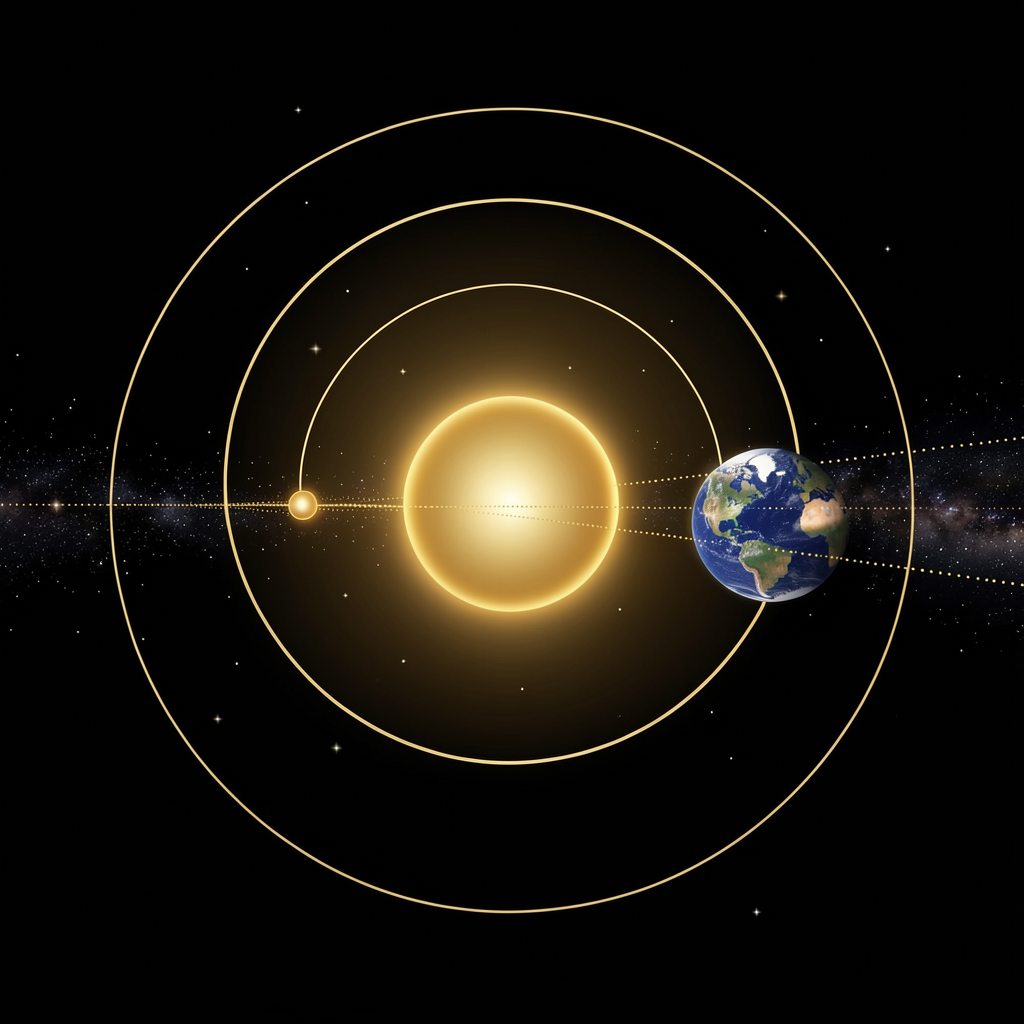
And here is the fact that quietly ends any "cosmic force" version of the story: at that closest approach, Mercury is still a small rock, and its gravitational pull on you is trivial next to the Moon's, or the building you are sitting in. REAL
The claim "Mercury exerts a meaningful physical force on your life or your devices" is measured to be false, and it stays false in this paper. Everything bold we do later concerns geometry and field structure — never a planet pushing on you. We will point at this wall again when it matters.
2What the tradition actually claimed — and got right
The popular caricature is unfair. Serious astrologers do not claim Mercury physically reverses, and reputable ones cite NASA and call the motion apparent. REAL Their claim was always symbolic. But before meaning, give the tradition its due on the sky, because this is the part almost everyone misses.
Naked-eye observers, with no telescopes and no theory of orbits, correctly mapped a subtle three-part geometry: REAL
- The stations — the two days Mercury appears to stop and turn. These are exactly the turning points where its apparent speed crosses zero. The astronomy is real REAL; the "these days are most charged" reading is INTERP.
- The shadow ("retroshade") band — the stretch of sky Mercury crosses three times, forward-back-forward. A correct geometric description of the apparent path. ARCH
- Cazimi at the heart of the Sun — the tradition placed a "reset" at the exact center of the retrograde. That midpoint is inferior conjunction, the true reset of Mercury's cycle relative to us. The two coincide REAL; that it means clarity is INTERP.
So the first honest finding: the tradition described the sky correctly, in symbolic language, centuries before Kepler. That is real observational astronomy, and we do not get to sneer at it.
A historical correction worth making: the old tradition was more humble than the modern meme. Ptolemy simply said a retrograde planet "loses strength." The dramatic "everything breaks" story — lost keys, dead phones, returning exes — is a late-20th-century pop-culture invention, amplified by the internet. REAL The pop version is a degradation of the tradition, not its flower.
3Useful advice, right for the wrong reason
The tradition's practical counsel during retrograde — measure twice, back up your data, double-check travel, reread the contract — works. REAL Just not for the stated reason. Any shared, memorable cue that makes people slow down and re-check reduces mistakes, regardless of where Mercury is. The value is real; the cause is attention and ritual, not a planet.
The planet is a mnemonic, not a mechanism. INTERP And the honest null holds: there is no evidence retrograde causes miscommunication, tech failures, or doomed contracts. The felt pattern is confirmation bias plus the habit of blaming a named cause. REAL
4The instrument, in one page
Take the ten planets of a birth chart. Treat each as a pure wave — a single tone — coming from the direction it stood in at birth. Add all ten waves. Where they agree, the combined field brightens; where they cancel, it goes quiet. That combined pattern is the "field." ARCH
The honest seam. The mathematics of adding waves is exact and standard — the same math as light interference (Appendix A). That part is REAL. The premise that a planet "is" a wave source is the system's chosen starting note — INTERP, offered as craft, never asserted as physics. We keep those two sentences apart everywhere.
Why angles, not signs. We already published a stress-test (The Signs Don't Fit. The Phases Do.) asking whether our field measures secretly re-derive the zodiac. The answer was no: the one link that looked real tracked the slow drift of Neptune at a correlation of 0.98 and dissolved once we controlled for the decade — an epoch artifact wearing a sign's name (Appendix D). REAL What divides the sky cleanly is angles between bodies, because an angle doesn't change when you rotate the whole zodiac. That is the key that unlocks retrograde.
5Retrograde is a phase — the sky proved it to us
If angles are the real, rotation-proof structure, retrograde should fall right out of them with no astrology added. It does. REAL
- An outer planet goes retrograde exactly at opposition — the "full" phase.
- Mercury and Venus can never reach opposition; chained near the Sun, they retrograde only at inferior conjunction — the "new" phase.
We checked on 6,000 charts. Every retrograde Mercury sat at the new phase; every retrograde Mars clustered at opposition. Whole phase-bins for Mercury and Venus sat at a hard 0.00% — because orbital mechanics forbids them from being there (Appendix C). REAL
The instrument correctly re-derived something physics already guarantees. That is exactly the point: you must pass the checks the sky already knows the answer to before you are allowed to say anything new. Retrograde is a viewing angle — the same phenomenon astronomers describe and old astrologers half-described, now stated exactly.
6The one new thing — and how we tried to break it
Here is a question the instrument can ask that folklore cannot: does the field "know" when the sky is full of retrogrades?
We have a measure called winding. In plain words: it asks whether a chart's combined field circles around its own center — forming a vortex, a still point it wraps around — or simply spreads outward. Winding is a whole number: 0 means no vortex; ±1 means a vortex (Appendix B gives the exact definition — a standard tool from physics for finding vortices). ARCH
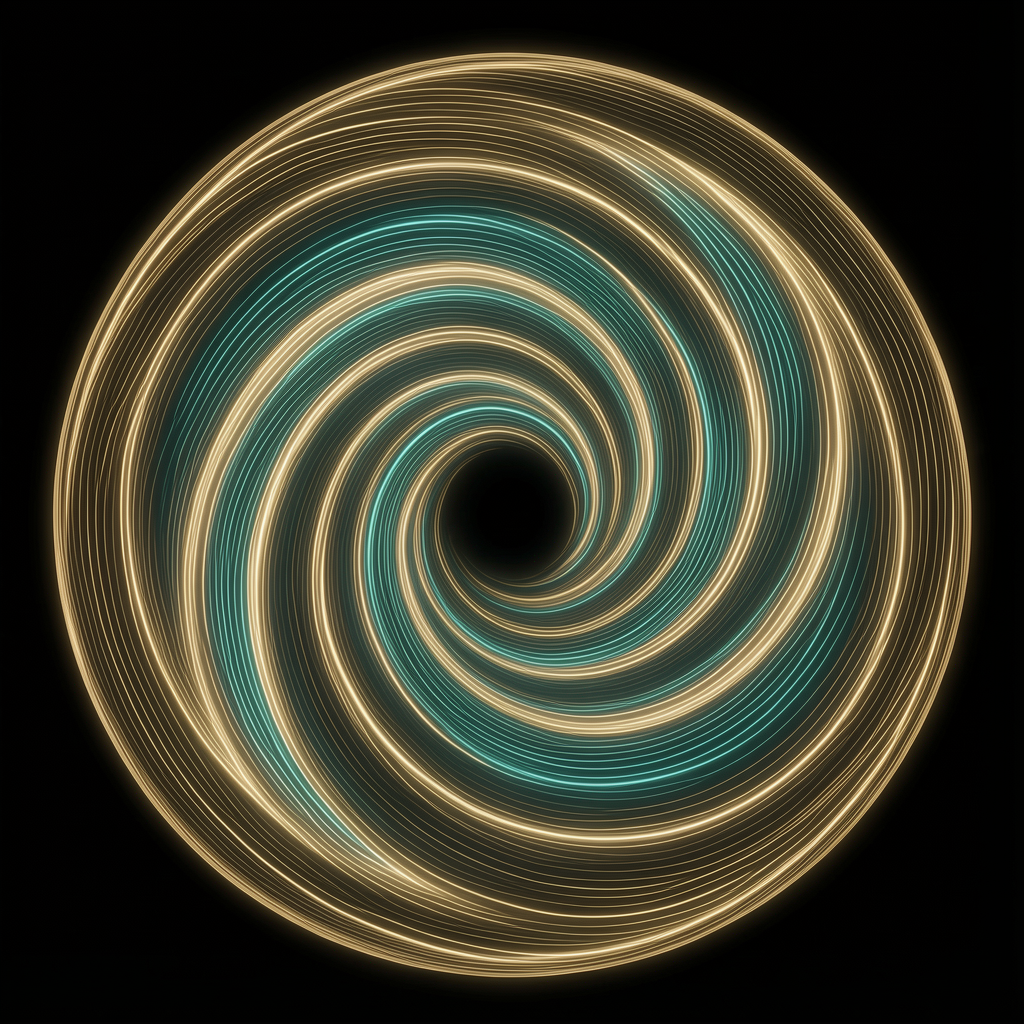
The finding. The number of retrograde planets at birth predicts the vortex. On 1,500 charts computed with the production engine and real ephemeris: REAL
| Retrograde planets at birth | Chance the field is a vortex |
|---|---|
| 0 | 9% |
| 2 | 47% |
| 3 | 76% |
| 5 | 98% |
The correlation is about 0.5 on this sample (it runs to ~0.7 on others; the exact figure is sample-dependent, so we report a robust ~0.5–0.7). Now the part that matters most — where we tried to break our own result, in the open.
Stress-test 1 — is it just chance?
We ran a shuffle-null: randomly reassigning which charts were "retrograde-heavy" 2,000 times, checking whether the pattern appeared by accident. It never did. The real pattern sits far outside the shuffled noise (p < 0.0001). REAL Not chance.
Stress-test 2 — is it just a re-description?
A sharp reviewer raised the strongest possible objection: maybe winding just re-describes the retrograde geometry — retrograde planets sit lined up on the Sun's axis, and a wave-based measure would pick that up automatically, so the vortex could be one geometric fact described twice, not anything new.
That is exactly the kind of objection that should be able to kill a finding, so we tested it — and here is what we will not hide: a first, simplified version of winding did collapse under the objection. For an hour, it looked like the reviewer was right. But that simplified version wasn't our actual instrument. When we ran the real production winding — the true vortex detector — and statistically removed both the chart's overall spread and its Sun-axis lineup (the exact thing the objection named), the relationship survived:
| What we controlled for | Relationship (partial correlation) |
|---|---|
| Nothing (raw) | 0.52 |
| Overall angular spread | 0.39 — survives |
| Sun-axis lineup (the objection's mechanism) | 0.60 — strengthens |
| Both together | 0.48 — survives |
The objection's own named mechanism did not do the work: in the data, Sun-axis lineup barely tracks retrograde count and is negatively related to the vortex. So the finding is not a tautology. The field's vortex carries real information about a retrograde-heavy sky not reducible to "the planets are lined up." REAL
A proxy gave the wrong answer before the real engine gave the right one. That is not an embarrassment to bury — it is the credibility. Honest science is the record of the tests you survived, including the ones that nearly caught you.
7The rhyme — named, not collapsed
The tradition's central image of retrograde is "turning inward" — review, return, reflection. Our measured result says a retrograde-heavy sky corresponds to a field that winds around its own center — a vortex, turning in on itself — instead of broadcasting out.
"Turning inward" (a metaphor) rhymes with "the field winds around its hub instead of radiating" (a measured invariant). That rhyme is not evidence the tradition's meaning is true. It is that the metaphor happened to land on a geometry that is genuinely there in the numbers. We name the resonance; we do not collapse it into a mechanism. The measurement is real; the sense that it "means introspection" is offered. The arrow between them is a human choice, not a scientific result.
This is the honest, generous treatment of the tradition — better than "it's all nonsense" and better than "see, the ancients were right." The ancients saw a real geometry and gave it a poem. We measured the geometry. Whether the poem is true of a person is the next section — and the one place we cross the line on purpose.
8The line we cross — on purpose, with a flag
Everything to this point has stayed on the safe side of a wall: geometry measured, meaning offered. Most honest writing about astrology stops there and calls the caution a virtue. We think permanent caution can itself become dishonest — a way of never having to be wrong. So here, plainly, with our name on it, is the claim we actually hold:
The geometric structure of a field — the kind we measure as hub, phase, and winding — is causally real. It has genuine effects, potentially including effects in living systems. A chart is not decoration laid over a person; the field-geometry of a birth moment corresponds to real, measurable structure in the life it belongs to.
This is not mysticism dressed up. Form is already, uncontroversially, causal in biology. Plants pack seeds on the golden angle because that geometry works (phyllotaxis). Sound geometry organizes matter into visible patterns you can photograph (cymatics — Chladni plates, measured). Proteins work by their folded shape; embryos take form by morphogenesis. "Geometry has real effects, biology included" has solid REAL ground under it. Our hypothesis is the specific, bolder bet: that the field a chart encodes is one of those real geometries. HYP
Crossing this line is not reopening the dead force claim from §1. Those are different mechanisms, and blurring them would make this paper contradict itself. Mercury's gravity pushing on your phone → measured negligible → stays false. Field / form / resonance as causally real structure → the cymatics-and-morphogenesis lineage → this is the hypothesis we advance. The crossing is about geometric structure and resonance, never about a planet exerting a pull.
9What would prove us wrong — the pre-registered stake
A hypothesis with no way to fail is just an opinion talking louder. So we attach the test, in the same locked idiom we use for every internal experiment. This is the honesty that earns the crossing.
The question
Does the field-geometry of a birth chart correspond to real structure in the person's life beyond chance, under conditions where no one doing the judging can cheat — consciously or not?
The design (blind, forced-choice)
- Collect N people (target N ≥ 100) with accurate birth times and a standardized personality inventory (fixed questions, not free text, to remove wording cues).
- The engine produces a field-geometry summary from birth data alone — computed mechanically, with no human interpretation and no knowledge of the self-descriptions.
- A judge (or a pre-registered algorithm) sees one field summary and two self-descriptions — the true owner's and a random decoy matched for age and sex — and picks which matches the field.
- No one knows the true pairing until the envelope is opened.
The locked criterion
- CONFIRMED: match rate significantly above 50% (pre-registered binomial test, p < 0.01, plus a minimum effect size so a trivial-but-significant result does not count).
- NULL — hypothesis falsified for this instrument: match rate indistinguishable from 50%. We commit, in advance, to reporting this outcome and downgrading the claim from HYP to "an elegant offered meaning with no demonstrated predictive content."
- UNRESOLVED: sample too small to separate the two; report the confidence interval and decline to force a verdict.
Controls locked in
A shuffle-null (randomly re-pair fields and descriptions — must give 50%); a decoy-quality check; and pre-registration of the exact statistic before any data is seen. No post-hoc criteria. No stopping when the number looks good.
Membrane note
Passing this test would license the claim that field-geometry carries predictive information about a life — a genuine upgrade from offered meaning to demonstrated hypothesis. It would not, by itself, prove why the correspondence exists. Mechanism is a separate, further claim. We keep that door honestly open.
This test is currently unrun. Until it runs, the §8 hypothesis is exactly what its tag says: a real claim we hold and are willing to be wrong about — not a proven fact. Stating it boldly and handing you the knife that could kill it is the honest form of crossing the line.
10Summary — the four tiers, in order
- Measured REAL: Retrograde is a viewing-angle illusion, a special case of the phase angle. A retrograde-heavy sky corresponds to a vortex in the field — a result that survived a shuffle-null and a re-description objection.
- Structure ARCH: The stations, the shadow band, winding, the phase octave — correct geometric descriptions and definitions.
- The rhyme INTERP: The tradition's "turning inward" mirrors our measured vortex. Named, not collapsed into a mechanism.
- The claim we stake HYP: Field-geometry is causally real, biological effects included — a hypothesis in the cymatics/morphogenesis lineage, with a pre-registered blind test that would prove us wrong, which we commit in advance to report honestly either way.
Where the tradition leapt to meaning without a test, we plant a flag with a test. That is the difference between the wheel we measured against and the instrument we are building.
AAppendix — the hub is optical interference, exactly
Plain words: adding the ten planet-waves at the center is the same equation as adding light waves; the brightness is how much they agree.
Character-for-character the optical-interference sum. That the equation is identical is REAL; that planets physically interfere is INTERP.
BAppendix — winding, and the re-description audit
Plain words: winding counts how many full turns the field's phase makes as you walk a tiny circle around the center; a full turn means a vortex. We then removed the "planets are lined up" effect statistically, and the retrograde link survived.
Partial correlations controlling spread and Sun-axis concentration are reported in §6. Audit scripts: _winding_retro_audit_engine.py, _winding_retro_axis.py. REAL
CAppendix — confinement & retrograde phase-clustering
Plain words: Mercury and Venus can't get far from the Sun, so whole regions of the sky are off-limits to them — the instrument found those empty regions on its own.
Reproduced across 6,000 charts. REAL
DAppendix — the epoch-artifact falsification
Plain words: the one place the zodiac signs seemed to matter turned out to be the slow drift of Neptune in disguise; once we corrected for the decade, it vanished.
Verdict: the 12-fold sign division does not carve the same space as the frame-invariant classifiers; the apparent overlap is an epoch confound. REAL
Internal: Test 13 pre-registration & results; The Signs Don't Fit. The Phases Do.; the winding–retrograde audit (this cycle).
Apparent retrograde motion — reference · Cymatics — reference · Phyllotaxis — reference