The Signs Don't Fit. The Phases Do.
We asked a dangerous question about our own model: are we secretly reinventing the zodiac? The honest test said no — and then showed us what the sky does divide cleanly into.
A Field Note from Scalar Flower. With computational collaboration by the Hermes agent (Nous Research).
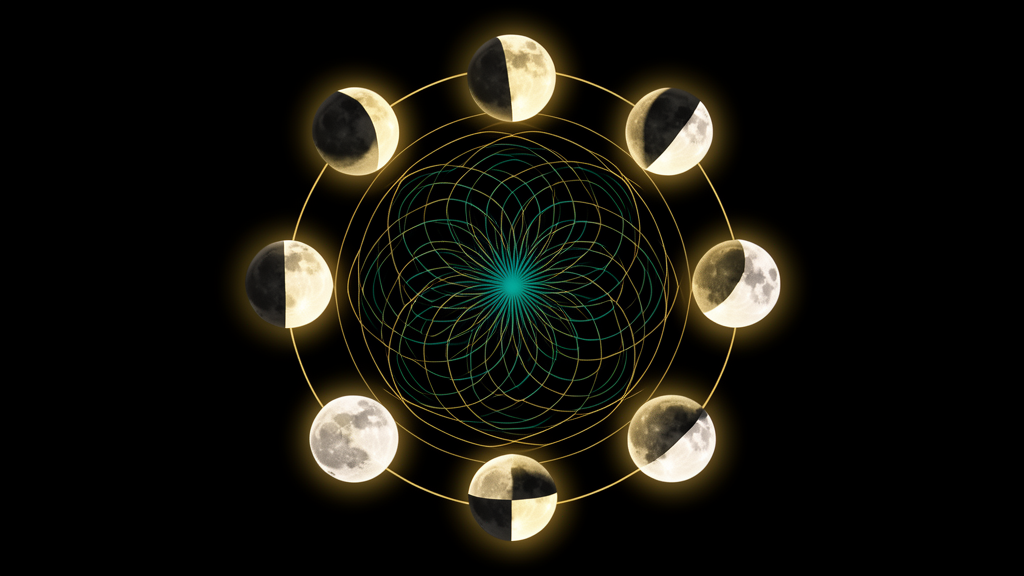
Not twelve slices of a wheel — eight moments in a real angular cycle, the Sun and Moon opening and closing the light between them.
Every so often you have to point the instrument at yourself. We had built a way of reading a chart out of frame-invariant geometry — quantities that do not change when you swap zodiacs, house systems, or the point you call zero. And a natural, uncomfortable question arrived: if our numbers are real, do they just re-derive the ancient categories? Are the twelve signs and the twenty-seven nakṣatras hiding inside our field measurements, dressed in new clothes?
If the answer were yes, it would cut two ways. It would flatter the tradition — and it would mean we had built an expensive machine to rediscover what a Babylonian scribe already knew. So we tested it, the way we test everything: against thousands of real charts, with a shuffle-control to tell signal from chance.
The question, made precise
Our core classifiers are things like the hub (how strongly the ten bodies' phasors reinforce), the moment spectrum (the invariant harmonic content of a chart), and the modality it implies — whether a field gathers into one direction, resolves into a polarity, or spreads across many voices. These are frame-invariant: rotate the whole sky and they do not move.
The zodiac signs and the nakṣatras are the opposite. They are absolute-longitude buckets — they depend entirely on where you put zero. So the mathematically honest prior is no association: you can rotate every planet into a different sign without changing a single one of our numbers. If we found overlap anyway, it would have to come from real ephemeris mechanics, not from the tradition capturing what we capture.
We sampled 4,000 real charts and measured association between each traditional bucket (the sign and nakṣatra of the Sun, Moon, and the field's aim) and each of our classifiers — then compared every number to a shuffled null.
What came back: a whisper, and a tell
Almost everything cleared the shuffle-null by a hair — real, but weak. The single strongest link was between the Sun's sign and the hub: the Sun's sign accounted for about 9% of the variation in hub strength. Interesting. Suggestive. The kind of number a person could build a whole cosmology on.
So we did the thing that separates a finding from a wish. We asked: if this overlap were real and intrinsic to the signs, it should hold steady across time. We sliced the data into nine decade-long windows and measured the same relationship inside each one.
It did not hold steady. It sharpened — from 9% across the full span to an average of 57% inside a single decade. And the "high-hub sign" refused to stay put. It marched around the entire zodiac, decade by decade:
Seven different signs across nine decades — the peak simply following the sky around. And when we lined that march up against the slow drift of the outer planets, we found the culprit. The peak-hub sign tracks the position of Neptune at a correlation of r = 0.98.
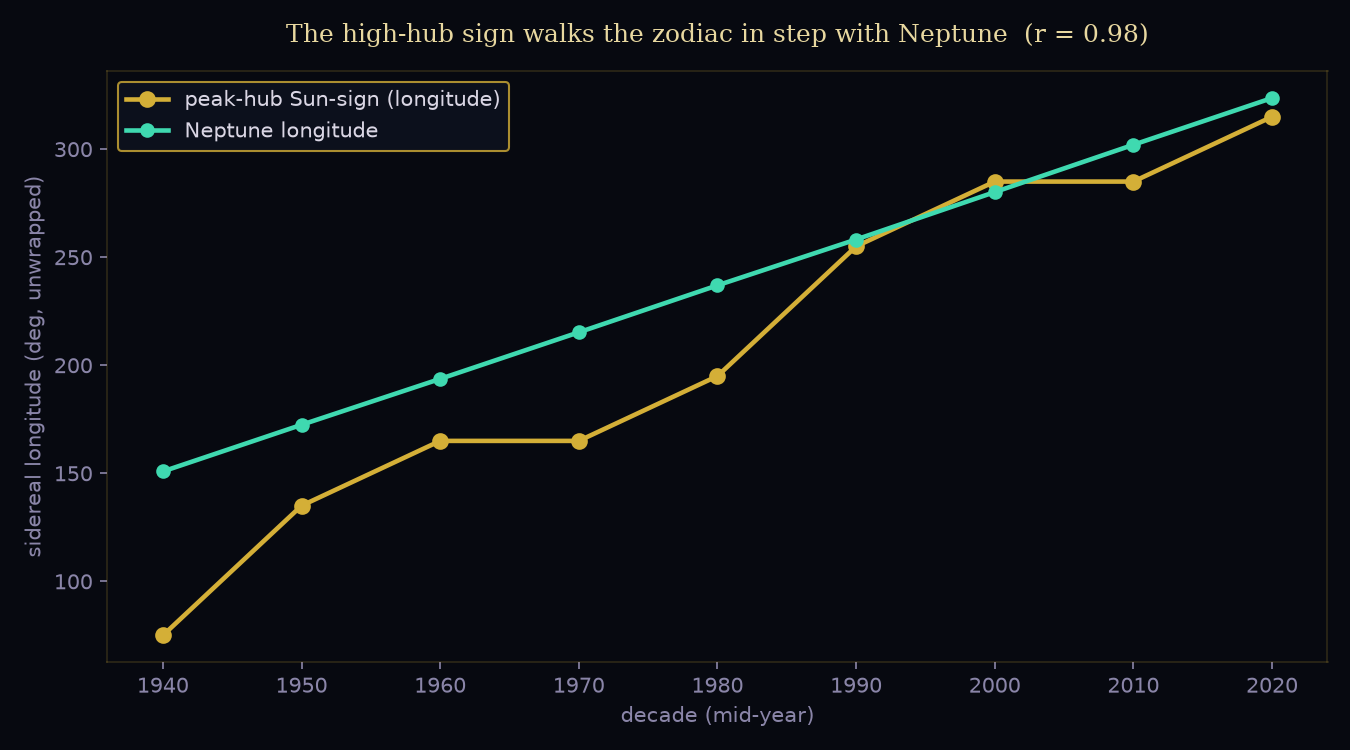
There it was. The overlap was never the tradition rediscovering our geometry. It was an epoch artifact. Mercury and Venus are chained near the Sun; when the Sun's arc happens to point at wherever the slow outer planets were pooled during the last century, the whole pack coheres and the hub runs high. That pool is a region of the zodiac — so it wears a sign's name. Relabel the decade and the "meaning" of the sign moves with Neptune.
The twelve-fold zodiac and the twenty-seven nakṣatras do not carve the same space our frame-invariant classifiers do. The apparent overlap (Sun-sign → hub, ~9%) is an epoch confound that tracks Neptune at r = 0.98 and dissolves the moment you control for the decade. Any claim that a sign "runs hotter" is false as a timeless statement — it was only ever true for one slice of the twentieth century.
This is, quietly, a good result. It means our instrument measures something orthogonal to the five-thousand-year-old system — not a rival account of the same buckets, but a different axis entirely. The originality survives contact with the data. But it left an obvious question hanging: if not the signs, then what does the sky divide into cleanly?
Looking where the geometry actually lives
The signs fail our tests because they are absolute positions on a wheel that has no physical zero. But there is a kind of "position" that is not arbitrary at all: the angle between two bodies. The Sun–Moon angle. A planet's angle from the Sun. These are pairwise separations — and a separation does not care where you put zero. Rotate the whole sky and the angle between the Sun and Moon is exactly what it was.
That angle has a name everyone knows: the lunar phase. New, crescent, first quarter, gibbous, full, and back. It is the oldest clock humanity has. And it is, by construction, frame-invariant.
So we ran the lunar-phase octave through the same gauntlet the signs had just failed — three gates, each one a place the nakṣatras had stumbled.
Invariance. Rotate every longitude by a constant; the phase label never changes. 0 mismatches in 500 charts. A genuine scalar.
Epoch stability. The phase distribution barely moves across nine decades — a swing of 4 points where the nakṣatra peak had marched the whole wheel. A 29.5-day cycle carries no outer-planet fingerprint, exactly as physics demands.
It couples to our spectrum — and that coupling is an identity, not a confound. New-moon charts load our first harmonic (Sun and Moon aligned, adding together); full-moon charts load the second (Sun and Moon opposed — the two-centered, polarity family). This is the same algebra by which aspects are harmonics. The phase and our modality are two views of one real geometry.
The signs are a wheel with no true north. A phase is an angle between two lights. Only one of them survives being spun.
The family behind the Moon
If the Sun–Moon angle is real and invariant, so is every planet's angle from the Sun — its synodic phase. We extended the test to all nine bodies, and the sky handed us two confirmations it did not have to.
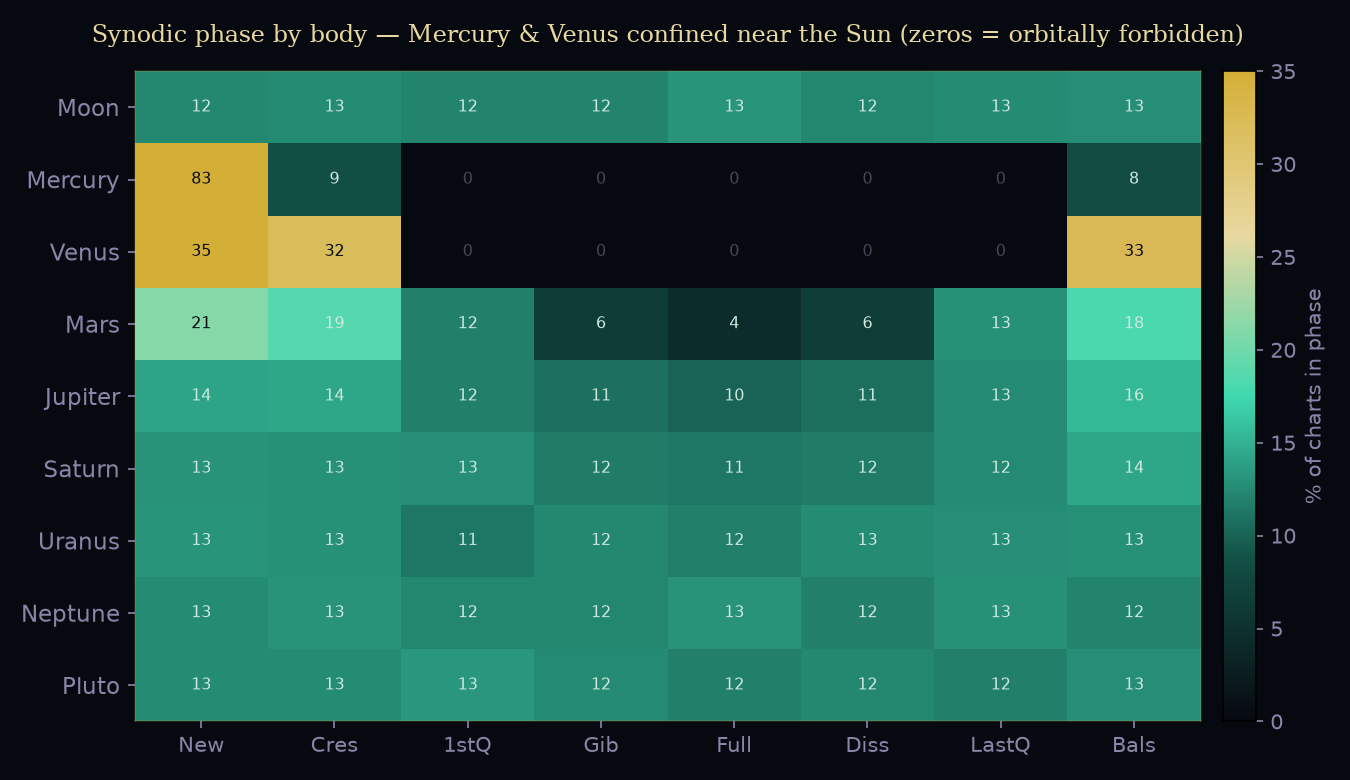
First, confinement. Mercury can never stray more than about 28° from the Sun; Venus, about 47°. So they physically cannot reach the "full" or "quarter" phases — they can only ever be near conjunction. The data shows exactly this: across 6,000 charts, Mercury and Venus land in the far-from-Sun phases 0.00% of the time. Four phase-bins sit at hard zero, because orbital mechanics forbids them. The instrument recovered the structure of the solar system from nothing but sampled positions.
Second, a hierarchy we did not expect. When we measured how strongly each body's Sun-angle drives the whole field's coherence, the outer planets dominated (Pluto, Neptune, Uranus) and the inner ones — Mercury, Venus — contributed almost nothing. The reason is clean: a body chained to the Sun carries no independent information in its phase; a body free to stand opposite the Sun does. The phases that matter for the field are the ones a planet is free to occupy.
Retrograde, without the folklore
There is one more place the Sun–Earth–body angle shows itself, and it is the one the culture loves most: retrograde. A planet never truly reverses; it only appears to, from our moving vantage, when Earth overtakes it. For an outer planet that happens precisely at opposition — the "full" phase. For Mercury and Venus, at conjunction — the "new" phase. Retrograde is not an omen. It is a viewing angle.
Our data confirmed the mechanics to the decimal — every retrograde Mercury sat at the new phase, every retrograde Mars clustered around opposition. But then we asked something our model could answer and folklore cannot: does the field know when the sky is full of retrogrades?
It does. Our winding classifier measures whether the interference field circulates around its center — whether there is a vortex at the hub, a point the field turns around rather than radiates from. And the number of retrograde bodies at birth predicts it, cleanly:
A calm, radiating field when nothing is retrograde; an almost-certain vortex when four or more bodies are. The coupling holds at a correlation of 0.71 — and, crucially, it survives our honesty control: the winding number is rotation-invariant (we rotated the whole sky through six different angles and every vortex reading held), and it does not depend on how we draw the field. It is real geometry, not an artifact of the picture.
A hub vortex is a frame-invariant feature of the interference field, and it marks a multi-retrograde sky. Retrograde bodies crowd the Sun-axis (opposition or conjunction); when several do so at once, their phasors give the field a net circulation. The vortex and the retrograde cluster are the same angular fact seen two ways — one in planetary motion, one in field topology.
This vortex isn't a metaphor — you can turn it in your hands. We built the birth field as a living interference pattern on the celestial sphere and rendered it in 3D: the phase pinwheels where the field circulates, the still dark points at each vortex’s eye, and the balanced pairs that a closed sphere must carry. Drag to rotate; read the short story beneath it.
Notice what we did not do. We did not tell you Mercury retrograde will scramble your travel plans. We found a real, measurable, invariant property of the field that corresponds to the retrograde sky, defined it exactly, and explained it geometrically — without borrowing a single meaning from the tradition.
Where the science stops, said out loud
Here is the line we will not cross, stated plainly. Everything above is measured geometry and its mechanical cause. What a phase or a vortex means for a person — whether a full-moon-born, two-centered field lives as a held polarity, whether a vortex chart circulates inward rather than broadcasts out — is offered, not proven.
A phase and a vortex are real, invariant divisions of the sky, derived from Sun–Earth–body geometry with no inherited meanings. What they signify in a life is a correspondence we offer for reflection — a mirror, never a forecast. We have not shown that a phase or a vortex predicts anything about a person; that test is unrun, and until it runs, the meaning stays soft. A slope, not a track.
This is the whole difference between what we are building and the wheel we tested against. Traditional astrology inherited twelve meanings and fitted the sky to them. We derive the divisions from provable, invariant, epoch-stable geometry — the phase angles, the confinement, the vortex — and then we are honest about exactly where the measuring ends and the offering begins.
We went looking for ourselves in the zodiac. We weren't there. What we found instead was the geometry the zodiac was always pointing at.
See the instrument these findings feed →
Why Mercury and Venus stay near the Sun (greatest elongation) — Elongation
Apparent retrograde motion as a parallax of orbital speeds — Apparent retrograde motion
The precession that makes sidereal signs drift over centuries — Axial precession