Jung's White Ant and the Membrane
In 1952 Carl Jung ran an astrological experiment that arrived, by a completely different road, at the exact verdict the Scalar Flower corpus keeps reaching: the tradition's marriage aspects carry no causal force that survives an honest test. He even discovered the failure mode our controls are built to catch — a “hit” in the first batch that cancels when the data accumulate. This is that story, held to the membrane.
A Field Note from Scalar Flower — dual-system model. Companion to The Layer of Invariants, Test 17 (Moon-Breath Vocation), and The Scalar Inventory. Occasioned by Armand Diaz, What Jung Said About Astrology and Synchronicity (2023). With computational collaboration by the Hermes agent (Nous Research).
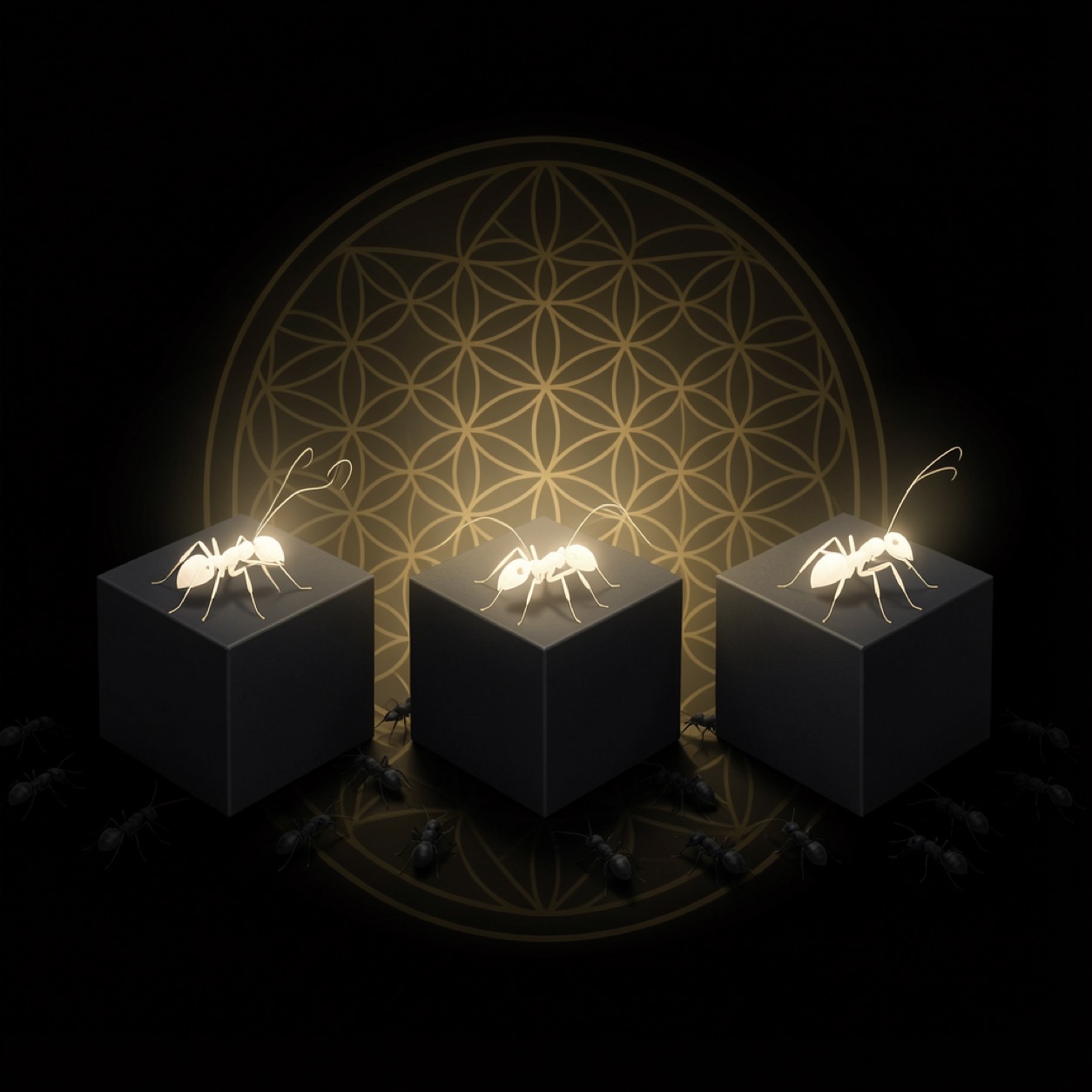
Three boxes, one white ant among a thousand black in each — and the white ant emerging first from all three. Jung's own image for a coincidence too clean to be chance, and too weak to be force.
Why Jung belongs in these field notes
The Scalar Flower Model was built to read a natal chart honestly — collapse the geometry to rotation-invariant scalars, test whether those scalars carry structure beyond a fair null, and tag every claim REAL, ARCH, or INTERP so that a beautiful idea never crosses a tier it hasn't earned. The empirical arc of the corpus is sobering and consistent: the geometry is real as geometry; it is not a physical force on Earth (Test 15); and it leaves no measurable imprint on human lives even through its single strongest channel (Test 17). Every bridge from the math to biography remains INTERP, unbuilt.
That verdict is easy to mistake for hostility to the tradition. It is not. And the cleanest proof that it is not comes from the one figure the psychological-astrology tradition most reveres — Carl Jung — who, in 1952, ran the experiment we would now call preregistered-in-spirit, and reached our verdict seventy-four years before we did.
Armand Diaz's essay makes the provocation sharp: what Jung said about astrology is not what most astrologers think. Astrologers invoke Jung's synchronicity as the one-word reason their art works — “as above, so below.” But Jung's longest written treatment of astrology sits inside Synchronicity: An Acausal Connecting Principle, and there he does something astrologers rarely quote: he counts, he finds the numbers non-significant, and he attributes the pattern in those non-significant numbers to the mind of the experimenter, not to the sky.
That is the membrane, in 1952, in a different vocabulary.
1. The experiment REAL — what Jung actually did
Jung tested whether the classical astrological “marriage aspects” appear more often in the charts of real married couples than in random pairings. The design was disciplined for its era:
— 966 charts, 483 married couples, gathered from acquaintances in Zurich, London, Rome, and Vienna, collected without disclosing the purpose.
— Three independent batches, evaluated as they arrived: 180, then 220, then 83 pairs — no selection, no back-fitting.
— A control group of roughly 32,220 randomly recombined “false couples” — the 483 men and women paired with everyone they were not married to.
— About 50 classical aspects — conjunctions and oppositions among Sun, Moon, Venus, Mars, Ascendant, and Descendant.
This is a married-vs-shuffled-control design with a locked aspect list and sequential, unselected batches. Strip the 1952 diction and it is recognizably the same shape as our own tests: a statistic, a fair null built by shuffling, and a pre-committed thing to look for.
2. What the numbers said REAL — the result, and only the result
Two facts have to be held together, because the tradition remembers the first and forgets the second.
Fact one — the striking sequence. Each batch's single largest effect was a different classical lunar marriage aspect, and each surfaced in order:
Three lunar conjunctions, each a canonical marriage signature, appearing one per batch, in sequence. Jung put the combined improbability at roughly 1 : 3 × 10¹¹ and reached for his white-ant analogy — three boxes, one white ant among a thousand black, and the white ant emerging first from all three.
Fact two — none of it was significant. No individual aspect crossed a conventional threshold. The mean marriage-aspect count was about 8.72 against an expected 8 — nowhere near p < 0.05. And the decisive move: when the three batches were pooled, the effects cancelled to overall non-significance. The Sun–Moon hit, the Moon–Moon hit, and the Ascendant–Moon hit did not reinforce each other — they washed each other out.
Jung's own words, filed at REAL with the emphasis that matters: the classical expectations “were confirmed in all three batches, which is extremely improbable although taken individually the figures are not significant.” The later scholarly verdict is blunter still: “statistically insignificant results revealed that such connection between married couples and astrological aspects is merely chance.”
3. The overlap that makes this a field note ARCH
Set Jung's 1952 experiment beside Test 17 and the structural rhyme is almost uncomfortable.
Both projects did the same three honest things. They pre-committed to what would count as a hit. They built a shuffled/recombined null so chance had room to play. And when a hit appeared, they subjected it to a control that could kill it — our era-matched resample; Jung's simple act of pooling more data — and reported the death rather than the birth.
This is the deepest point of contact in the corpus so far, and it is worth naming plainly: Jung independently discovered the membrane discipline in 1952, and his experiment is a 74-year-old external replication of the Scalar Flower's own conclusion. The tradition's most serious empirical champion, using the tradition's own canonical marriage aspects, on the tradition's home turf, found that they carry no force that survives accumulation. Our corpus — REAL geometry, ARCH structure, every biographical INTERP bridge unbuilt — is exactly where Jung landed.
There is even a Layer-II grace note. Jung's aspects (Sun–Moon, Moon–Moon, Asc–Moon conjunctions) are inter-chart angular separations — relational, rotation-covariant quantities, not raw longitudes. In Ji's terms and ours, he was already reaching for Layer II: the invariant relational structure, not the frame-dependent appearance. He tested the right kind of object. It still came back null.
He tested the right kind of object. It still came back null.
4. Where the membrane holds the line INTERP
Here is where Jung and the Scalar Flower part company — and where the membrane earns its keep.
Jung did not stop at “chance.” He proposed that the arrangement of those chance figures — three classical aspects surfacing in sequence — was itself meaningful: a synchronicity, an acausal connecting principle, driven by the emotional state and expectation of the experimenter. As enthusiasm for the experiment cooled, he observed, the favorable results leveled off; he suspected his own and his collaborator's inner state had, for a while, nudged chance into a personally meaningful shape. His follow-up qualitative experiment pushed the same idea further: participants drawing chart-pairs found aspects matching their own psychological states.
Diaz's essay sharpens what Jung was really claiming: astrology, for Jung, works as a projection of the collective unconscious onto the heavens — the gods are inner archetypes mapped upward, not external forces reaching down — and genuine synchronicity carries an elevated emotional value that ordinary chart-reading lacks.
The membrane files all of this at INTERP, and declines to test it — not out of dismissal, but out of honesty about scope:
1. The projection/synchronicity claim is structurally outside the falsifiable frame. Its causal variable is the observer's emotional state, and its connecting principle is defined as acausal. There is no instrument in the SFM for the first and no null definable for the second. Jung himself conceded the point: statistics “is unable to establish scientifically the principle of synchronicity.” A claim that cannot fail a test cannot pass one either, and the membrane refuses to launder it into REAL.
2. The sky-on-people reading was tested — by Jung, and by us — and did not survive. This is the falsifiable half of astrology's marriage claim, and it returns null on both sides of the 74-year gap. It stays at INTERP, now empirically unsupported.
3. Naming what we decline to adjudicate strengthens the membrane, it does not weaken it. The Scalar Flower's credibility has never come from what it accepts; it comes from what it refuses to accept unearned. Jung's synchronicity is the cleanest example in the literature of a claim worth stating, worth respecting, and impossible to test — so we state it, respect it, and leave it uncrossed.
5. What this opens — the honest re-run
Jung had 483 couples. Modern public datasets are far larger — Wikidata alone yields on the order of 16,000+ public-figure marriages with birth data. That makes a preregistered replication genuinely runnable inside the SFM pipeline:
— A Jung marriage-aspect replication on roughly 35× his sample, computed on inter-chart invariant scalars (Layer II), with the recombined-false-couple control and a positive-control power gate of the kind that let Test 17 report a decisive null rather than an underpowered one. Predicted verdict, stated in advance and held to the membrane: clean NULL.
— A batch-order calibration test that formalizes Jung's actual discovery — that sequential subsamples throw up unstable, self-cancelling “top hits.” That is precisely the artifact our surrogate-validity and multiple-comparisons controls exist to catch; reproducing it, and then killing it, would be a calibration of our own false-positive machinery against the most famous example of it on record.
Those are for the pre-registration file, not this field note. What belongs here is the overlap itself, and it is a genuinely striking one to be able to report: the founder of psychological astrology, running the tradition's own experiment, reached the Scalar Flower's verdict first. The geometry is real. The relational invariants are the honest description. And the bridge from the sky to a human life remains, on the evidence — Jung's and ours — unbuilt.
The white ant came out of the box first three times. Then Jung added more boxes, and it stopped. That is not a failure of the experiment. That is the experiment.
Sources
- Diaz's thesis (Jung ≠ what astrologers assume; synchronicity needs elevated emotional value; astrology as projection of the collective unconscious): Armand Diaz, What Jung Said About Astrology and Synchronicity, Medium (2023) — medium.com
- Experiment design (483 couples / 966 charts; batches of 180, 220, 83; ~32,220 false couples; ~50 classical aspects): Seba Health — seba.health; Jungian Alchemist — jungianalchemist.substack.com; Astrologers Forum — astrologersforum.com
- Per-batch top aspects and rarities; white-ant analogy; combined 1:3×10¹¹: Seba Health — seba.health; Reddit r/ShadowWork summary — reddit.com
- Non-significance and cancellation on pooling; mean 8.72 vs expected 8: Astrologers Forum — astrologersforum.com; AIPR News — aiprinc.org; Synchronicity in Post-Jungian Astrology, Journal of Analytical Psychology (PMC) — ncbi.nlm.nih.gov
- Jung's own words (“taken individually the figures are not significant”; experimenter-state influence): Carl Jung Depth Psychology — carljungdepthpsychologysite.blog; Astrodienst Astrowiki — astro.com
- Second (qualitative) experiment; statistics cannot establish synchronicity: Journal of Analytical Psychology (PMC) — ncbi.nlm.nih.gov
- Modern scaled dataset (16,861 Wikidata marriages): Jan Jileček, The Astrology of Lasting Unions (2025) — blog.jilecek.cz
- Layer-of-invariants framing; Test 17 method and verdict; the membrane: project corpus — The Layer of Invariants (Ji & the Scalar Flower); Test 17 (Moon-Breath Vocation) RESULTS; The Scalar Inventory.