An Astrology That Can Say No to Itself
Introducing Scalar Flower — an astrology rebuilt from physics, on a single pattern that runs from the dividing cell to the spinning galaxy, and held to tests that were allowed to kill it. We published the failures first.
A Field Note from Scalar Flower. With computational collaboration by the Hermes agent (Nous Research).
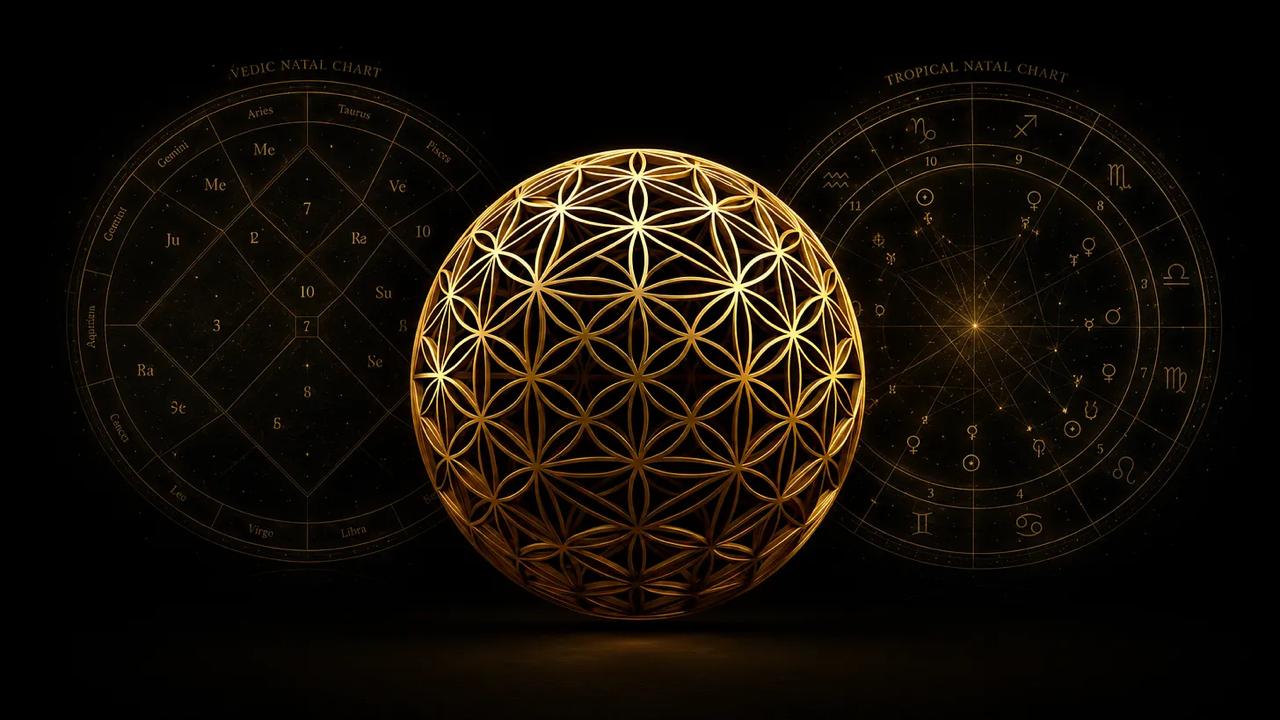
Two zodiacs, one moving structure: the Vedic and Tropical charts are not rivals but two readings of a single turning form.
In the middle of building what follows, a number appeared on my screen that I had been hoping to see, in one form or another, for most of my life: p = 0.003.
We had aimed our hardest pre-registered test at 21,165 timed births from the open Gauquelin database (birth times from civil registries, fought over by skeptics and believers since the 1950s) — physicians, scientists, athletes, military — asking whether the Moon’s breath sorts human lives into destinies. It lit up. If nothing real were there, chance alone would produce a signal at least this strong about three times in a thousand — statistically significant by any conventional bar. The confirmation this whole tradition has been waiting on.
Then the confound control we had committed to in writing, before a single number was computed, did its job. The signal was a calendar coincidence. It collapsed to p = 0.83 — the sort of reading pure chance hands you.
Verdict: null. And we are publishing it anyway — the failure first, under my own banner, before a single triumph. Eleven tests were pre-registered, pass/fail criteria locked before any data ran. Most of them killed what they touched. Four things came out the other side alive. This letter is the story of the four, the fallen, and the instrument they left standing — a system with the rare property its title claims: it can say no to itself, and it just did.
It starts, as it always did for me, with a picture.
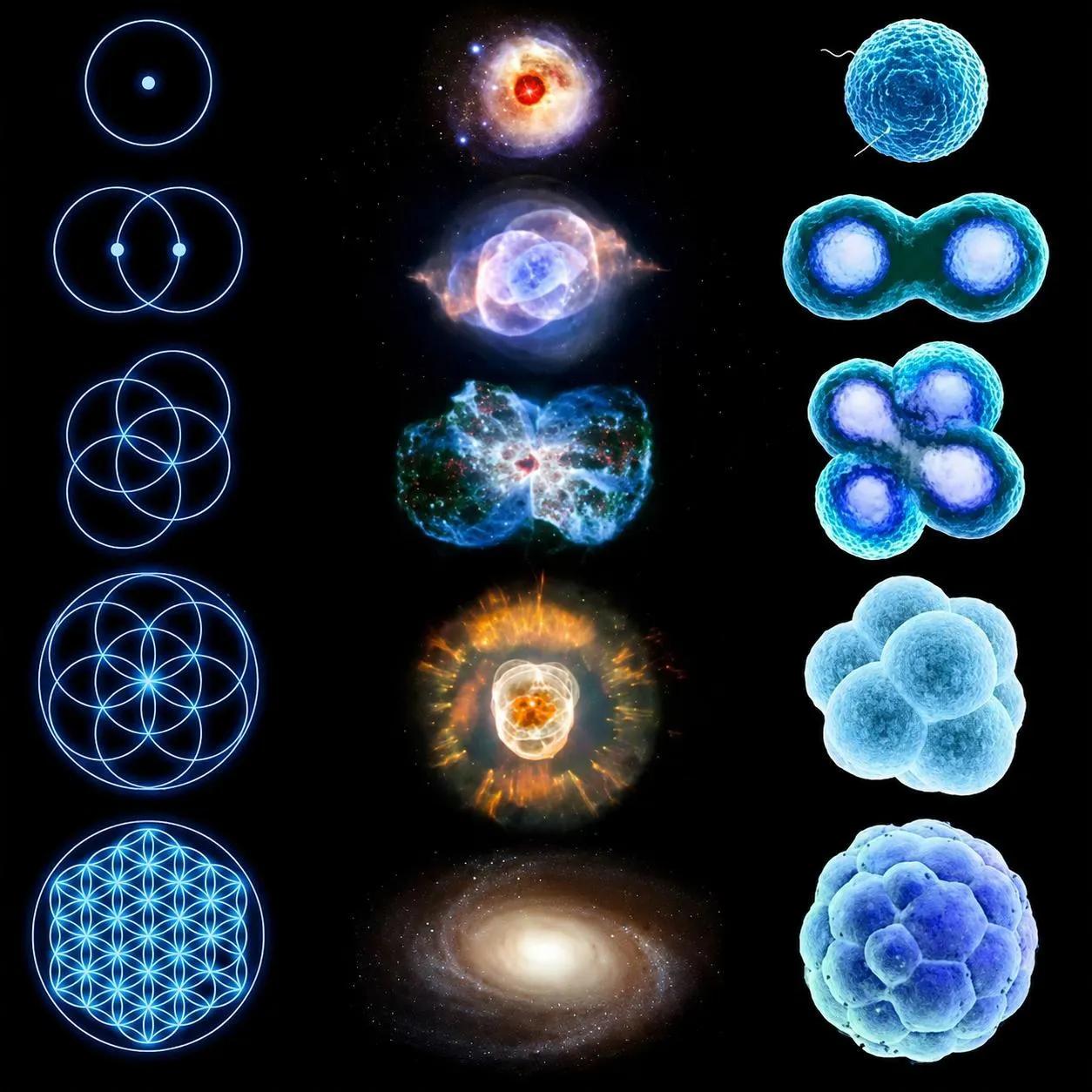
Put a dividing cell beside a spinning galaxy and something uncanny happens: for a second, you’re not sure which one you’re looking at. One is microscopic and alive; the other is a hundred thousand light-years wide and made of stars. They share no size, no substance, no timescale. And yet they seem to be making the same move — one thing winding, dividing, opening into more of itself along a single turning axis.
For a while now I’ve been writing here about the edges of things. Cavitation in living tissue. Piezoelectric signals in bone. The half-lit territory where physics and biology stop behaving like separate disciplines. If you’ve followed along with my Sacred Technology series, you know the rule I hold myself to: I don’t want the mystery explained away, and I don’t want it dressed up either. I want to know what’s actually there.
That same instinct kept snagging on this resemblance — the cell and the galaxy — and refusing to let go. Is it a real structural fact about how the universe builds form at every scale? Or is it the oldest trick the mind plays on itself, seeing faces in clouds? There’s a whole tradition — astrology, the oldest pattern-language we have — built on the intuition that the answer is yes, it’s real: that what happens overhead and what happens in a body are versions of one thing.
And this is no fringe intuition. By Pew’s most careful polling, about one in four American adults believe it — looser surveys run as high as seven in ten — and roughly a third of the country consults a chart, a card, or a horoscope at least once a year. Yet the tradition carrying all of that belief has never agreed with itself on the basics: which zodiac, which house system, which sky. Hundreds of millions of people, standing on a foundation no two schools compute the same way.

I wanted to know if any of that survives an honest look. Not “does astrology work” — that question is a trap. The sharper one: strip it down to only the quantities the sky measurably has, and does the resemblance hold? Or does it dissolve the moment you test it?
That question became a project. The project became a system. And somewhere in the middle of it, the ground moved — because the resemblance turned out to be real, but not for the reason everyone assumes, and only after most of what I hoped for had failed.
What the name is doing
This is the launch of that system. It’s called Scalar Flower, and the name is doing real work, so let me define it before anything else. A scalar, in the mathematician’s plain sense, is a pure magnitude — the measured strength of a pattern before anyone names what the pattern means. A number with no direction and no agenda. (It is not the “scalar wave” of frontier energy medicine — a lineage I’ve explored with genuine interest in earlier essays, and which this system deliberately does not lean on. Here the word means only what it means in a physics textbook.) The flower is the form all those magnitudes draw when you let their cycles overlap — petals of interference, the oldest geometry there is. Measured strengths, arranged as a living form. That’s the whole name.
A confession, and where this really started
Let me come out of the closet about something, because this piece isn’t honest without it. This is not a new curiosity for me. It’s a lifelong one.
When I was seventeen, I found a used book on the two-zodiac problem — the old, maddening puzzle of precession: the slow wobble of the Earth that pulls the tropical zodiac (tied to the seasons) and the sidereal zodiac (tied to the fixed stars) apart by about a full sign over the centuries. Which one is “true”? Astrologers have fought about it for a hundred years. I read that book and I was hooked — not on the fortune-telling, but on the problem. Two systems, both claiming the same sky, neither willing to yield. It lodged in me and never left.
In the decades since, I’ve cast and studied thousands of charts — quietly, off to the side of the work most of you know me for. And across all of them, one stubborn observation kept surfacing, the same one that answers the precession puzzle: the configurations of the planets lend truth to both systems. It was never a matter of picking sidereal or tropical and declaring the other wrong. The geometry the planets actually make — the angles, the couplings, the standstills — carries real information in both frames. The two zodiacs aren’t rivals. They’re two readings of one moving structure. That’s the knot I couldn’t untie at seventeen, and it’s the knot Scalar Flower’s dual-system architecture — two frames held apart by a membrane and coupled at exactly one point — finally, mostly, unties.
The two zodiacs aren’t rivals. They’re two readings of one moving structure.
What comes next is the rest of that story: the old chart and the new one set side by side, the vision that gave the system its shape, the standard I hold it to — and then the tests themselves. The place where the node pointed at nothing. The root the ancients had already named, waiting exactly where the radio telescopes found the galaxy’s heart. The four findings that walked through the whole gauntlet and lived. And the one, shining at p = 0.003, that did not.
The four discoveries that survived — and the one that didn’t
The full essay continues on my Substack: the Whitman charts, the vision Vedha carried, the node that breathes instead of points, the root at Mula, the coil a life winds through space, and the complete ledger of honest tests — including the failure we published first.
Read the rest on Substack →