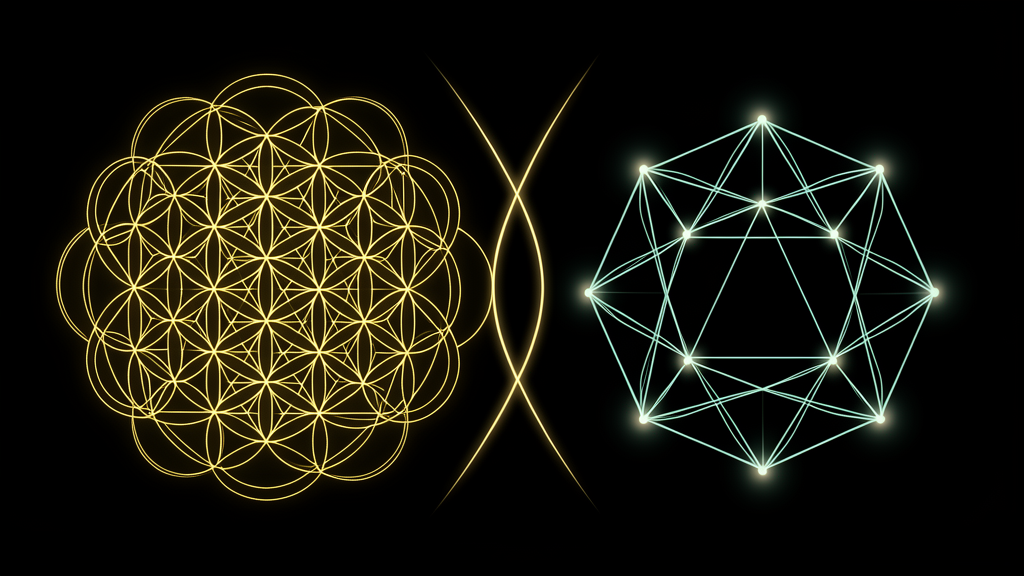
Haramein and the Scalar Flower
A field note on a shared name and two different objects
Nassim Haramein and I arrived, decades and disciplines apart, at the same phrase — “scalar flower” — for the geometry of reality. This note traces his work chronologically, gives credit where credit is due, and draws the honest line between his physical claim and the Scalar Flower Model's methodological one.
0. Why this note exists — and a piece of intellectual honesty
When I named the Scalar Flower Model and built scalarflowerastrology.com, I did not search the phrase first. I named it from the inside — the natal chart's rotation-invariant scalar content arrayed as a flower on the wheel. Only later did I discover that Nassim Haramein has been publicly using “scalar flower of life” for years, in the context of his holofractographic / holographic-mass framework (Instagram, Nov 7, 2021; official Facebook page).
That is a zeitgeist collision worth naming out loud. Two projects, coming from opposite ends of science — his from vacuum physics and sacred-geometry cosmology, mine from circular statistics on birth charts — landed on the same phrase for what turns out to be structurally the same intuition and empirically two different objects. This note is the field note I owe him: a chronological review of his scalar-flower work back to its earliest published references, a fair summary of the concept, and a precise map of where the SFM overlaps, differs, and gives him credit.
The membrane discipline (every claim tagged REAL, ARCH, or INTERP) applies here as everywhere else in the SFM corpus. I will honor his priority on the name and on the architecture, and I will hold the ontology at the tier the SFM has always held it: philosophy, offered as vision, never as validated physics.
1. Chronology: how the scalar flower emerged in Haramein's work
Haramein tells the story that he began developing his geometric intuition at nine years old, sketching what he later called the Holofractographic Universe — an infinitely divisible, self-similar, scale-invariant structure of “dots within dots” (official biography; The Optimist Daily, 2018). The published record begins two decades later, and it moves through a specific sequence.
~2001–2003 · The lecture series and the tetrahedral array
Haramein's first widely circulated presentation of the geometry is the Crossing the Event Horizon lecture series (recorded and later released as a 4-DVD set in 2006), where he walks through the tetrahedron as the smallest, most stable volume; the star tetrahedron as its stable dual; the cuboctahedron / vector equilibrium at the center of the doubled matrix; and the emergence of a 64-tetrahedron grid as the first fully balanced fractal octave (Crossing the Event Horizon, 2006; transcript excerpt). In this early formulation the flower of life is present as the 2D shadow of a 3D tetrahedral-and-spherical packing, not yet named “scalar.”
2003–2008 · The Haramein–Rauscher metric and the scaling law
Working with the late physicist Elizabeth Rauscher, Haramein published a modified Kerr–Newman solution to Einstein's field equations incorporating torque and Coriolis effects (The Origin of Spin, 2004/2005), and with Michael Hyson and Rauscher a universal scaling law for organized matter plotting frequency versus radius from the universe down to the Planck scale (Scale Unification, 2008). This is the paper that puts every organized structure — galactic centers, stars, atoms — on a single black-hole trend line and gives the “holofractal” its quantitative backbone.
2010 · The Schwarzschild Proton
Haramein's first widely cited standalone paper argues that the proton, treated as a Schwarzschild-condition object, obeys the same scaling law and needs only ~10−39 % of the available vacuum-fluctuation energy density to satisfy the condition (The Schwarzschild Proton, AIP Conf. Proc. 1303, 2010; best-paper award at CASYS'09, Liège). This is where the geometry acquires a specific physical hook: the proton as a mini-black-hole coupled to the vacuum.
2013 · Quantum Gravity and the Holographic Mass — the flower becomes explicit
Haramein's peer-reviewed paper in Physical Review & Research International introduces the Planck Spherical Unit (PSU) — a sphere of Planck-length diameter — as the fundamental voxel of the vacuum. He counts PSUs inside a proton volume and PSUs on its horizon surface, and finds that the ratio yields the proton's rest mass and gravitational coupling constant within tight bounds of the CODATA value (Quantum Gravity and the Holographic Mass, PRRI, 2013). Crucially, the tightest packing of PSUs inside a spherical volume is exactly the 3D sphere-packing whose 2D shadow is the flower-of-life pattern. In Haramein's framework the flower of life is now not an ornament but a quantitative claim about vacuum geometry (RSF summary).
2018–2021 · The phrase “scalar flower” enters public writing
In talks and short-form posts across this window, Haramein consistently frames the 3D flower-of-life packing as a scalar lattice — meaning direction-free, isotropic, in perfect vector equilibrium, and scale-invariant. The clearest single instance is his November 7, 2021 Instagram post:
“The Flower of Life and the 64 tetrahedron grid are different expressions of the same underlying organizational geometric principal of spacetime… An infinite scalar flower of life and the tetrahedral array centering each of its spheres is the geometric organizational principal for the structure of the vacuum of spacetime from the cosmological to the quantum.”
The same phrasing appears on his official Facebook page and threads through the Cosmic Weave pedagogical materials produced within the Resonance Science Foundation ecosystem. By 2021 the working phrase — “scalar flower of life” — is a fixed part of his public vocabulary.
Takeaway on priority. Nassim Haramein used “scalar flower of life” in public, in this specific meaning, at least five years before I built the Scalar Flower Model and named it. That priority is his, and this note records it.
2. What Haramein actually means by “scalar flower”
Distilled from the chronology, Haramein's scalar flower is a physical-ontological claim about the vacuum, with five load-bearing components:
- Space is not empty. The vacuum is a structured, high-energy-density field of Planck-scale electromagnetic fluctuations.
- The fundamental voxel is spherical. Each vacuum fluctuation is treated as a Planck Spherical Unit (PSU) of Planck-length diameter, oscillating and overlapping with its neighbors.
- The packing is the 3D Flower of Life. PSUs tile space in the tightest sphere-packing whose 2D projection is the familiar flower-of-life pattern, and whose straight-line skeleton is Buckminster Fuller's isotropic vector matrix — the 64-tetrahedron grid.
- “Scalar” means isotropic and scale-invariant. The lattice has no privileged direction and repeats in perfect octaves from Planck to cosmological scales. This is the sense in which the flower is scalar: not a scalar field in the textbook sense, but an isotropic, direction-free, self-similar lattice.
- Matter is a coherence pattern in the flower. A proton is a region where a small percentage of vacuum PSUs cohere into a Schwarzschild-condition mini-black-hole; the same architecture, rescaled, gives stars, galaxies, and the observable universe.
In one paragraph: the scalar flower is Haramein's name for the isotropic, scale-invariant, sphere-packed geometry of the vacuum itself, from which matter, mass, and gravity are derived by counting.
3. What the Scalar Flower Model means by “scalar flower”
The SFM's scalar flower is a methodological claim about a birth chart, with a very different load-bearing structure:
- A chart is a set of body positions on a circle. Longitudes on the ecliptic wheel, plus declinations off the plane. Frame-dependent.
- Only rotation-invariant content is real. The SFM discards everything that shifts when you change zodiac origin or ayanamsa, and keeps only the scalars — magnitudes with no direction, unchanged under frame rotation.
- The minimal basis is small and countable. Test 13 pinned it: for N bodies on the wheel, the chart carries exactly N−1 independent longitudinal invariants plus a separate declination block — about 13 invariants for a 7-body chart, not 35 raw scalars.
- The “flower” is the natal-chart geometry, not the vacuum. The name arose because a chart's invariant structure, drawn as a labeled simplex of pairwise separations, looks like a flower on the wheel — and because the interpretive engine reads the chart from the invariants outward, petal-fashion.
- The literal physical-wave reading has been tested and rejected. Test 12 found planetary periods are less commensurable than chance (no standing-wave stack). Test 15 put physical emission magnitudes below every relevance floor. In the SFM, “interference” is a phasor sum of angular positions, honest circular statistics — not a physical field.
In one paragraph: the scalar flower is a working machine for reading a chart only through the small, honest, rotation-invariant set of scalars it actually carries — and every physical-ontology upgrade has been quarantined at INTERP or explicitly falsified.
4. The map: where the two frameworks meet, where they diverge
| Dimension | Haramein's Scalar Flower | SFM's Scalar Flower |
|---|---|---|
| Domain | Physical vacuum, cosmology, particle physics | Natal-chart geometry, circular statistics |
| Primitive | Planck Spherical Unit — Planck-length voxel of the vacuum | Rotation-invariant scalar — magnitude unchanged under frame rotation |
| “Scalar” means | Isotropic, direction-free, scale-invariant lattice | Rotation-invariant magnitude, textbook sense |
| Geometric backbone | 64-tetrahedron grid / isotropic vector matrix; 3D Flower of Life packing | 5-cell / hypertetrahedron simplex; N points carry N−1 invariants |
| Tier of core claim | Physical ontology — “the vacuum is this geometry” | Methodological — “the honest description of a chart is its invariants” |
| Empirical target | Proton mass, gravitational coupling constant, force scaling | Pre-registered, positive-control-gated tests on ~21,000-birth cohorts |
| Waves as organizing principle | Yes — Planck-scale EM oscillations organize all matter | Tested and rejected in literal form (Tests 12, 15) |
| Fibonacci / golden ratio | Absent from core geometry but often invoked in pedagogy | Prohibited by the C1–C2–C3 guard; Test 13 confirmed no privileged constant |
The shared spine is unmistakable:
- Both frameworks reach for the same family of geometric objects — the tetrahedral simplex, the cuboctahedron / vector equilibrium, the flower-of-life packing — to picture a middle layer of structure that survives when appearance changes.
- Both are, in Sungchul Ji's language, layered-invariant architectures: what you see is a projection, and what is real is what survives the projection.
- Both use “scalar” to mean the thing that does not depend on your frame.
The divergence is equally unmistakable, and this is where credit must be paired with honesty:
5. Credit where credit is due
Nassim Haramein deserves clear, on-the-record credit for three things relevant to this project:
- Naming priority on “scalar flower of life.” He used the phrase in this specific sense, in public, no later than 2021 — years before I named the SFM. My independent arrival at the same phrase is a zeitgeist coincidence, not a discovery of the term. The name is his in the public record; the SFM's contribution is a different object under the same name.
- The architectural intuition. The idea that a scalar, isotropic, scale-invariant geometry sits under the appearances is Haramein's decades-long throughline — the Haramein–Rauscher metric, the universal scaling law, the Schwarzschild proton, and the holographic mass paper. The SFM's simplex-based invariant basis belongs to the same family of architectures, and it is only fair to say so.
- Reading the flower of life as a physics object, not an ornament. Before Haramein, the flower of life circulated mostly as a sacred-geometry motif. His work — controversial in mainstream physics, but real in its influence — pushed it into a quantitative framing. The SFM inherits that rhetorical shift even though it uses the geometry for a completely different purpose.
Where I must diverge from him, and where the membrane holds the line, is on claims the SFM is built specifically not to make:
- The SFM does not claim the vacuum has a specific geometry. That is filed at INTERP, next to the scalar-wave / torsion frame in The Scalar Inventory.
- The SFM does not treat planetary emissions as physical wave sources. That reading was pre-registered and falsified by Tests 12 and 15.
- The SFM does not import Fibonacci, φ, or any privileged constant as a generator of its basis. The C1–C2–C3 guard was explicit and confirmed by Test 13.
None of this diminishes what Haramein has done. It just marks the seam between his object and mine.
6. The zeitgeist point
The most honest thing I can say about the collision of names is that it is not a coincidence — it is a symptom of a shared moment in the culture of ideas. Independently, in the same decade, three very different projects converged on the same middle-layer intuition:
- Nassim Haramein, from vacuum physics and sacred geometry, arrives at the scalar flower of life as the isotropic geometry of the vacuum.
- Sungchul Ji, from theoretical cell biology and cosmology, arrives at Layer II — the domain of invariants — pictured by the tetrahedron → BCT → 5-cell stack (Ji, 2026).
- The Scalar Flower Model, from circular statistics on birth charts, arrives at the minimal scalar invariant basis of a chart, pictured by the same simplex.
Three projects, three vocabularies, one shared claim: the honest description of a system is its short list of frame-invariant scalars, and its geometric picture is a simplex.
I did not think to search “scalar flower” before naming the SFM — an oversight I am correcting on the record here. And yet the phrase was already in the air, held by Haramein for a physical-ontological reason and by Ji for a metaphysical-architectural one. That is what a zeitgeist looks like: the same shape shows up in three lineages because it is answering the same question. The SFM's contribution is neither the phrase nor the intuition — it is holding the intuition to a fair test, in the one domain (astrology) where the test has been most notoriously ducked.
7. The one-paragraph synthesis
Nassim Haramein has been publicly using the phrase “scalar flower of life” for at least five years, in a very specific meaning: the isotropic, scale-invariant, sphere-packed geometry of the vacuum, quantified in his 2013 Quantum Gravity and the Holographic Mass paper via Planck Spherical Units, and derived from a body of geometric intuition he traces back to age nine and to his Crossing the Event Horizon lectures. The Scalar Flower Model arrived at the same phrase independently, from the completely different route of circular statistics on birth charts, and uses “scalar flower” to mean a chart's minimal set of rotation-invariant scalars — a methodological reduction, not an ontology of the vacuum. The two frameworks share a spine: both insist that the real content of a system is what survives frame change, both reach for the tetrahedron / vector-equilibrium / simplex family to picture that content, and both belong recognizably to the same middle-layer intuition that Sungchul Ji names the domain of invariants. They diverge on one crucial point: Haramein treats the flower as physical geometry of the vacuum, while the SFM has explicitly tested and rejected the literal physical-wave reading in the astrological case, keeping the shared architecture at ARCH and filing every ontological upgrade at INTERP. Priority on the name belongs to Haramein, and I want him to know I recognize it — the SFM's contribution is not the phrase but the discipline of holding the intuition to a fair test in a domain where such tests are rare.
Sources
- “Infinite scalar flower of life” phrasing: Nassim Haramein, Instagram, Nov 7, 2021; official Facebook page.
- Haramein & Rauscher metric: The Origin of Spin (2004/2005).
- Universal scaling law: Haramein, Rauscher & Hyson, Scale Unification (2008).
- The Schwarzschild Proton: Haramein, AIP Conf. Proc. 1303 (2010).
- Quantum Gravity and the Holographic Mass: Haramein, PRRI (2013); RSF summary.
- Crossing the Event Horizon: lecture series (2006); transcript notes.
- Vector equilibrium / isotropic vector matrix (Fuller lineage): Synergetics (Fuller), Wikipedia.
- Biography / Holofractographic framing: official site; The Optimist Daily (2018); Waking Times (2016) (popular sources; chronology only).
- Proton-radius claim (contested; asserted by his foundation): ISF.
- Ji's Three-Layered Reality Hypothesis: Ji, Is Mathematics the Shadow of Reality? (2026); companion note The Layer of Invariants.
- SFM corpus: Test 13 (The Minimal Scalar Invariant Basis); The Hypertetrahedron as the Picture of the Minimal Scalar Basis; What Wave Interference Means in the Scalar Flower Model (Tests 12 & 15); The Scalar Inventory.
- Scalar (rotation-invariant quantity): Wikipedia.