The Skeleton Under the Signs
The oldest objection to this instrument is that it throws away signs and houses. It doesn't. It shows they were never the thing doing the work — and underneath them lies a real, Earth-built skeleton the tradition was reaching for all along.
A Field Note from Scalar Flower. With computational collaboration by the Hermes agent (Nous Research).
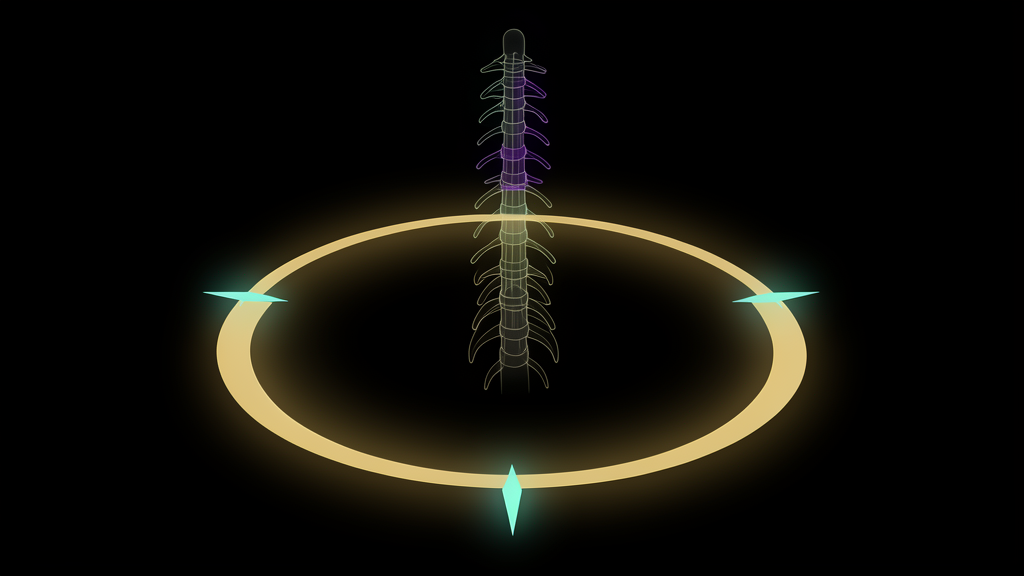
The flat wheel everyone knows — and the structure standing underneath it, which is what this Field Note is about.
People who love astrology and people who dismiss it agree on one thing, and they are both wrong about it. They agree that the signs and the houses are astrology — that Aries and Scorpio and the twelve houses are the content, the substance, the thing that would have to be true. So when they hear that this instrument doesn't score signs or houses at all, the believer feels robbed and the skeptic feels vindicated. Both think we threw away the building.
We didn't. We found the foundation the building was sitting on — and it turns out the foundation is real stone, quarried from the Earth itself, while a good deal of the upper story was painted on. This Field Note is the honest map of which is which: what has a skeleton, what is a naming convention, and the one new bone we found that nobody had named before.
IWhy the signs cannot be the content
Start with the fact that surprised us most, because it is not an opinion — it is a small theorem, and anyone with the ephemeris can check it in an afternoon.
The number this instrument actually reads is the field: take the ten bodies, treat each as an arrow on a wheel, and add the arrows up. The length and direction of that sum — how strongly the chart gathers, and which way it leans — is the signal. Now do the one thing that defines a "sign": change where you start counting. Tropical astrology starts at the spring equinox; sidereal astrology starts about twenty-four degrees away, against the fixed stars. Slide every planet from one system to the other and re-add the arrows.
The sum does not move. Not approximately — exactly, to the last decimal a computer will print. Rotating the whole wheel rotates every arrow together, and a shape doesn't change when you turn the paper it's drawn on. We verified it on real charts: swap the zodiac and the field's strength is identical to four decimal places.
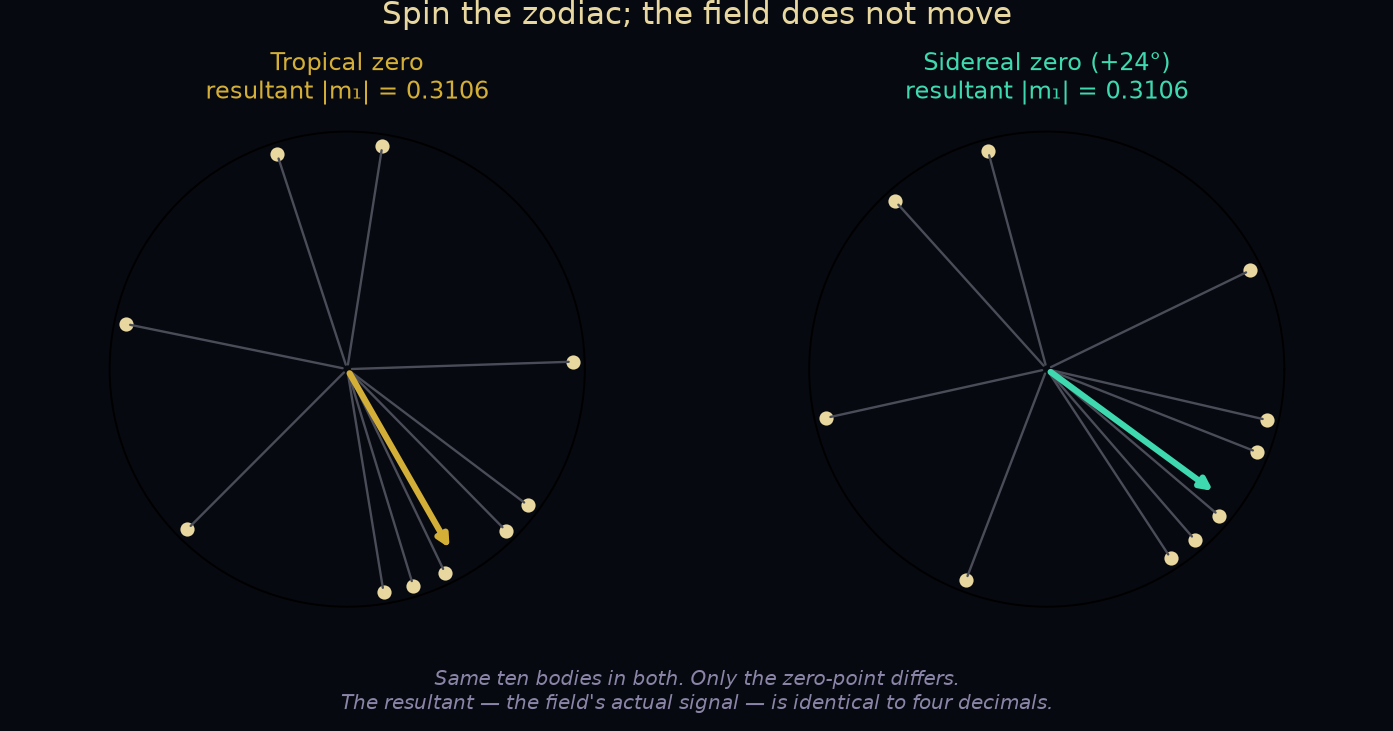
Sit with what that means. If the choice of sign-system changes nothing we measure, then the signs cannot be carrying the measurement. They are names for where the arrow points — a vocabulary laid over a field that was already there and doesn't care what you call its regions. That is not an insult to the signs; it is a precise account of their job. A map's place-names are real and useful, and they are not the terrain.
Because the field is built from the angles between bodies, and angles are unchanged by rotating the whole wheel, every scored quantity is identical across tropical, sidereal, any house system, any zero-point. The sign is provably a frame — a naming layer — and cannot be the content. This is the one genuinely new structural result here, and it settles the "you threw away the signs" objection by showing there was nothing to throw away: the signs were never in the measurement to begin with.
Change the zodiac and nothing we measure moves. The signs are the map's names, not the terrain.
IIThe fourfold that is real: the Earth's own tilt
So if the signs are names, is there any real skeleton under them at all? Yes — and it is the part the tradition got most right, because it is built into the planet.
The Sun's height above the equator over a year traces one clean wave. That wave has exactly four turning features: two places where it crosses zero (the equinoxes) and two where it reaches its farthest and turns back (the solstices). These are the four cardinal points — the corners the whole zodiac is pinned to. And here is the quiet marvel: the height of the wave at the solstice is the tilt of the Earth's axis, 23.44 degrees. No choice, no convention, no fitting. Four corners fall out of one number the planet hands you.
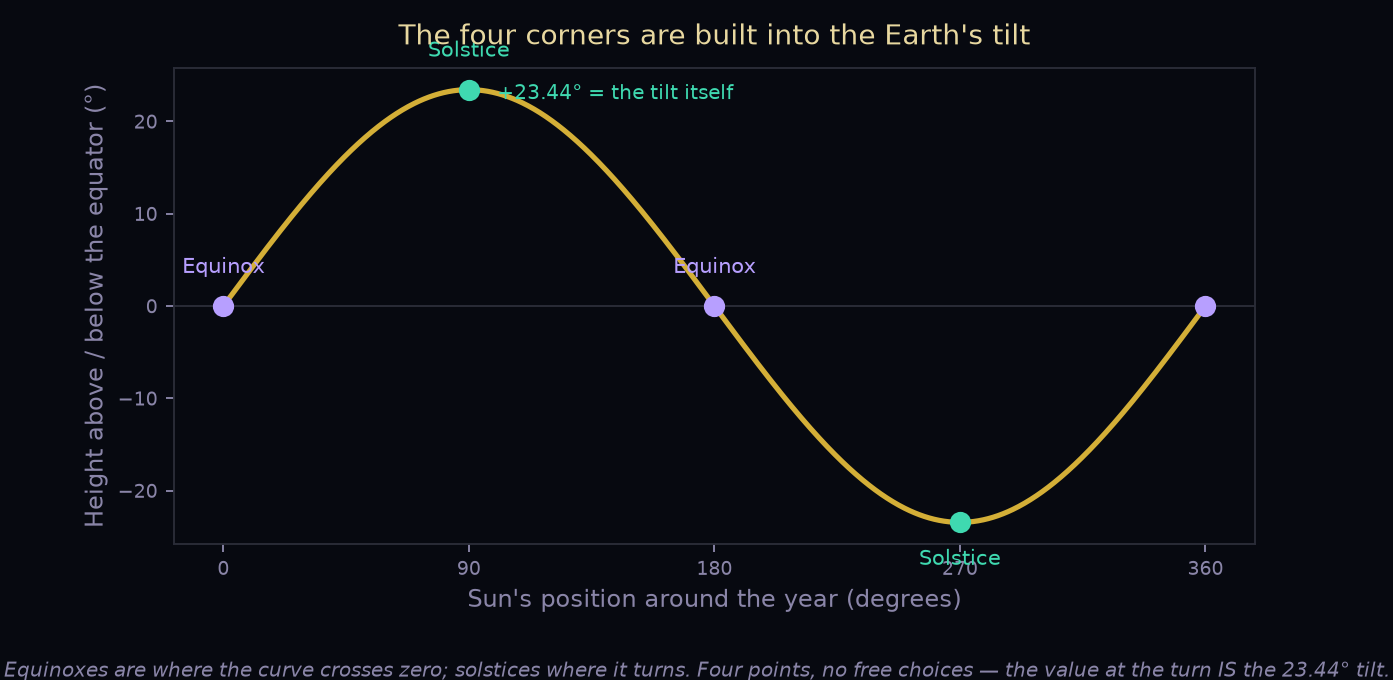
This is why the tropical zodiac has real coherence where it does: it is anchored to the seasons, which are the Sun–Earth relationship itself. Spring's fresh start landing on the first cardinal point isn't arbitrary poetry — it's the same physical cycle that governs everything that grows here. The fourfold is stone. It came out of the ground.
The houses reach for the same kind of thing from the other direction. Where the signs are the Sun's yearly path, the houses are your local sky at the moment of birth — the horizon, the point overhead, above and below the earth. They are the tradition's honest attempt at the here-and-now, up-and-down dimension. Their four angles — the rising point, the setting point, the top and bottom of the sky — are a real cross too, driven by the daily spin and your latitude. Two different fourfolds, one seasonal and one local, both built from real astronomy.
IIIThe twelvefold: a container, not a decree
The fourfold is stone. But why twelve? Here the honest answer is neither "it's sacred" nor "it's arbitrary" — it's arithmetic, and it's rather beautiful.
The tradition sorts the twelve signs three independent ways. Polarity alternates every other sign (positive, negative). Modality — cardinal, fixed, mutable — repeats every three. Element — fire, earth, air, water — repeats every four. Each of these is a clean cycle around the wheel: one full turn every 2 signs, every 3, every 4.
Now ask the practical question a builder would ask: what is the smallest wheel that can carry all three of those cycles with whole, equal cells — no sign split down the middle? The answer is the least common multiple of 2, 3, and 4, which is twelve. Not ten, not eight, not thirteen. Twelve is the smallest number of divisions that lets polarity, modality, and element all land on clean boundaries at once.
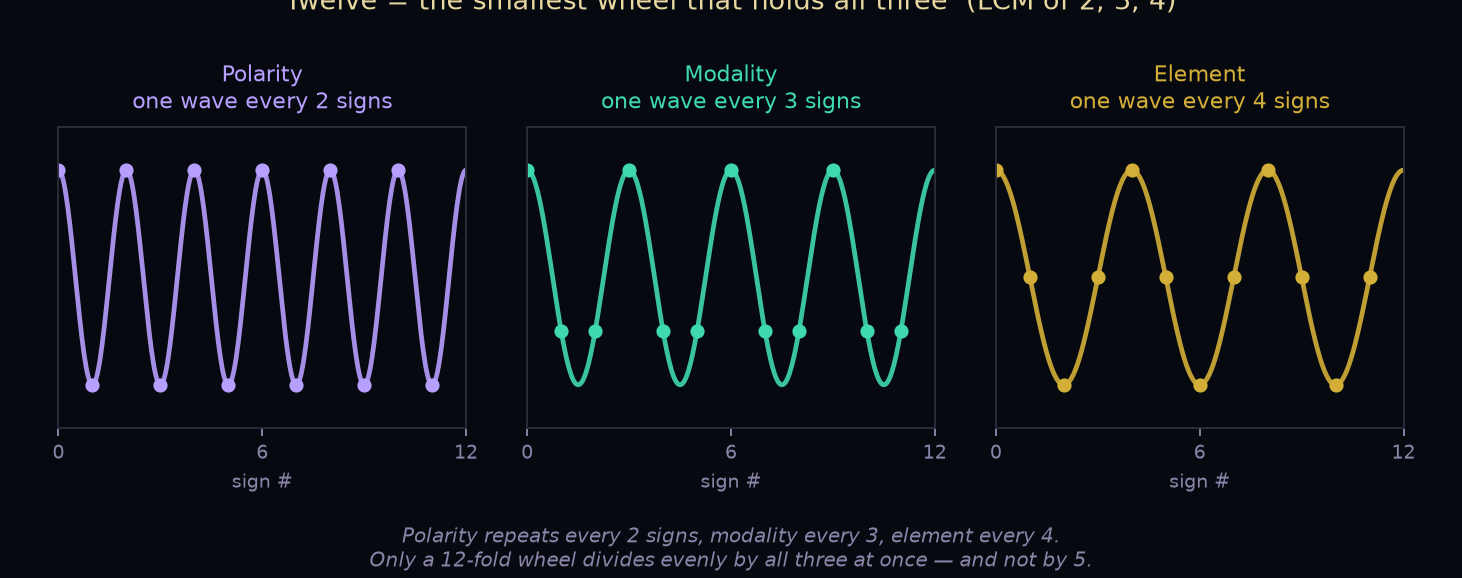
There's a satisfying check hidden in this. If twelve were arbitrary, you'd expect the tradition to have a fourth attribute system somewhere. It doesn't — and the arithmetic says why: twelve divides cleanly by 2, 3, 4, and 6, but not by 5. So a "quintile" sign-system was never available; the container has no room for it. The math predicts the exact set of attribute systems the tradition actually built, and stops where the tradition stops.
That the sign attributes are cycles of the wheel — that polarity, modality, and element are the 2nd, 3rd, and 4th "harmonics" of the zodiac — is the heart of harmonic astrology, laid out by John Addey in Harmonics in Astrology (1976) and carried forward by Charles Harvey, David Hamlin, and others. We did not discover this. What we can add is that it is the same harmonic language our field already speaks: the way aspects (trine, square, sextile) are those same cycles is built into how we read a chart. The twelvefold isn't foreign to the instrument — it's a low, simple set of the very harmonics we measure. Addey saw the music fifty years ago; we're pointing out that our instrument plays in the same key.
IVThe one new bone: the breath
Everything so far is either a re-derivation of what careful astrologers already knew (the harmonics) or a sharpening of it (the tilt as the source of the cardinal cross). The frame theorem in Section I is genuinely ours. And there is one more thing that is ours, because it lives in a dimension the flat wheel throws away entirely.
Every chart is drawn flat, as if the planets sat on a single tabletop. They don't. Some ride a little above that plane, some below. The flat wheel simply cannot see this — it's the one direction a circle on paper has no room for. We built a measure for it and called it the breath: how strongly the whole field lifts up off the flat plane into its third dimension.
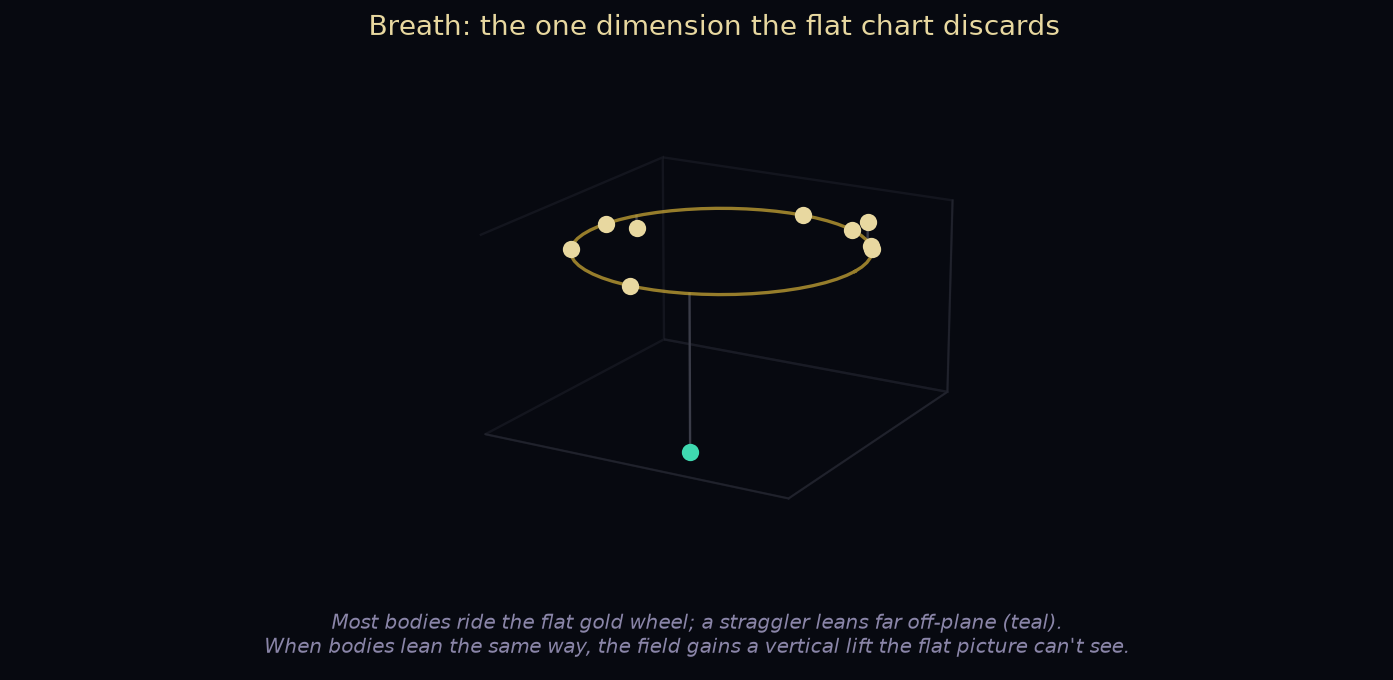
Two things make the breath worth its own name. First, it is independent — it isn't a restatement of how gathered or scattered a chart is; a tightly-gathered chart can lie flat and a loose one can stand tall. It tells you something the flat picture genuinely cannot. Second, and more human: two charts can stand equally tall for opposite reasons. In one, a single deep body does all the lifting while the rest lie flat — a soloist. In another, several bodies lean the same way and add up to a lift larger than any one of them — a chorus. Same height, different architecture. That distinction is real, measurable, and new.
Now the honest part, because it's the part that makes this a Field Note and not a sales pitch. We wondered whether the breath was secretly the tradition's own idea of the vertical — the old notion of a planet "out of bounds," straying past the Sun's own limit of height. We checked. It isn't: the breath and out-of-bounds barely correlate at all. The tradition sensed that the flat chart was missing a vertical — it reached for it with out-of-bounds planets, and with the up-and-down of the houses — but it never quite caught the clean version. The instinct was right. The specific capture was something else.
Real: the breath is a frame-invariant number computed from the bodies' true off-plane positions, and the soloist-vs-chorus split is a plain fact about which bodies carry the lift. Offered: what a tall soloist life or a tall chorus life is like to live is a mirror we hold up, not a forecast we issue. The measuring ends at the geometry; the meaning is offered for reflection, never as prediction.
VWhat has a skeleton, and what doesn't
Here is the whole map in one place, stated as plainly as we can.
- The fourfold is stone. The seasonal cardinal cross and the local angles of the houses come straight from the Earth's tilt and its daily spin. Real astronomy, no convention.
- The twelvefold is a container. Twelve is the smallest wheel that holds polarity, modality, and element with whole cells — the harmonic structure John Addey mapped, and the same harmonics our field reads.
- The signs' names are a frame. Provably: change them and nothing we measure moves. Legitimate as vocabulary, never as the content.
- The breath is a new bone. The vertical dimension the flat chart discards — ours, independent, and not the tradition's out-of-bounds after all.
- The fortune-telling has no skeleton. Every test we've run for "this sign or placement predicts that outcome in a life" has come back empty. The bones are real. The claim that the bones foretell a life is the part that dissolves.
So the objection — "you discarded signs and houses" — has an answer we're glad to give. We discarded nothing that was doing work. We showed the signs were a naming-frame, credited the harmonic skeleton to those who found it, added one honest new dimension, and drew a bright line at the place where measurement ends and meaning is only offered. What's left standing is more solid than what we started with, not less. The building was always resting on the Earth. We just went down and looked at the foundation.
The bones are real and old and mostly borrowed. What's new is the proof that the names are only names — and one dimension nobody had measured.
The seasonal points themselves — Position of the Sun
The harmonic reading of the zodiac — John Addey, Harmonics in Astrology (1976); overview at Astrodienst — Harmonics
The precession that slowly slides sidereal names off the seasons — Axial precession