The Moon Doesn't Sit. It Breathes.
We went looking for the lunar node in the one place every tradition told us to look. It wasn't there. What we found instead is stranger, more beautiful, and — best of all — true.
A Field Note from Scalar Flower. With computational collaboration by the Hermes agent (Nous Research).
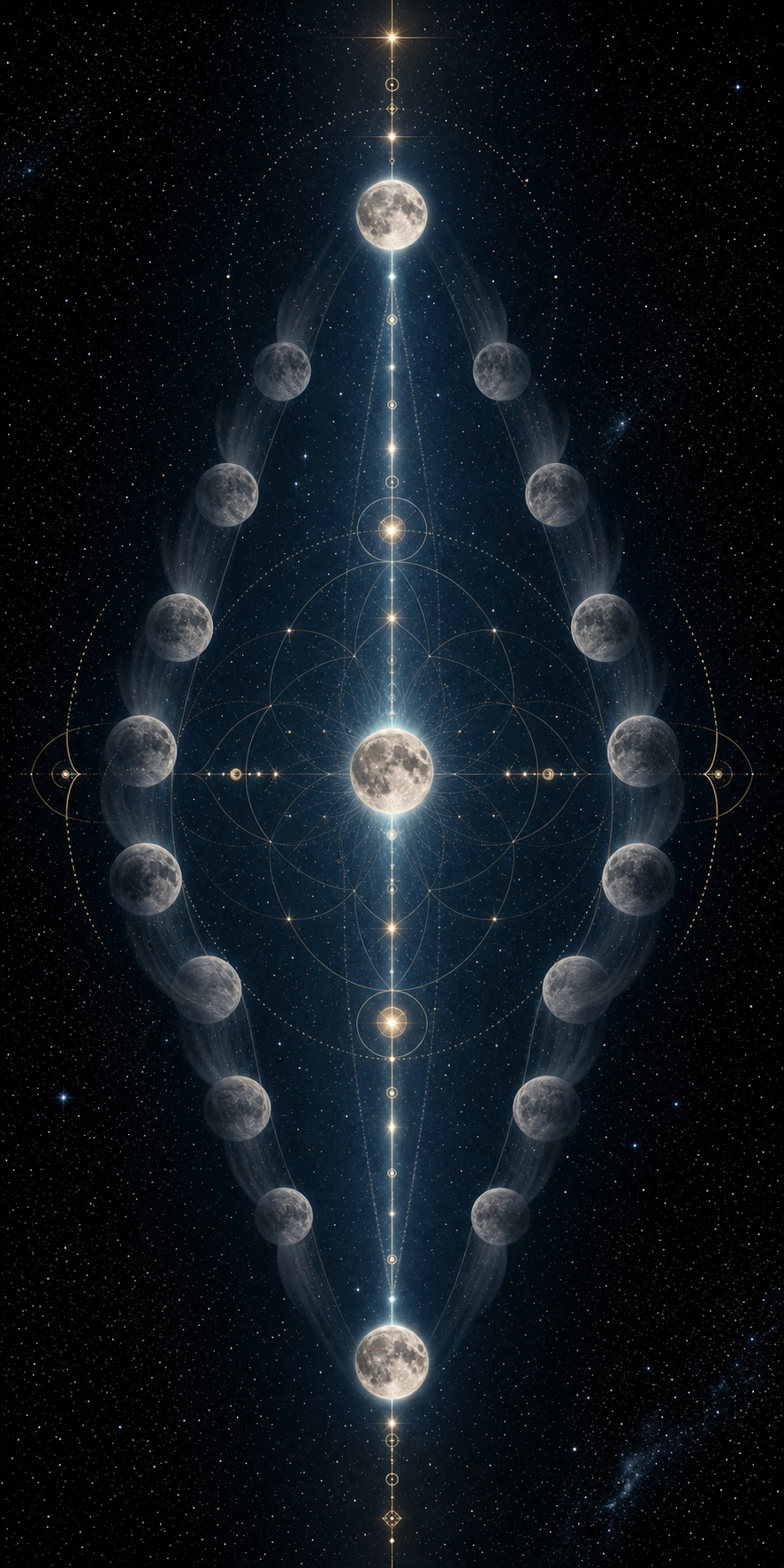
The node as a vertical axis, not a heading on a wheel — the Moon's path opening and closing above and below the plane.
There is a moment in any honest investigation where the thing you set out to prove quietly refuses, and something you weren't looking for taps you on the shoulder instead. This is the story of one of those moments — the single finding that did the most to reshape how the Scalar Flower reads a chart. We call it the Vertical Breath.
It begins with the oldest object in lunar astrology: the node.
The hinge of the whole system
Every few thousand years a culture rediscovers that the Sun and the Moon do not travel the same road. The Sun walks the ecliptic — the flat plane of the year. The Moon's path is tilted off that plane by about 5.1°, so the two roads cross at exactly two points. Those two crossing points are the lunar nodes. In the Vedic tradition they are Rāhu and Ketu — the head and the tail of the dragon, the points where eclipses are born, because an eclipse can only happen when a New or Full Moon lands near a node.
In the architecture of the Scalar Flower, the node is not one feature among many. It is the hinge — the single physical junction where our two systems are allowed to touch.
The Scalar Flower is a dual-system model. One half (System A, the Flower itself) is spatial — it answers where in the fixed sky are you? It is anchored to the Galactic Center, divides the zodiac into the 27 nakṣatras, and places Mūla nakṣatra at the galactic root. The other half (System B, the Planetary Waveform Inference Model) is temporal — it answers where in the wave are you? It treats the planets as frequencies sounding against the Sun, sampled through the 28 lunar mansions, night by night.
We keep these two halves deliberately apart. They are different questions and must not be allowed to quietly bleed into each other. But they are coupled at exactly one point — the nodal axis, which in physical astronomy corresponds to the draconic month. The node is the one sanctioned bridge between space and time. It is, structurally, the most important point in the entire model.
So when it came time to test, the node is where we pressed hardest. If the model had a heart, we wanted to put a stethoscope on it.
The hypothesis we expected to confirm
Here is what every tradition implies, and what we fully expected to measure: the node should govern where the Moon sits. Rāhu and Ketu are drawn on the chart wheel as a pointer — an axis of longitude, a soul-direction, a heading. The natural prediction is that as the nodes slowly regress around the zodiac (a full lap takes 18.6 years), they should modulate the Moon's longitude — pulling it toward certain signs, certain nakṣatras, certain mansions. The signal, if it exists, should live in the horizontal: in where around the wheel the Moon lands.
We pre-registered this as Test 10. We committed, in writing, before running it, to report the result whatever it turned out to be. Then we ran the numbers: a circular correlation of lunar-node longitude against nakṣatra and mansion longitude, across 8,000 years and roughly 2.9 million samples.
The result came back:
That is not a weak signal. That is not a signal at all. It is one of the flattest results I have ever seen come out of a real dataset — a correlation of essentially perfect zero, with a p-value that says the data are completely consistent with pure noise. Eight thousand years. Three million samples. Nothing.
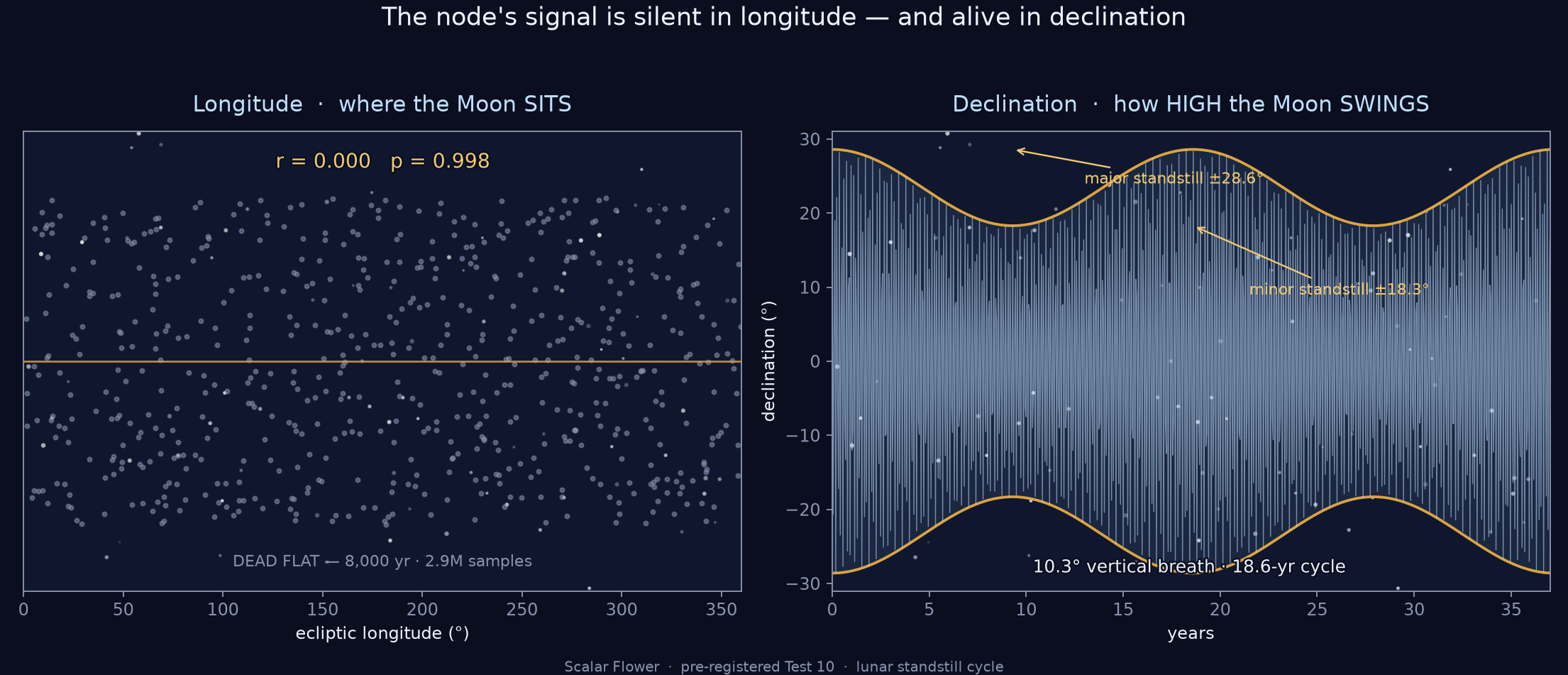
The honest thing to do with a result like that is to feel it. The node — the most important point in our entire model, the hinge the whole architecture hangs on — does not move the Moon sideways through the signs. The thing astrology has drawn as a pointer for two thousand years points at nothing measurable.
For about an hour, that felt like the floor falling out.
Then we looked up instead of around
The mistake, it turned out, was the assumption baked into the question. We had asked where around the wheel? — a question about longitude, about horizontal position. But the nodes are defined by the tilt of the Moon's orbit. They are an out-of-plane object by their very nature. Why would we expect an out-of-plane cause to show up in an in-plane measurement?
So we changed the axis of the question. Instead of asking how far around, we asked how far up and down — the Moon's declination, its height above and below the ecliptic plane. And the dead-flat signal came roaring to life.
Over each 18.6-year nodal cycle, the Moon's declination range opens and closes like a breath. At one extreme — the major standstill — the Moon swings a full ±28.6° above and below the celestial equator, riding higher and dipping lower across the month than at any other time. Then, over the following ~9.3 years, that range slowly contracts to the minor standstill at ±18.3°, where the Moon's monthly arc is at its most shallow. Then it opens again. Out and in. Open and closed. A 10.3° vertical breath with a period of 18.6 years.
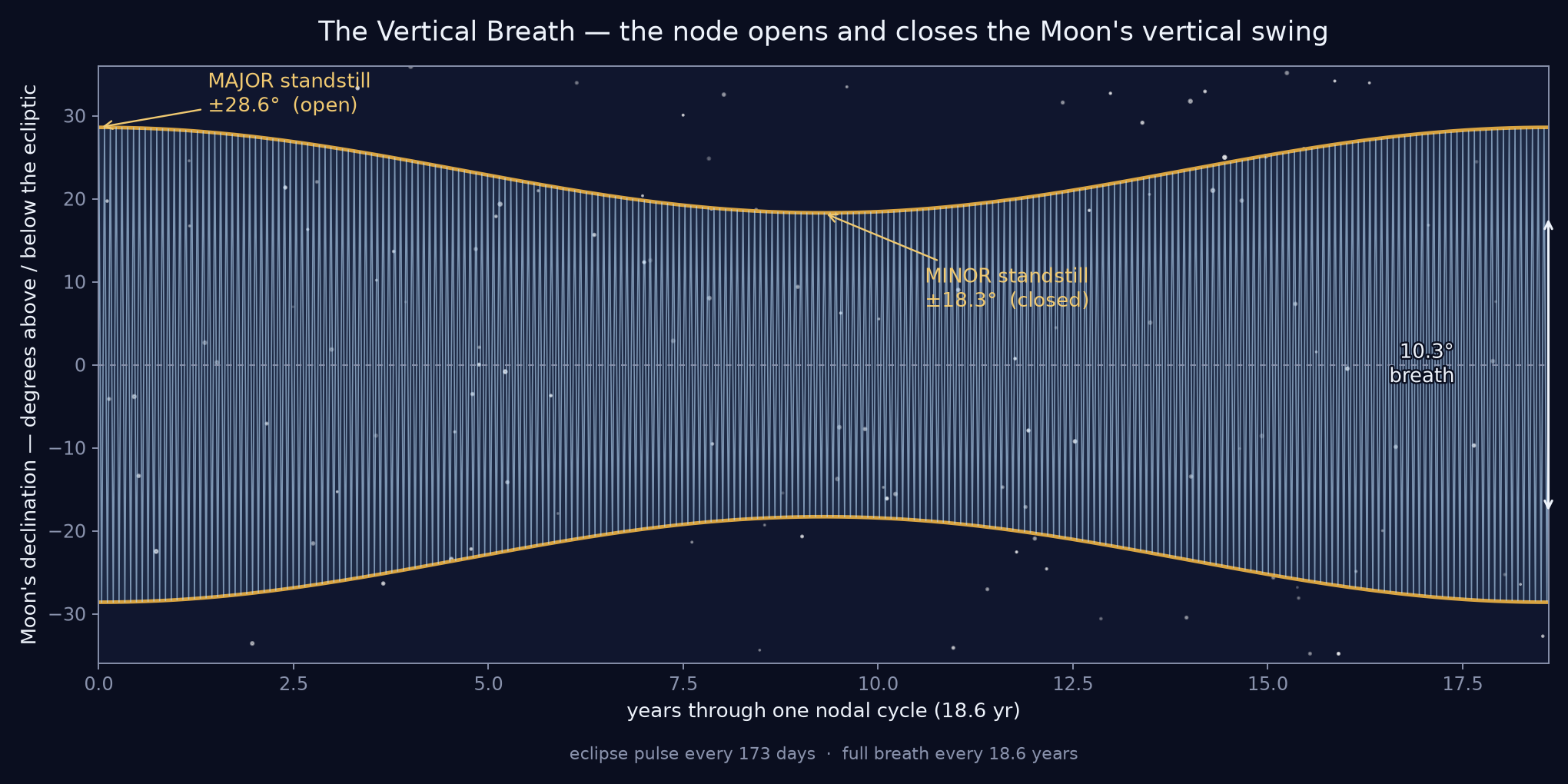
This is not a Scalar Flower invention. It is the lunar standstill cycle, known to astronomers, almost certainly tracked by the builders of the great Neolithic stone alignments, who oriented their monuments to the Moon's extreme rising and setting points. What our testing did was something different: it told us, with statistical force, that this is where the node's real action lives — and that the longitudinal "pointer" is a fiction.
The node does not move the Moon sideways. It makes the Moon breathe.
Why a "failed" test is the best thing that happened to us
It would have been easy — and dishonest — to bury Test 10. We had a beautiful model with a node at its heart, and the most obvious test of that node returned zero. The temptation in this field is overwhelming: quietly drop the null, keep the pretty story, never mention the place where the sky said no.
We did the opposite. We labeled Test 10 a confirmed null in longitude, and we let it relocate the finding rather than kill it. The signal was real; we had simply been measuring along the wrong axis. The membrane discipline we hold ourselves to — three clearly separated tiers of claim — made this possible:
The Moon's declination breathes ±10.3° over 18.6 years, from a ±28.6° major standstill to a ±18.3° minor standstill. You can check this against any ephemeris. We are not asking you to believe it; we are asking you to verify it.
The node couples our two systems out-of-plane, in declination, not in-plane in longitude. This is the structural correction Test 10 forced on us — and the longitudinal "pointer" reading was retired.
A node placement is about the amplitude of your departure from the plane and the cadence of your return — not a fixed compass heading. Offered as correspondence, a mirror for reflection, never as prediction.
Notice what this discipline buys you. When we tell you the node breathes, you never have to wonder whether we're seeing our own hand in the clouds — because we just showed you the test where the sky told us we were wrong, and we kept it.
What this changed in an actual reading
Old astrology reads Rāhu/Ketu as a longitudinal soul-vector: here is the direction you point, here is what you're moving toward and away from. Our own testing demolished the basis for that. So the reading changed to match the geometry.
In a Scalar Flower chart, the node is no longer a heading on a wheel. It is rendered as a vertical breathing — the lunar path bulging above and below the column's mean plane, swelling and shrinking on its 18.6-year cadence, pulsing at the 173-day eclipse tempo. A node reading becomes about two real, trackable things:
- The amplitude of departure — how far you tend to leave the plane.
- The cadence of return — the rhythm by which you come back, on the standstill cycle (18.6 years) and the eclipse pulse (173 days).
That is something a fixed compass heading never had: an actual tempo you can track in time. The node went from a static arrow to a living rhythm — and it did so because a test failed and we refused to hide it.
The company it keeps
The Vertical Breath does not stand alone. It is one of four structural findings that survived our eleven pre-registered tests — and it sits beside another that matters for why the node has to behave this way at all.
When we tested whether the 27 spatial divisions (nakṣatras) and the 28 temporal divisions (mansions) interfere with each other, the answer was a clean no. Twenty-seven and twenty-eight are coprime; they realign only once every 756 steps; across millions of samples they are statistically orthogonal to the measurement floor. They live, in effect, in perpendicular dimensions — which is exactly why the spatial and temporal systems don't smear into one another, and exactly why the node's coupling has to happen out-of-plane, in the one direction left over.
Two perpendicular clocks. A node that breathes in the third, vertical direction. The architecture is consistent, and not one piece of it required a magic number to be true.
The sky, told honestly
I want to be clear about what I think the real discovery here is. It isn't the standstill cycle — astronomers have known that for a long time. The discovery is methodological. It's the demonstration that you can take a beautiful, ancient, meaning-rich idea, subject its central claim to a brutal, pre-registered, multiple-comparison-corrected test, watch that claim return a flat zero — and end up with something better than you started with, because you let the data move you instead of moving the data.
The node breathes. We can prove it. We can also prove that the thing everyone assumed about it — that it's a pointer — doesn't survive contact with 2.9 million samples. Both of those are gifts. The Scalar Flower is built out of gifts like that: places where we expected one thing and the sky honestly handed us another.
A living chart you can turn in your hands. Not a fortune. A field of choice.
The lunar nodes (Rāhu/Ketu, eclipses, draconic month) — Lunar node
Orbit of the Moon (sidereal & synodic months) — Orbit of the Moon