What the Geometry Says About Jyotiṣa
With computational collaboration by Claude (Anthropic) and the Hermes agent (Nous Research).
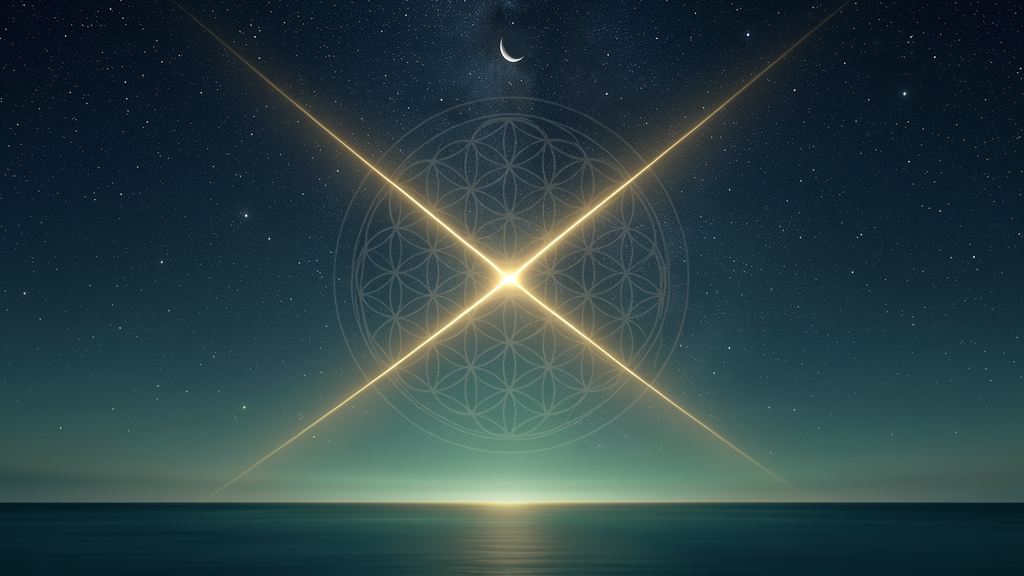
The two great circles of the sky — the Sun's path and the Moon's tilted orbit — cross at the lunar nodes. That crossing is real astronomy, and it is where our instrument and Jyotiṣa meet.
Jyotiṣa — the “science of light,” the astrology of the Indian subcontinent — is among the oldest continuously practiced sky-traditions on Earth. It carries a vast, intricate inheritance: the twenty-seven nakṣatras or lunar mansions, the lunar nodes Rāhu and Ketu, a sidereal zodiac anchored to the fixed stars rather than the seasons. When we built the Scalar Flower — a wave-field instrument that begins by proving the part of a chart that does not depend on belief — an honest question followed almost immediately: what does our geometry actually say about this tradition?
The temptation is to answer too warmly (“the math proves the ancients right”) or too coldly (“it is all convention”). Both are over-claims. The truthful answer is more precise, and more interesting than either: the geometry confirms some of what Jyotiṣa rests on, stays silent on most of it, and — crucially — is indifferent to the very thing the two traditions seem to argue about most. Let us hold the waterline visible the whole way down.
“The lattice registers; we do not claim it transmits.”
First, the thing everyone expects us to settle — and doesn't
Western and Vedic astrology are popularly framed as divided over which zodiac is correct: the tropical zodiac, tied to the equinoxes and seasons, versus the sidereal zodiac, tied to the fixed stars. The two now differ by about 24° — roughly a full sign — an offset called the ayanāṃśa. Surely, one imagines, a mathematical instrument could referee the dispute.
▶ Read deeper — the math
It cannot — and that is itself a theorem, not a dodge. The structural quantities the Scalar Flower reads (the hub, the moment spectrum, the chorus) are built only from the differences between body positions. Shifting from a tropical to a sidereal frame at a given instant adds the same constant to every longitude. A quantity built from differences cannot feel a constant added to all of its inputs — it is rotation-invariant, exactly as a melody is unchanged by transposing every note. We checked this against the live ephemeris on real charts: the hub computed in the tropical frame and in the sidereal frame agrees to fifteen decimal places. The difference is zero to the limits of the machine.
The invariant geometry is indifferent to the choice of zodiac frame. Tropical and sidereal produce bit-identical hubs, moment magnitudes, and chorus structure, because the swap is a single global rotation and the invariants are rotation-invariant. The instrument literally cannot prefer one zodiac over the other.
So the geometry does not validate the sidereal zodiac — it declines the question. What, then, does sidereal astrology get right? Not something in the numbers, but something in the names. If your interpretive vocabulary is anchored to particular stars — "the Moon in Mūla, at the root, the heart of the galaxy" — then to keep that vocabulary coherent across centuries you must track the actual stars, which is precisely what a sidereal frame does. Tropical degrees drift away from their namesake constellations at about a degree every seventy years; sidereal degrees do not. The case for sidereal is not that the geometry demands it. It is that a star-named symbolic language should be read against the stars it names. That is a real and defensible point — and it lives entirely on the interpretive side of the seam, never the proven side.
The lunar nodes: where astronomy and Jyotiṣa genuinely agree
Now the strongest point of real contact. Jyotiṣa gives the lunar nodes — Rāhu (north) and Ketu (south) — the status of full planets, grahas, treating them as among the most consequential points in the chart. To a modern eye this can look like superstition: the nodes are not bodies, they are mathematical points. But they are not arbitrary points.
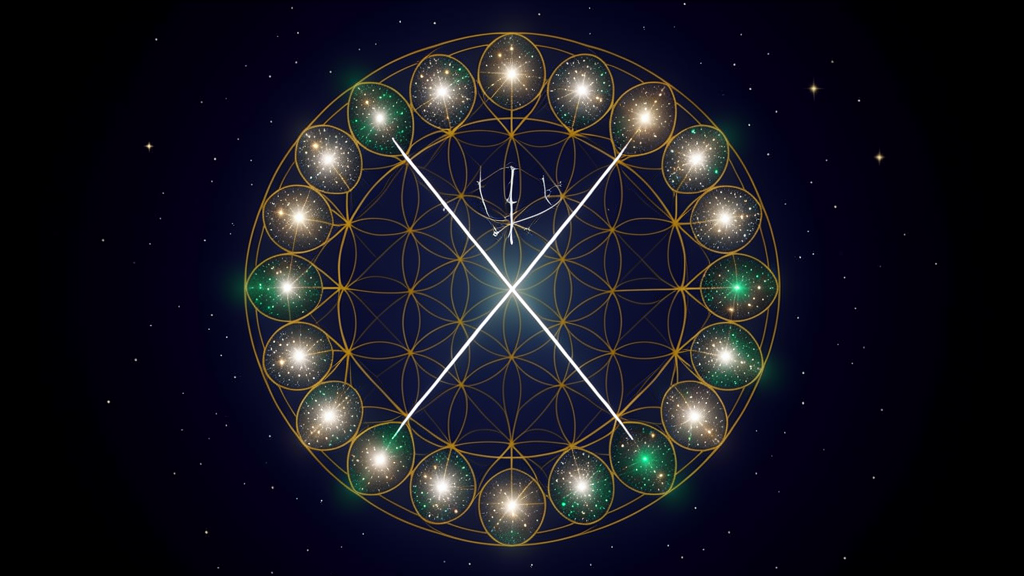
▶ Read deeper — the node's vertical rhythm
The Moon's orbit is tilted about 5° from the ecliptic, the Sun's apparent path. Two tilted circles cross at exactly two points — and those are the nodes. They are where eclipses happen, the only places the Sun, Moon, and Earth can fall into a line. The nodal axis is the one genuinely physical "doorway" in the whole chart. The Scalar Flower independently arrives at the same axis: we seat every chart on the lunar nodal line, because — unlike the Ascendant, which needs an exact birth time and swings a degree every four minutes — the nodal axis is a real astronomical line that barely moves across a whole day. It is what lets our core readings stay trustworthy even when the birth time is uncertain.
There is a subtler agreement still. When we studied how the node behaves in our geometry, we found that it does not act as a pointer in longitude — it has no preferred direction around the wheel. What it governs is the vertical dimension: the Moon's climb above and below the ecliptic plane, the slow 18.6-year breath of the lunar standstill cycle. The node is a clock for the field's vertical rhythm, not an arrow on its face. Jyotiṣa's instinct to treat the nodes as profound, axis-defining, and tied to the deep tides of a life — rather than as one more body sitting at one more degree — rhymes with what the geometry shows. We mark the rhyme as resonance, not proof.
The lunar nodal axis is real astronomy (the crossing of the Moon's orbit and the ecliptic; the eclipse line), and it is the anchor our instrument is built on. In our tests the node governs the chart's vertical rhythm (declination, the 18.6-year standstill envelope), not a longitudinal direction.
The twenty-seven mansions: a real lunar rhythm, a human naming
The nakṣatras divide the zodiac into twenty-seven equal segments — one for each day of the Moon's roughly 27.3-day journey through the stars. The choice of twenty-seven is not idle: it tracks the sidereal month closely, so that the Moon occupies very nearly one mansion per night. That is a real lunar rhythm, faithfully observed by people watching the sky for millennia. The count is anchored in astronomy.
What the count does not fix is the meaning. That Aśvinī carries the healer's swiftness, that Mūla is the root that must sometimes tear up the ground — these are the accumulated symbolic readings of a long tradition. They are not derivable from the geometry, and we do not pretend they are. Our instrument can tell you, exactly and invariantly, where the Moon falls and how its position relates to the nodal anchor. Whether that place means what the tradition says it means is a question the mathematics leaves open — offered, never asserted.
What we will not claim
Honesty cuts both ways, so here is the other half plainly. Our geometry does not confirm the daśā systems — the great planetary time-cycles by which Jyotiṣa times the events of a life. It does not confirm the predictive force assigned to planetary periods, or the specific life-outcomes read from a mansion or a house lord. It offers no support for any forecast of events. The Scalar Flower is, by design and by repeated test, not a personality predictor and not an event-oracle. It is a portrait of a field's coherence and shape, read in the free-will tradition of Edgar Cayce — a slope, not a track.
The mansion meanings, the node mythologies of Rāhu and Ketu, the symbolic weight of a sidereal placement: these are read as correspondence, a mirror for reflection. The instrument computes the geometry exactly; the meaning is a human inheritance laid alongside it, and you are always free to set it down.
Why this seam is the whole point
It would be easier to tell Jyotiṣa it was right all along, or to tell it that it was never more than convention. We have done neither, because the truth is a clean seam running through the middle: the nodal axis is real and our instrument is built on it; the count of the lunar mansions tracks a real rhythm; the choice of sidereal frame is a wise convention for a star-named language, not a fact the geometry can prove; and the meanings — the heart of the living tradition — remain offered correspondence, untouched and unvalidated by any equation.
This is not a verdict on Jyotiṣa. It is a map of which parts of it rest on geometry that holds up under any frame, and which parts rest on something older and softer than proof — the long human practice of reading meaning into the lights. Both are real. We only insist on knowing, at every moment, which one we are standing on.