The Paired Vortices of the Birth Field
On the celestial sphere, a chart's interference field is threaded by whirlpools that must come in balanced pairs summing to zero — a conservation law. Coherence sets how many; axial alignment makes them annihilate. Here is the measurement, and the fence around what it means.
A Scalar Flower research paper. With computational collaboration by the Hermes agent (Nous Research).
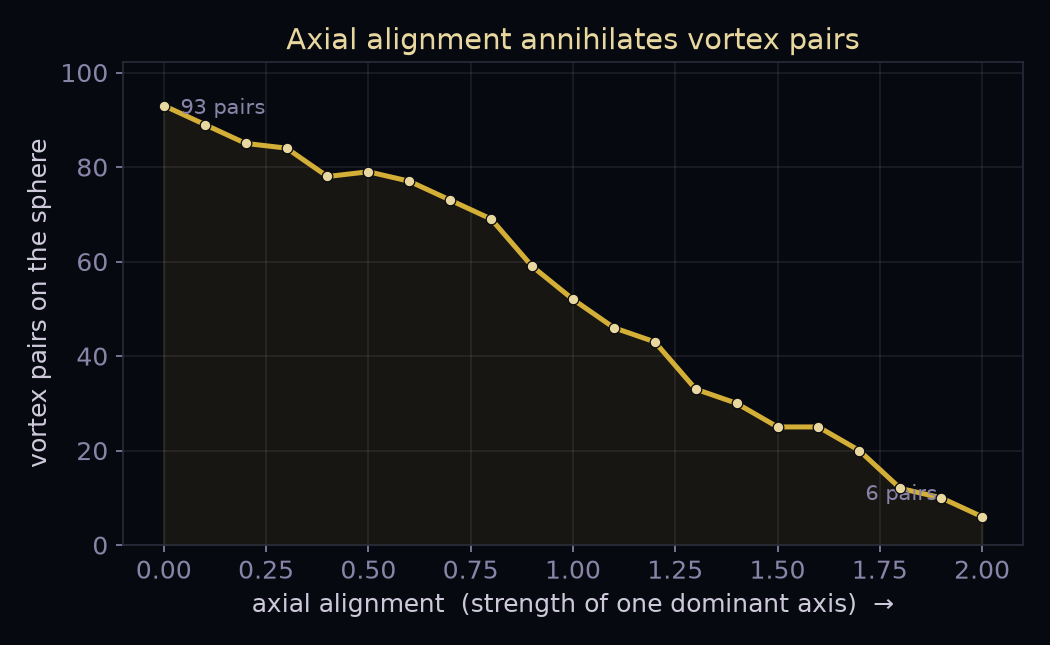
The central result: as a field is pushed toward a single dominant axis, its vortex pairs annihilate — 93 pairs collapse to 6 — while their net charge stays pinned at zero throughout.
Scalar Flower represents a birth moment as an interference field: each body is a wave, and the field is their sum. Prior work established that the field's winding number — a topological vortex at the chart's center — is predicted by retrograde count and, more strongly, by the field's coherence (the "hub"). Here we lift the field from the plane onto the celestial sphere, where longitude and ecliptic latitude are both honoured.
On the sphere the isolated planar vortex is revealed as the piercing of a vortex filament through a slice, and a conservation law appears: the phase singularities of a smooth complex field on a closed surface must sum to zero total charge. Every +1 vortex is topologically bound to a −1 partner. We confirm this numerically — the measured net charge converges to zero as resolution refines (0.91 → 0.97 → 0.99 of charts exact) — and we identify the two forces that govern the pairs: coherence sets their number (r = −0.77), and axial alignment annihilates them, watched pair by pair.
We are careful about the fence. This is a conservation law of the instrument's mathematics — established topology (Nye–Berry wavefront dislocations; the index theorem for complex fields), not new physics, and not a demonstrated fact about a human life. Each claim carries a tag marking exactly how far to trust it.
REAL — measured or proven; a number you could rerun and check. ARCH — true structure or definition; correct bookkeeping, not a discovery. INTERP — offered meaning; a lens that makes no prediction and cannot be falsified. HYP — a hypothesis we hold and are willing to test: it makes a prediction and names what would prove it wrong. All mathematics lives in the appendices, each with a plain-language twin in the body.
1The field, and the vortex we started from
Scalar Flower does not draw a wheel. It treats each of the ten bodies as a plane wave — a direction (its longitude, measured from the lunar node) and a wavelength (from its orbital period) — and sums them. The result is an interference field: a landscape of reinforcement and cancellation. ARCH
At the center of that field there can sit a phase vortex: a point where the field's phase winds a full turn as you circle it, and where the amplitude must fall to zero (the phase is undefined exactly there). The integer number of turns is the winding number. It is not a metaphor borrowed from physics — it is the same object as an optical vortex, the twist in a beam of light that carries orbital angular momentum. REAL
Earlier Scalar Flower work found that this winding is predicted, in the plane, by how many planets are retrograde and — far more strongly — by the field's coherence. That coherence is the hub: the length of the summed unit-vectors of the bodies. A high hub is a field whose voices agree into one bright tone; a low hub is a field with a quiet, contested center. Low hub predicts the vortex with striking reliability (a monotone ladder from ~100% of low-coherence charts winding to ~0% of high-coherence ones). REAL The full derivation is in the companion Field Note; this paper takes it as the starting point and asks the next question.
2From plane to sphere: the vortex is a filament
The production instrument sums plane waves on a flat disc. But a chart lives on the celestial sphere — every body has a longitude and an ecliptic latitude, a genuine point on a globe. So we rebuilt the field there: each body becomes a wave on the sphere, in its true direction, and the field is evaluated over the whole surface. ARCH (Appendix A.)
This immediately reframes the planar vortex. In two dimensions a phase singularity is a point. In three dimensions it is a line — a vortex filament, exactly as in optics and superfluids. The isolated "vortex point" we had been measuring in the plane is simply where such a filament pierces the flat slice. REAL We confirm this directly: the planar winding correlates with the spherical pair count at r = 0.60 — the flat result is a shadow of the spherical one.
3The conservation law: vortices come in balanced pairs
On a closed surface, a smooth complex field cannot carry an unbalanced set of vortices. The sum of all the phase-singularity charges over the whole sphere must be exactly zero. REAL This is a topological theorem — the index theorem for complex fields, the same family of result as the "you cannot comb a hairy ball flat" theorem. Every clockwise (+1) vortex is bound to a counter-clockwise (−1) partner. (Appendix B.)
The claim is checkable, and we checked it. Counting the singularities on a real chart's spherical field, the positive and negative charges balance. Across a population, the measured net charge is not exactly zero at coarse resolution — but it converges to zero cleanly as the grid refines, which is the signature of a real conservation law being resolved through numerical noise (filaments grazing the poles are the last to be counted correctly):
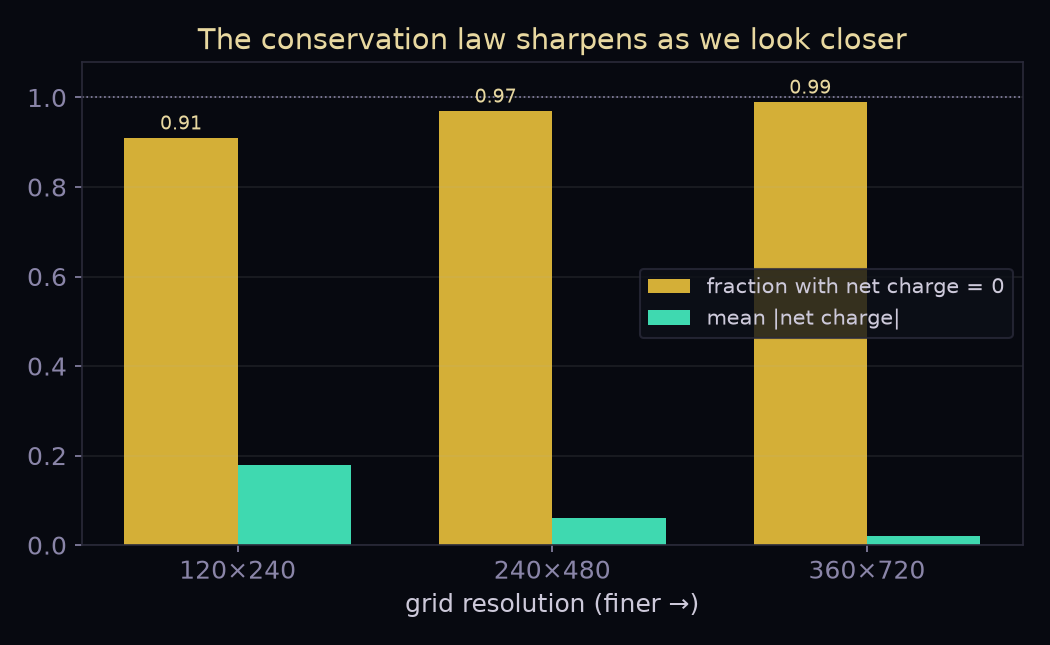
The net topological charge of the birth field on the sphere is zero. This is the conserved quantity: not energy, not a force, but a count — the signed total of the field's vortices, held at zero by the topology of a closed surface. A vortex can never be created or destroyed alone; only a +/− pair can be born or annihilated together.
4What sets the number of pairs: coherence
The conservation law fixes the balance, not the abundance. A field could satisfy "net zero" with two vortices or with a hundred. What decides how many pairs a given birth field carries? REAL
The dominant answer is coherence — the same hub as before, now even stronger on the sphere. Across charts, the number of vortex pairs anti-correlates with the hub at r = −0.77. A gathered field (high hub) is a nearly smooth sphere with few whirlpools; a deep field (low hub) is a sphere richly threaded with paired filaments. REAL
We have taken to calling this axis the field's soul-shape: not a claim to have measured a soul, but a name for the shape of how a life's field gathers. The gathered pole — one bright, unified tone — and the deep pole — a still center that many voices circle — are the two ends of a single measured axis. This is INTERP: a lens, not a prediction.
5What annihilates the pairs: axial alignment
The second force is axiality: how much the field is stretched along one dominant axis (a strong second-harmonic, opposition-like structure). We had found in the plane that axiality suppresses the vortex. On the sphere we can see the mechanism directly. Adding a controllable axial component and turning it up, we count the vortex pairs at each step. REAL
They do not simply fade. They annihilate — a + and a − filament drift together, meet, and cancel, always in twos, so the net charge never budges from zero. The pair count falls monotonically from 93 to 6 (the hero figure above). And we can follow a single identified pair to its death:
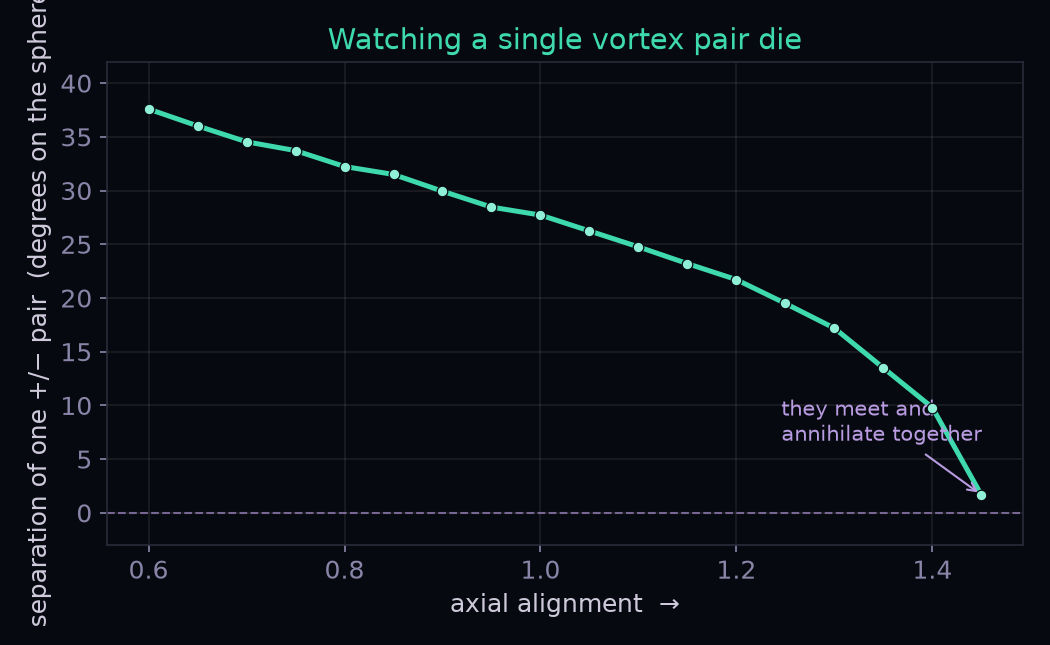
Coherence sets how many pairs a field carries; axial alignment drives them to annihilate. Both operate under the iron constraint of the conservation law: charge is only ever moved in balanced pairs. This is the dynamical picture behind the static correlation — not "fewer vortices when axial," but "watch this specific pair merge and disappear."
6The anchor is the calm line — and eclipses do nothing
The whole field is anchored to the lunar node (every longitude is measured from it), so the node is the origin of the pattern, not merely another point. Two questions follow, and both have honest, non-obvious answers. REAL
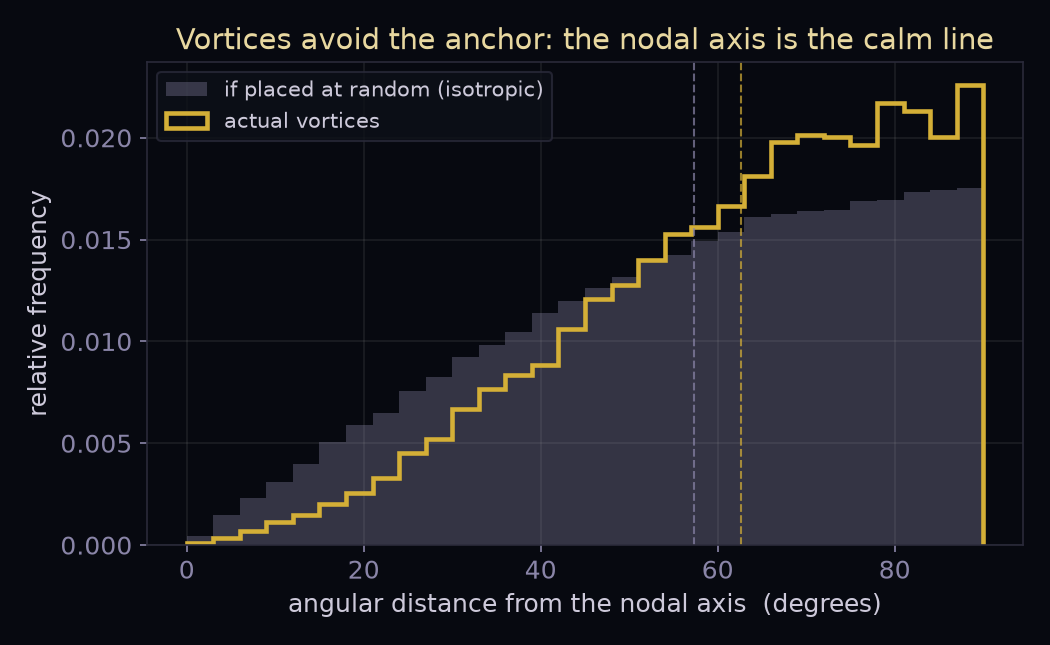
Where do the vortices sit relative to the nodal axis? Not on it. They mildly avoid it: the average vortex sits 62.7° from the node–antinode axis, versus 57.3° expected if placed at random, and they are roughly three-fold depleted within 20° of the axis. The anchor line is the field's calm axis — where coherence is highest — and coherence is what suppresses vortices. The storms gather in the belt between the poles. REAL
Do eclipse-season charts — Sun and Moon tight on the node — carry anomalous vortex structure? No. The correlation of pair count with the luminaries' proximity to the node is essentially zero (r = +0.03 for the Sun, +0.005 for the Moon). This is exactly where the tradition asserts a charged, fated condition — and our topology finds nothing special. We report the null as plainly as the finding. REAL
Alongside the eclipse null, the following candidates were tested and did not survive as independent predictors of the vortex: grand trines, stationary fast planets (Mercury/Venus/Mars), t-squares, and Sun-conjunction counts. Two of these the authors expected to matter. They did not. The map is honest about its empty regions.
7The crossing — and the wall we do not breach
Everything above is REAL or ARCH: measured structure, or established topology correctly applied. Now we mark, explicitly, the two lines we will not let the beauty of the result blur.
The "waves" here are abstract phasors we chose; the field has no electric or magnetic component, no charge, no energy. The conserved quantity is topological — a count held at zero by the geometry of a closed surface — and it lives in the mathematics, not in any physical force. Any reading of this result as scalar-longitudinal EM, Whittaker potentials, or a conserved Maxwell four-current is HYP with no support in this model, and we do not assert it.
We advance a single falsifiable claim: that a field's soul-shape — its position on the gathered↔deep axis, i.e. its vortex-pair richness — corresponds to something real and describable in the life of the person born into it. HYP
This is not yet shown. It would be tested by the same pre-registered, blind, forced-choice protocol described in our companion white paper: decoy-matched readings, criteria locked before data, the null committed to in advance. Until that test runs, the soul-shape reading is a lens we hold and are willing to be wrong about — not a fact about anyone's life.
8What was discovered, in one paragraph
A birth moment, sung as ten overlapping waves on the celestial sphere, is threaded by phase-vortex filaments that must occur in balanced +/− pairs summing to exactly zero — a topological conservation law, confirmed numerically. How many pairs a field carries is set by its coherence (the soul-shape axis, from gathered to deep); axial alignment annihilates the pairs, watched one at a time, always in twos. The nodal anchor is the field's calm line, which the vortices avoid, and the tradition's charged eclipse condition produces no anomaly. This is a real, elegant law of the instrument's mathematics. Whether it reaches into a human life is the next honest question — written, and unrun. REAL INTERP HYP
AAppendix — the spherical field
Plain twin: each planet is a wave pointing in its own direction on the globe; the field is their sum, read over the whole sphere.
λ_b = (longitude_b − node) in radians ; β_b = ecliptic latitude_b
k_b = 2π / wavelength_b // keplerian, from orbital period
F(r) = Σ_b exp( i · ( k_b (n_b · r) + λ_b ) ) , r ∈ S²
The winding / topological charge in a small loop is the number of times the phase F wraps a full turn around that loop.
BAppendix — the conservation law
Plain twin: on a closed surface, the whirlpools must balance to zero. You cannot have a lone one.
(index theorem; cf. Poincaré–Hopf. A smooth complex scalar field on S²
has zero total phase-singularity index.)
Measured: net charge → 0 as the grid refines. Fraction of charts with exactly zero net charge = 0.91, 0.97, 0.99 at grids 120×240, 240×480, 360×720; mean |net| = 0.18, 0.06, 0.02.
CAppendix — the two governing forces
Plain twin: coherence (hub) sets how many pairs; axiality (one-axis stretch) annihilates them.
harm2 = | mean_b exp( i · 2 (λ_b) ) | // axiality (2nd harmonic)
corr( pair_count , hub ) = −0.77 // coherence sets abundance
corr( pair_count , harm2 ) = −0.32 // axiality annihilates (in the wild)
axial sweep: pairs = 93 → 6 as α: 0 → 2 // driven annihilation
tracked pair: separation 37.6° → 1.7° → annihilate (net charge conserved)
DAppendix — anchor and nulls
fraction within 20° of axis: observed 0.022 vs null 0.061 // ~3× depleted
corr( pair_count , Sun–node proximity ) = +0.03 // eclipse: null
corr( pair_count , Moon–node proximity ) = +0.005 // eclipse: null
falsified as independent predictors: grand trines, fast-planet stations,
t-squares, Sun-conjunction count