Beyond the Opposition
Oppositions, conventional aspects, and a higher-order way of reading the same chart.
Scalar Flower · the instrument, read honestly
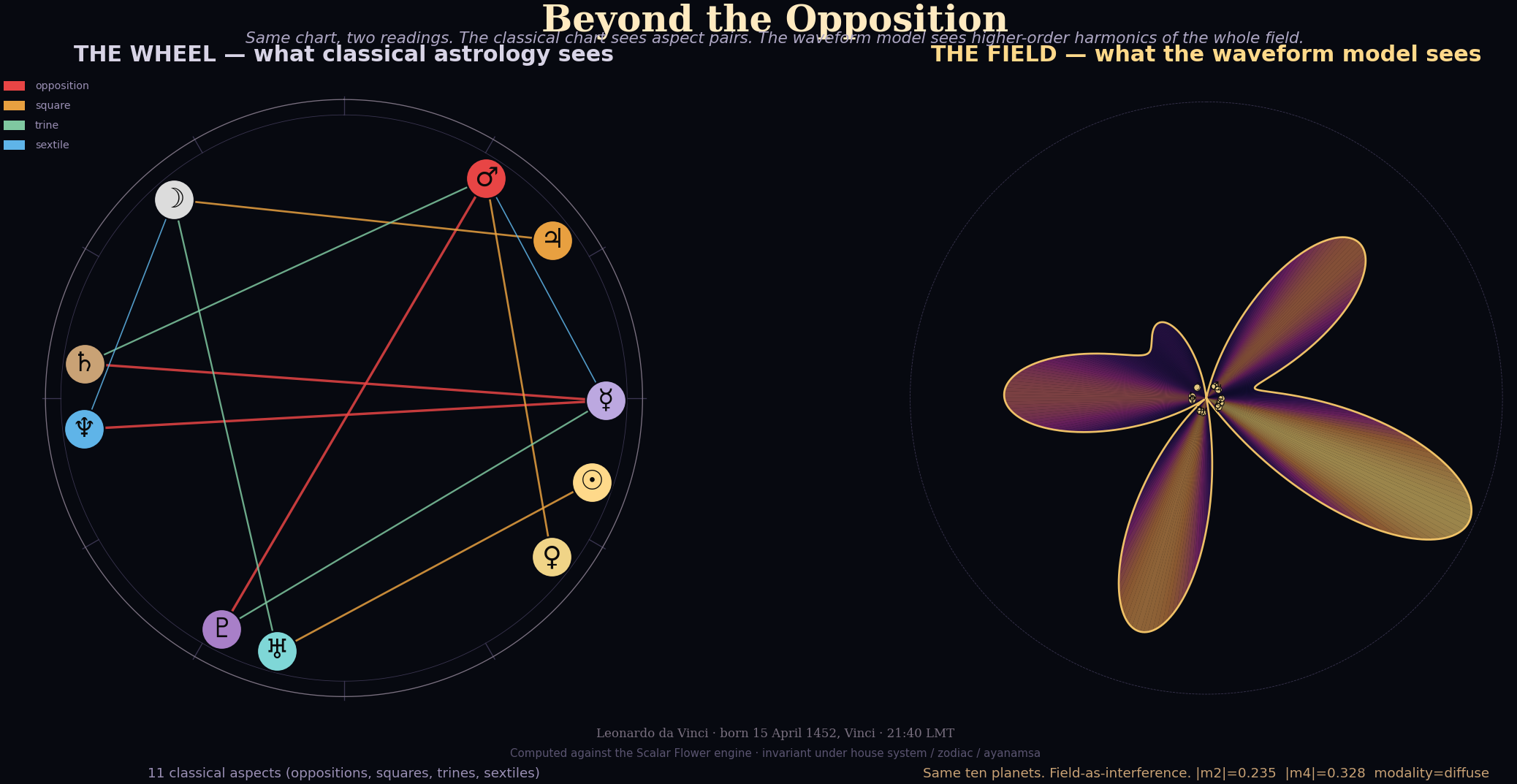
Leonardo da Vinci, born 15 April 1452. Left: the wheel, with every classical aspect drawn — three oppositions, three squares, three trines, two sextiles. Right: the same ten bodies read as one field. The second picture is the first picture, told in a different language.
I have been reading charts for four decades. Long enough that the vocabulary stopped being vocabulary and became something closer to eyesight. You see a Sun opposite Saturn and you feel the weight of it before you have finished the sentence. You see a stellium and you feel the gravity viscerally.
The Scalar Flower does not know what an opposition is. It was never taught. It takes the ten planets, finds their longitudes relative to the lunar node, and asks a different question: not which pairs are tense, but what shape does the whole set make. The answer comes back as a spectrum of harmonics — how strongly the field folds in one, in two, in three, in four, in five, in six.
What I want to do here is start with what an opposition actually is. Then show what other aspects are. Then show what the new reading sees. Then five famous charts, read both ways.
1 What an opposition is
Two planets are in opposition when they are 180° apart in the zodiac. A Sun at 5° Aries and a Saturn at 5° Libra are in opposition. The classical reading, the one I was taught, is that the two are in conflict: the Sun wants to shine, Saturn wants to deny; or one wants to expand, the other to limit. The opposition is the place where two opposing forces meet and have to be held at once. ARCH
Astrologers do not treat the opposition as a knife-edge point. They give it an orb — a margin of error. Two planets 178° apart are still in opposition; 175° is a wide opposition, but still an opposition. The orb is what lets the chart breathe. Throughout this piece I have used 8° for oppositions, 6° for squares and trines, and 4° for sextiles. These are the orbs the engine uses for aspect work.
The classical reading has been around for about two thousand years. It works. A real opposition between slow planets (Saturn, Jupiter, the outer planets) tends to correlate with real conflict in the life — a parent and a child who cannot agree, a marriage that locks two wills against each other. The reading is grounded in observation. REAL
The trouble is not that the reading is wrong. The trouble is that it is a picture of a pair. It does not tell you what the chart as a whole is doing.
2 The other aspects
There are four aspects the classical tradition uses a lot.
Opposition. 180°. Two planets pulling apart. Tense.
Square. 90°. Two planets at right angles. Also tense — classical astrology calls it the aspect of friction. Two wills, each pushing perpendicular to the other. Nothing cancels; nothing aligns; the energy has nowhere to go except into work.
Trine. 120°. Two planets a third of the way around the circle. Easy. The classical reading is that two planets in trine share an element (fire, earth, air, water) and the energy flows between them without resistance.
Sextile. 60°. Two planets a sixth of the way around. Easy, but slightly weaker than the trine — it is the aspect of opportunity rather than talent. The classical reading is that the energy is available, but you have to do something with it.
What the tradition does not usually emphasise is that all four aspects are angles between two planets. Each one is a fact about a pair. The chart is read by listing the pairs and the verdict on each. ARCH
3 The arithmetic that reframed everything
The waveform model starts from a simple change of view. Instead of asking which pairs are at 90 or 180 or 120 or 60, it asks what shape do all ten make together. The answer is built from the same ten longitudes, but treated as a set of phases and added up — not in pairs, but as a whole.
For each harmonic p, you take every planet’s phase, multiply it by p, and sum the unit vectors. That gives you the p-th moment, mp: REAL
The size |mp| says how strongly the chart folds p-fold. |m1| is the one-fold gathering: pull all ten planets to a single resultant, take the size. That is the hub of the chart. |m2| is the two-fold axis: how strongly the chart divides into two camps. |m3| is the threefold, and so on up to at least the sixth.
Now watch what happens to the classical aspects inside this arithmetic. Two planets 180° apart contribute ei·2·180° = +1 to the second moment. They reinforce it. Two planets 90° apart contribute ei·2·90° = ei·180° = +1 — the same thing. ARCH
The opposition and the square are the same thing to the second harmonic. Classical astrology says they feel different. Both statements are true, and that is where this gets interesting.
So the hard aspects — oppositions and squares — are the second harmonic’s raw material. But |m2| is not a count of them. It is a vector sum. Three oppositions pointing along the same axis build a tall second harmonic. Three oppositions pointing in scattered directions cancel each other and leave almost nothing. The wheel cannot tell those two charts apart. It counts three either way.
4 The whole model, in two panels
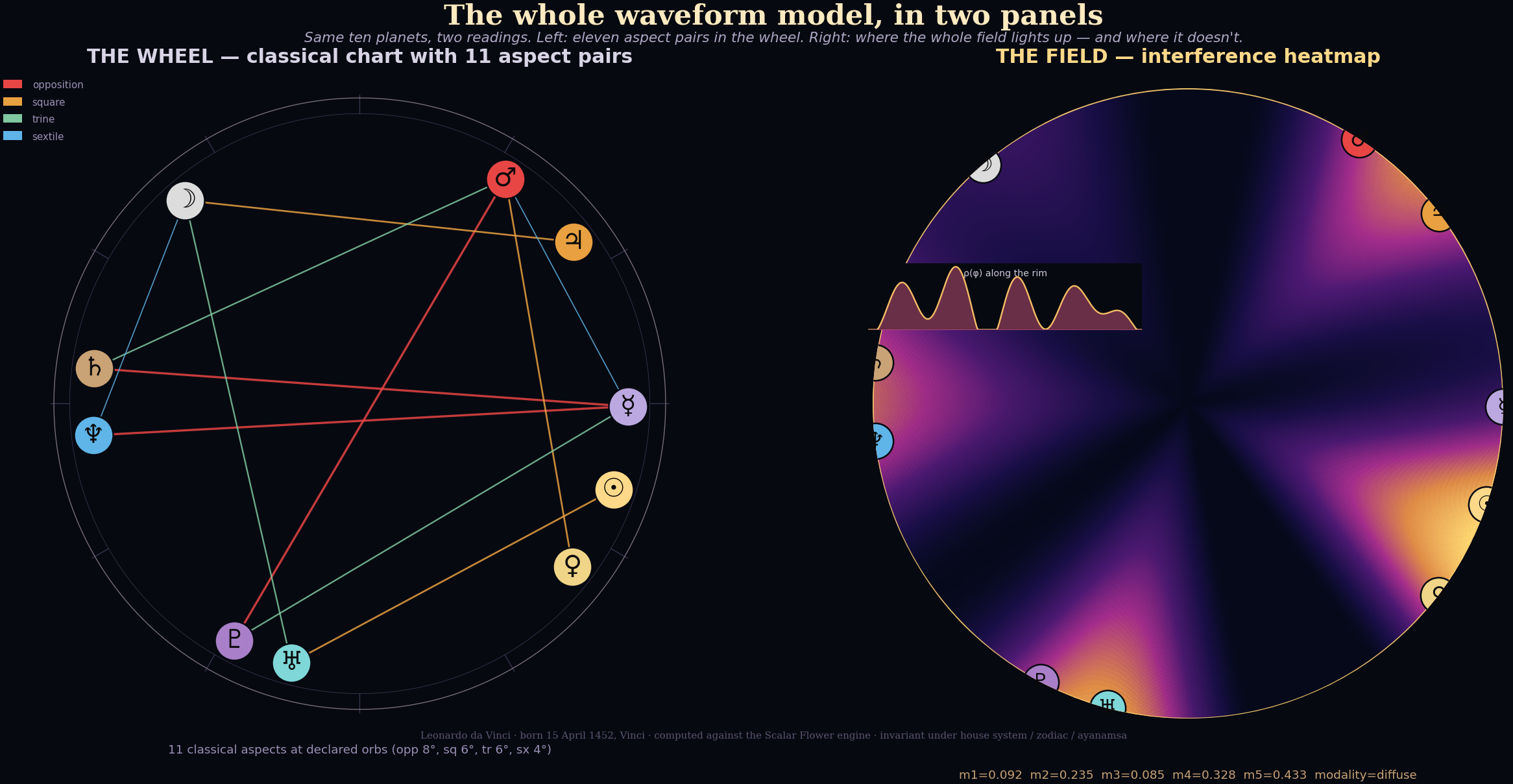
Da Vinci, read twice. Left: the wheel with every classical aspect drawn. Right: the resulting field as an interference heatmap — gold ridges where the ten planets constructively agree, deep blue valleys where they cancel. The small inset at the upper-left of the right panel is the rho curve around the rim — the radial profile of the heatmap. Both panels show the same ten bodies.
The heatmap on the right is the same data as the wheel on the left, drawn as a field. The gold ridges are where the ten phasors (one per planet, each centred on its longitude) line up to construct a strong amplitude. The deep blue valleys are where they line up to cancel. REAL
Each case study below uses a smaller version of the same drawing: the interference pattern alone, with the faint ten phasor waves behind it. You can see them — faint white traces around the rim — and the petal pattern on top is what they add up to.
5 Five charts where the two readings part company
Same five as the case selection. Birth data is the documented record; all five have times good enough for the longitudes, which is all the harmonics use. REAL
| Chart | Hard aspects | Hub | |m2| | Leading harmonic | Modality |
|---|---|---|---|---|---|
| da Vinci | 6 | 0.92 (3rd pct) | 0.235 (32nd) | p5 — 0.433 | diffuse |
| Mandela | 2 | 5.58 (72nd pct) | 0.420 (74th) | p1 — 0.558 | unipolar |
| Bowie | 2 | 3.30 (33rd pct) | 0.449 (80th) | p2 — 0.449 | bipolar |
| Marley | 5 | 0.60 (1.5th pct) | 0.201 (24th) | p6 — 0.581 | trilobed |
| Tesla | 6 | 4.79 (58th pct) | 0.174 (18th) | p4 — 0.522 | diffuse |
Percentiles are against a 20,000-chart population. “Hard aspects” counts oppositions plus squares at the orbs declared above.
Read the first two columns against each other and the pattern is immediate. Da Vinci and Tesla have six hard aspects each and a quiet second harmonic. Mandela and Bowie have two hard aspects each and a loud one. The count and the structure are running in opposite directions.
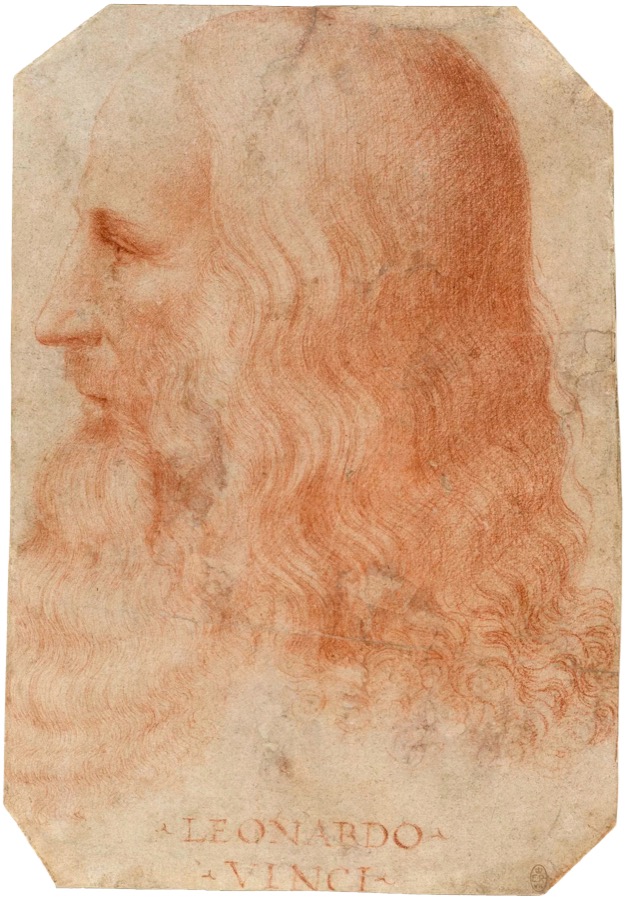
Leonardo da Vinci
15 April 1452, Vinci · painter, engineer, anatomist, hydrologist, and finisher of almost nothing
Eleven classical aspects. A hub in the 3rd percentile. The busiest wheel in this set sits on the emptiest centre.
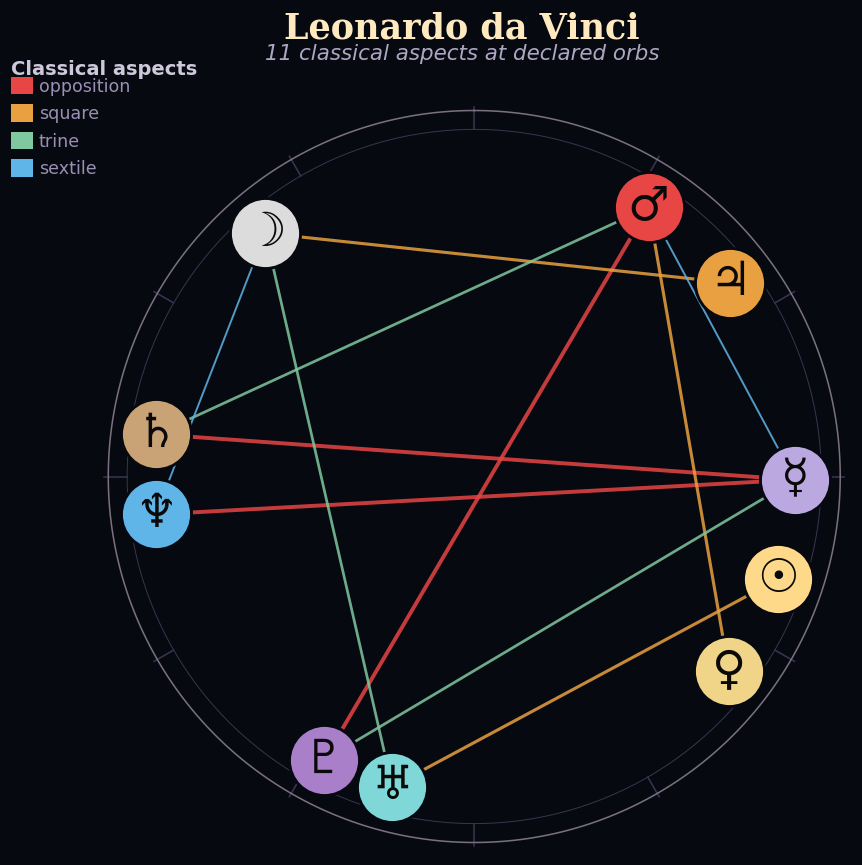
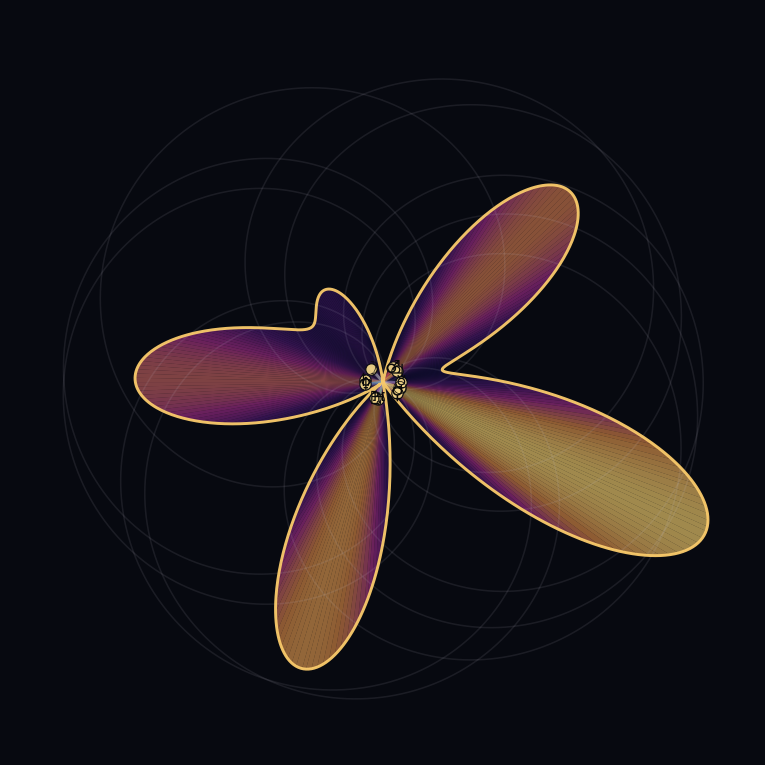
Left: da Vinci's chart as a classical astrologer reads it — 11 aspect pairs in the wheel. Right: the same ten bodies read as one field, with the faint ten phasor waves visible behind the petal pattern. Same data, two readings.
The wheel gives you plenty to say. Mercury opposite Saturn at 173°. Mercury opposite Neptune at 172.6°. Mars opposite Pluto at 175°. Moon square Jupiter, Sun square Uranus, Venus square Mars. If you handed me this chart cold in 1990 I would have talked for an hour about a mind at war with its own authority.
The field says something different. The hub is 0.92 — third percentile. Ten bodies, and their resultant is nearly nothing. The three oppositions do not stack; they sit at scattered angles and cancel one another out. |m2| lands at 0.235, thirty-second percentile. There is no axis. REAL
Where the structure lives: |m5| = 0.433, |m4| = 0.328, both well above his second. The leading harmonic is the fifth, not the second. The modality is diffuse.
|m2| = 0.235 (32nd percentile)
Three oppositions at 173.0°, 172.6°, 175.0° do not reinforce — they cancel. The classical chart reads them as three tensions. The arithmetic reads them as none.
Nelson Mandela
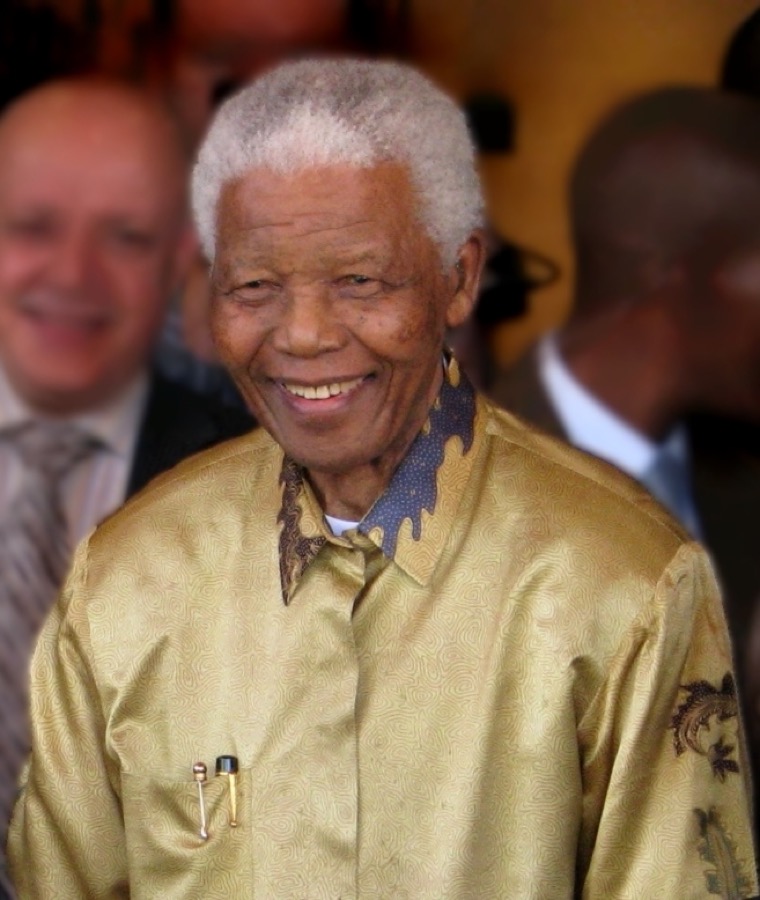
18 July 1918, Mvezo · lawyer, prisoner, president
Zero oppositions. Two squares. And a second harmonic in the 74th percentile with a threefold at the 91st.
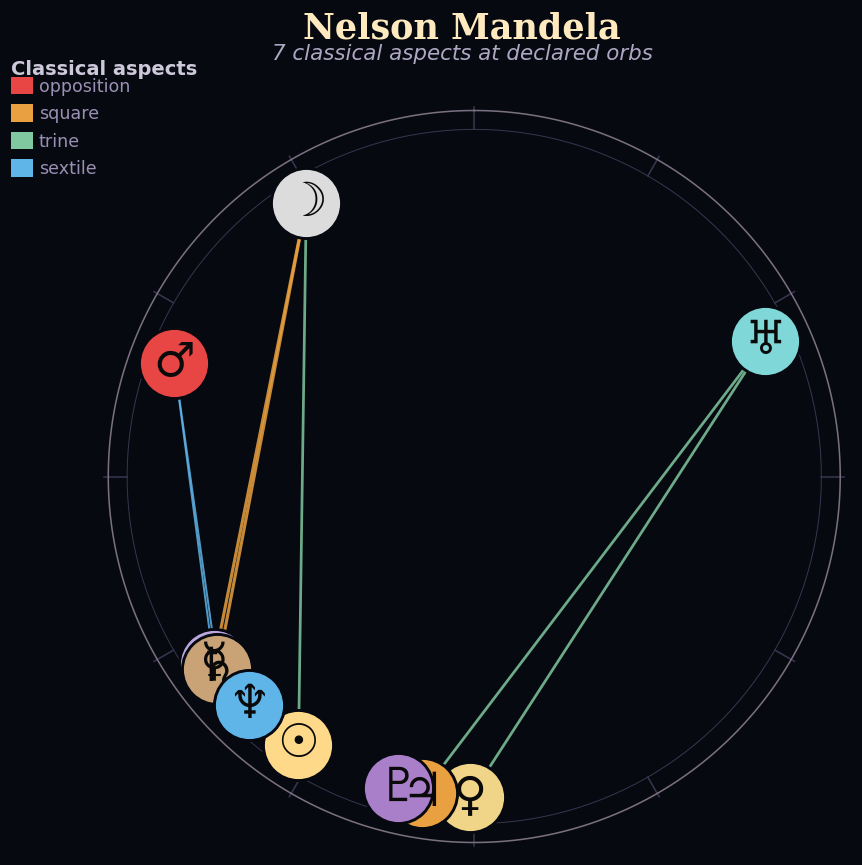
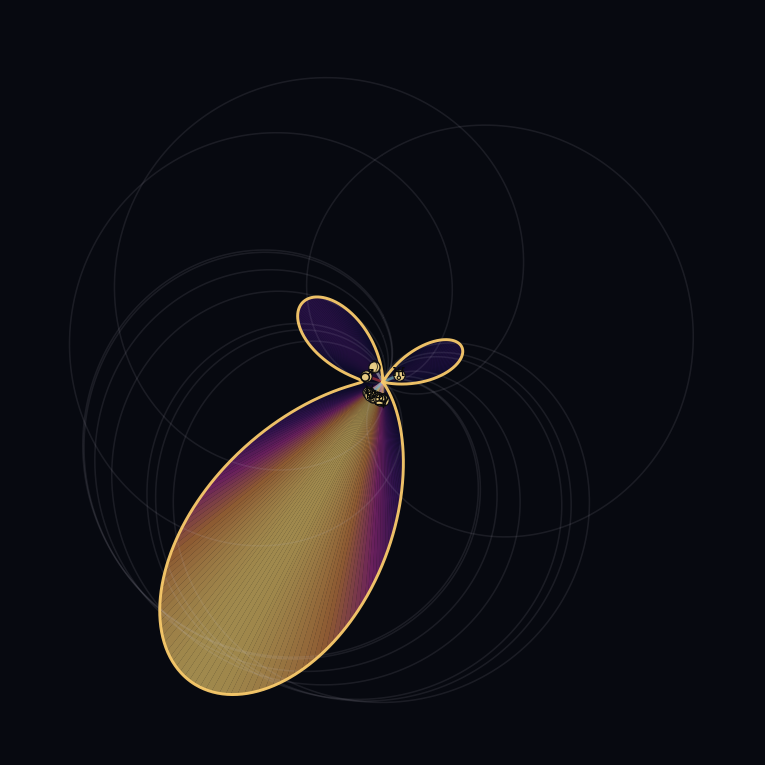
Left: Mandela's chart as a classical astrologer reads it — 7 aspects, no oppositions. Right: the same ten bodies read as one field. Same data, two readings.
This is the chart that would have bored me. Not one opposition inside 8°. Two squares, both loose — Moon square Mercury off by 4.1°. Otherwise trines and sextiles, the aspects we call easy. A working astrologer flips past this page.
The field does not flip past. Hub 5.58, seventy-second percentile — a genuinely gathered chart. And underneath it, |m2| = 0.420 at the seventy-fourth percentile and |m3| = 0.468 at the ninety-first. The second and third harmonics are both strong and the third is stronger. REAL
Where did a loud second harmonic come from with no oppositions to build it? From the squares and sextiles, phase-aligned. Mars sextile Saturn at 57.5°, Mercury sextile Mars at 56.4°, the Moon-Mercury square — these fold onto a common axis at p2. The wheel scores them as minor. The arithmetic does not care what we call them. ARCH
|m2| = 0.420 (74th percentile)
No oppositions. Two loose squares. Three trines and two sextiles, all phase-aligned — the 60° angles double to 120° at p2 and reinforce. The chart's axis comes from pairs the wheel would call minor.
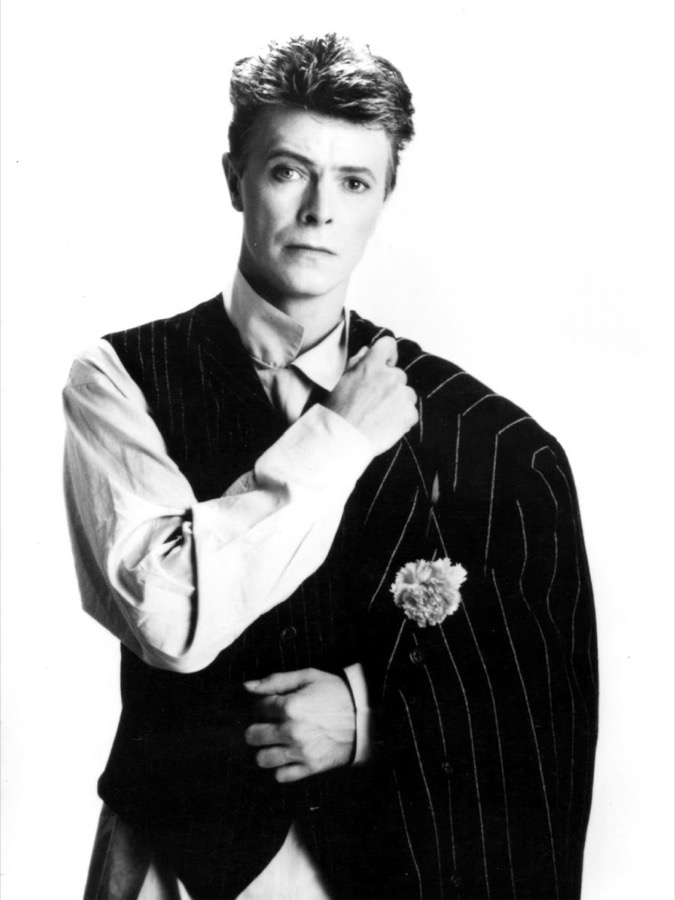
David Bowie
8 January 1947, Brixton · Ziggy, Aladdin Sane, the Thin White Duke, and a man called David Jones
Same classical profile as Mandela — zero oppositions, two squares. Same verdict from the field: bipolar. Completely different life.
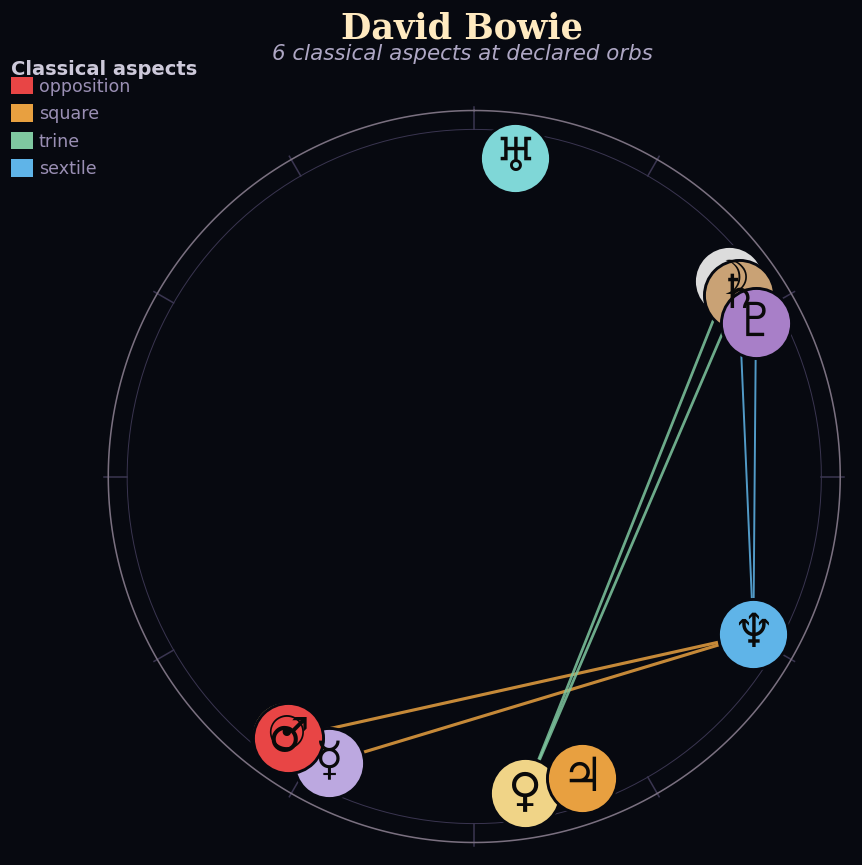
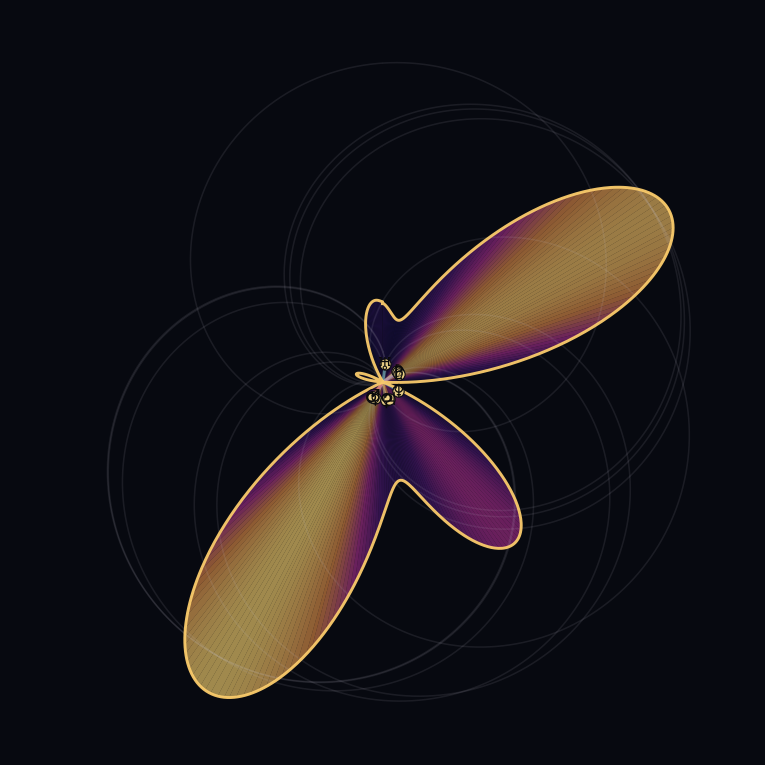
Left: Bowie's chart as a classical astrologer reads it — 6 aspects, no oppositions. Right: the same ten bodies read as one field. Same data, two readings.
Put Bowie’s wheel beside Mandela’s and a classical reading struggles to separate them. Zero oppositions each. Two squares each. Trines, sextiles, nothing screaming.
The field separates them instantly — and this is the part I find most useful, because it separates them on where the structure sits, not how much of it there is. Bowie: hub 3.30, thirty-third percentile. Modest gathering. But |m2| = 0.449, eightieth percentile, and it is the leading harmonic — p2 tops his spectrum outright. The modality is bipolar. REAL
Mandela’s second harmonic was strong but subordinate; his first and third were both above it. Bowie’s second harmonic is the chart. A two-fold structure with a weak centre.
|m2| = 0.449 (80th percentile, leading harmonic)
Same pair-count as Mandela. Same aspect families. The two-body vector sum lands higher because the four contributing pairs cluster on one axis — the modal reading is bipolar, not unipolar.
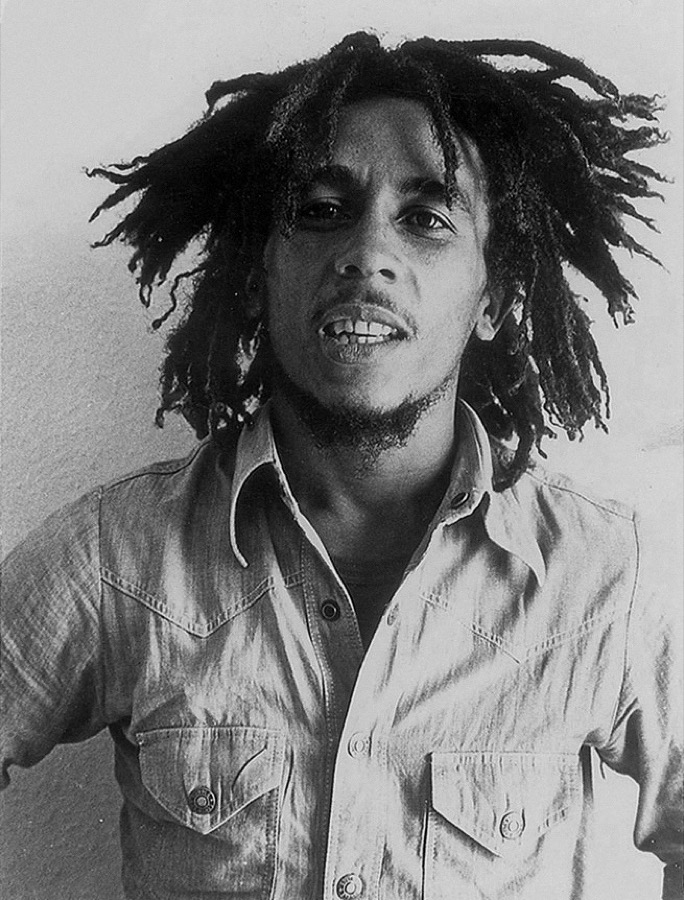
Bob Marley
6 February 1945, Nine Mile · singer, and something closer to a preacher
Hub in the 1.5th percentile — the lowest here. Fifteen classical aspects. And a sixth harmonic at 0.581, the tallest single number in this set.
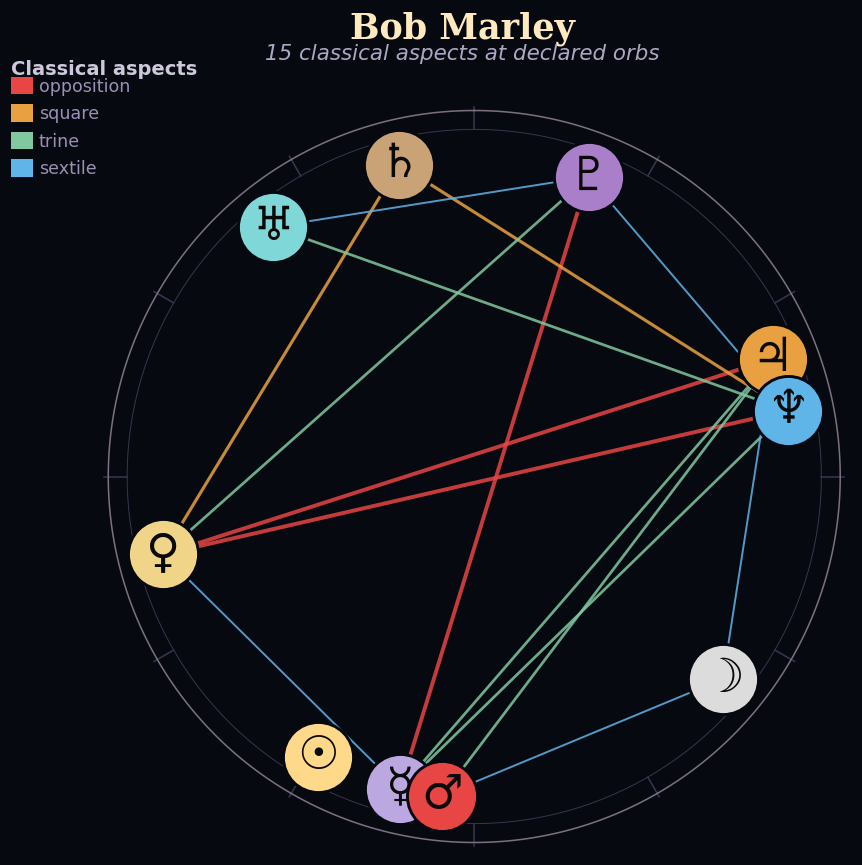
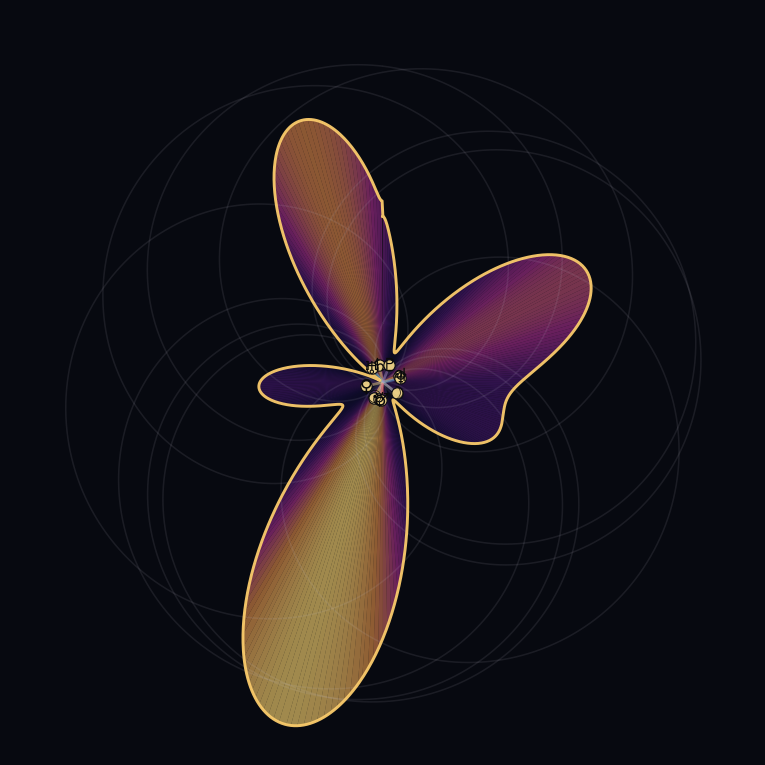
Left: Marley's chart as a classical astrologer reads it — 15 aspect pairs, the busiest wheel in this set. Right: the same ten bodies read as one field. Same data, two readings.
Marley’s wheel is crowded: three oppositions, two squares, five trines, five sextiles. Venus opposite Neptune at 177.8°, nearly exact. Venus square Saturn at 90.5°, nearly exact. Uranus sextile Pluto at 59.8°, exact to two-tenths of a degree. A rich page.
And his hub is 0.60. First-and-a-half percentile. Of twenty thousand charts, almost none are less gathered. |m2| is 0.201, twenty-fourth percentile — those three oppositions cancel almost perfectly. REAL
Where the structure is: the sixth harmonic, at |m6| = 0.581, the tallest number in this whole set. The modality is trilobed from the lower moments; the sixfold is the loudest thing in the chart. ARCH
|m6| = 0.581 (leading harmonic, p6)
The classical chart sees fifteen aspects. The second harmonic collapses. The sixth harmonic carries the structure — the field divides into six lobes around the wheel with no centre to anchor them.
Nikola Tesla
10 July 1856, Smiljan · alternating current, and a room at the New Yorker
Six hard aspects, five of them squares. |m2| at the 18th percentile. The tension the wheel sees does not exist in the field.
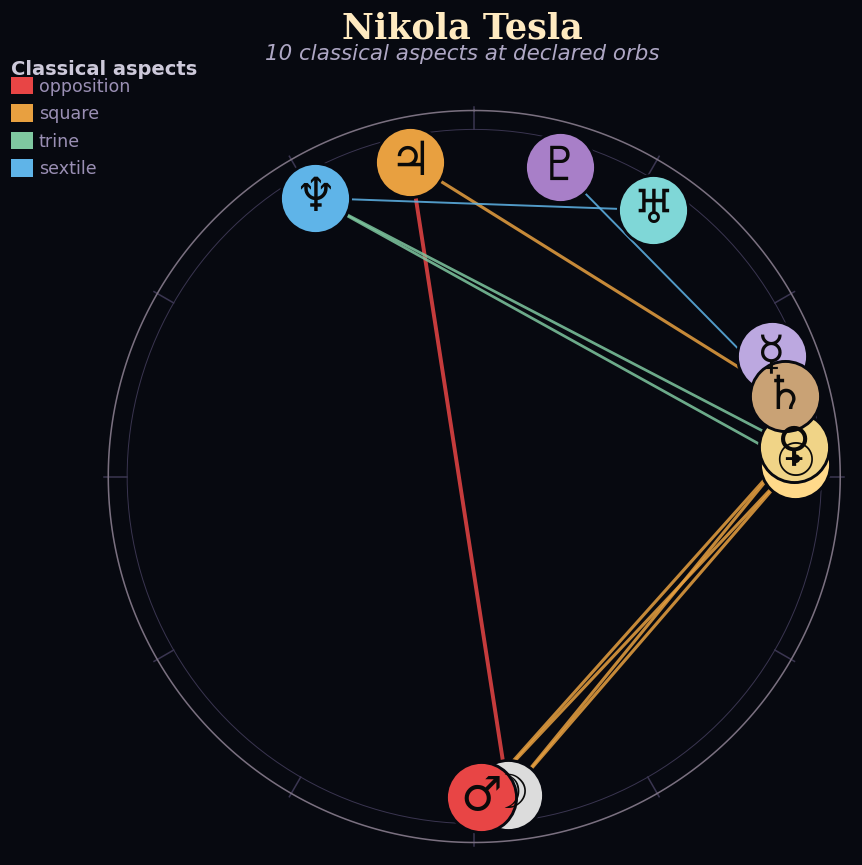
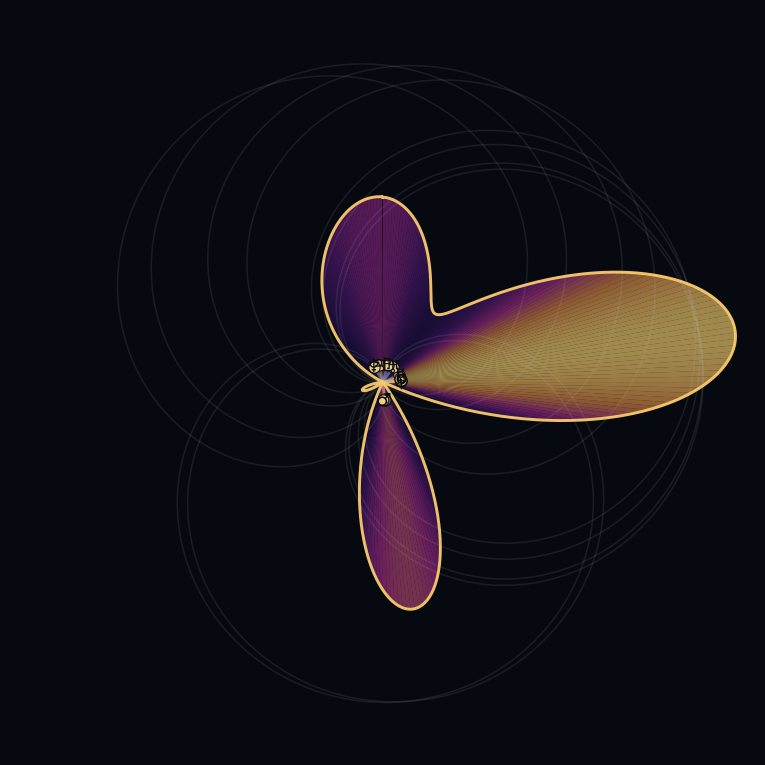
Left: Tesla's chart as a classical astrologer reads it — 10 aspect pairs, five of them squares. Right: the same ten bodies read as one field. Same data, two readings.
Five squares. Moon square Venus at 89.2°. Sun square Mars at 91.1°. Jupiter square Saturn at 87°. Saturn sextile Pluto exact to the degree. On the wheel this is a man under pressure from five directions, and the biography obliges — the patents, the feuds, the pigeons, the hotel room.
But |m2| is 0.174, eighteenth percentile. Five squares and almost no two-fold structure, because they point in five different directions and sum to nearly zero. His hub is respectable at 4.79. His fourth harmonic is 0.522 and leads the spectrum. REAL
He and da Vinci arrive at the same verdict — diffuse, no axis, structure in the higher folds — from opposite directions. Da Vinci had a near-empty hub with a busy wheel. Tesla has a solid hub with a busy wheel. Neither has an axis.
|m2| = 0.174 (18th percentile)
Five squares pointing in five different directions. Each one is real; together they cancel. The fourth harmonic carries the chart: |m4| = 0.522, leading.
6 What the counting misses
Line up the five and the failure of counting is stark:
The two charts with the fewest hard aspects have the strongest two-fold structure. The three with the most have the weakest. In this set the relationship is inverted. REAL
Let me be careful here, because this is exactly the kind of moment where I would want someone to check me. Five charts is not a population study. I am not claiming that hard-aspect counts anti-correlate with |m2| in general — I have not run that test, and if I did I would expect a weak positive relationship with enormous scatter. What these five show is that the scatter is large enough to swallow the signal at the level of an individual reading. That is the claim, and it is enough.
Because the reason is not statistical, it is geometric. An aspect count is a scalar. A harmonic is a vector sum. Three oppositions on a shared axis and three oppositions scattered around the circle give the same count and opposite structures. The wheel throws away the phase and keeps the tally. That is the information loss, and no amount of interpretive skill recovers it, because it was discarded before the interpretation began.
Forty years of practice made me faster at reading the tally. It could not make me see what the tally had already thrown away.
7 What this does not mean
It does not mean the tradition was wrong. Every aspect I found in these five charts is really there. Mercury really is opposite Saturn in da Vinci’s chart, within 7°. The tradition’s observations are observations.
It does not mean the harmonics are validated as meaning. The geometry is REAL — computed, invariant under house system and zodiac and ayanamsa, reproducible by anyone with an ephemeris. The identification of harmonics with aspect families is ARCH — it follows from the arithmetic. Everything I said about what a fourfold field means for a life is INTERP, offered and nothing more. I picked five charts whose biographies I already knew. That is illustration, not evidence, and if you want to hold me to a standard, hold me to that one.
And it does not mean I have stopped reading wheels. I read one this morning.
What it means is narrower and, to me, larger. The opposition was never the top of the structure. It was the second harmonic of something with at least six, and for forty years I mistook one layer for the whole building because it was the only layer my language had a word for. When I finally saw da Vinci’s eleven aspects sitting on a third-percentile hub, the thing I felt was not that I had been wrong. It was that I had been reading one line of a score and calling it the music.
See your own field, not just your wheel
The waveform view renders your chart as the interference field it is — harmonics, ridges, silences, and the shape underneath the aspects.
Open the waveform view