The Long Way Home
Most of you know me from the health world — the research, the activism, the long fight over what's actually true about the body. Fewer of you know that I started somewhere stranger: a philosophy student who couldn't stop asking what reality is made of. This is the bridge between those two lives. They were never really two.
A Field Note from Scalar Flower.
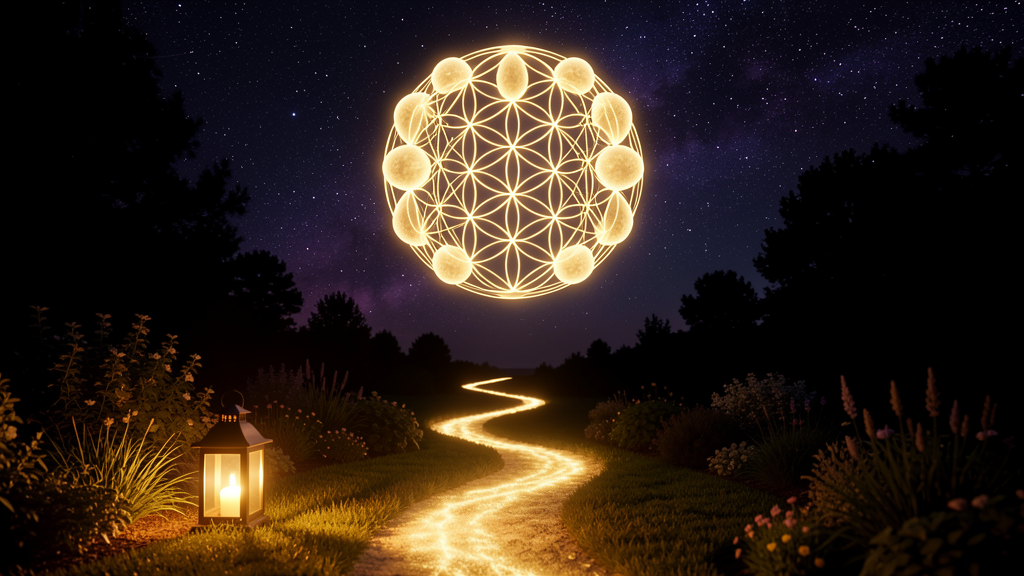
One path, two apparent worlds: the warmth we live in, and the geometry underneath it.
If you've followed my work for any length of time, you know me for one thing: the body, and the truth about it. Whether a molecule in turmeric can do what a patent drug claims to do. Whether the story we've been told about our own biology serves us or sells to us. I've spent most of my adult life defending a simple, radical idea — that the human body is not a broken machine waiting for a prescription, but a coherent, intelligent, self-healing whole, and that most of what threatens it is our forgetting of that wholeness.
What far fewer people know is where that conviction actually comes from. It didn't start in a lab, or a clinic, or a health-food store. It started in a philosophy seminar, with a question I could not put down: what is reality, underneath everything — and why did we ever come to believe that the living, feeling, first-person world is less real than the numbers we measure it with?
This letter is for the reader who has trusted me on wellness, on beauty, on gratitude, on the fight — and who may have seen me lately talking about physics, phenomenology, and a strange instrument called the Scalar Flower, and wondered: where did this come from, and what does it have to do with anything I care about?
Everything. Let me show you the road.
It began with beauty
Not long ago I wrote to you about the strongest medicine I know, and it wasn't a supplement. It was beauty — the light in a city at the end of the day, the face of someone you love, a building that makes you inhale before you understand why. I made a claim there that I want to pick back up, because it's the hinge of this whole story: that beauty is not decoration. It is ontological — a fact about the structure of reality — before it is ever a matter of taste.
The Navajo have a word for this: hózhó. We translate it as "beauty," but that translation already breaks something. Hózhó means beauty, harmony, order, and goodness all at once, as a single undivided thing. To walk in beauty, in that tradition, isn't an aesthetic preference. It's alignment with the way things actually are.
And here's the detail that has haunted me for years. Our own language remembers the same wholeness, buried in its oldest roots. The words heal, whole, and holy all descend from a single ancestor — the Proto-Indo-European kailo, meaning uninjured, entire, sacred. One word. To heal was to make whole was to make holy. They were never separate ideas. We split them.
To heal, to be whole, and to be holy were one word — before we learned to cut them apart.
Sit with that, because it's the seed of everything I do. If healing and wholeness and holiness were one thing, then the crisis of health in our time is not only medical. It's metaphysical. We got sick, in part, because we adopted a picture of reality in which the body is just matter, meaning is just chemistry, and the sacred is just a feeling in the skull. The fracture in the word is the fracture in us.
The cut that made us sick
So where did the fracture come from? This is where the philosophy student in me has never been able to stay quiet — because I think I can name the moment, and naming it matters.
Almost four hundred years ago, René Descartes went looking for something he could be absolutely certain of, and he found it in his own thinking: I think, therefore I am. But look at the price. To get that certainty, he had to declare the thinking mind one kind of thing and the whole physical world — including your body — a completely different kind of thing: dead, measurable stuff, a machine with no inside, no felt life, no point of view.
That split is the reason your doctor can treat you like a collection of parts. It's the reason "subjective" became an insult and "objective" became the only respectable truth. It's why we learned to trust the view from outside and above — the god's-eye measurement — and to distrust the one thing we actually are: a living body, standing somewhere, feeling from the inside. Philosophers call that god's-eye stance the view from nowhere. We built a civilization on it. And it gave us extraordinary things — science, medicine, the map of the world. It also quietly told us that the dweller inside the body was an illusion to be corrected.
The wellness instinct you and I share — that the body is wise, that nature has a grammar, that health is a kind of remembering — is, whether we say it in these words or not, a revolt against that four-hundred-year-old cut. Every time you insist that a person is more than their lab values, you are doing philosophy. You're just doing it with your life instead of a chalkboard.
The wager I made at twenty-something
Thirty years ago, long before GreenMedInfo, I was a philosophy student, and I wrote a paper for a professor named Bruce Wilshire that made what felt at the time like a wild bet.
I had fallen in love with two thinkers who never met. One was Maurice Merleau-Ponty, a French philosopher who spent his life trying to heal exactly the Cartesian cut — insisting that mind and world are not two substances but one living tissue he called the flesh, the place where the one who touches and the thing touched fold into each other. The other was Sungchul Ji, a biologist reaching for the same unity from the side of hard science, building on quantum physics and the work of Niels Bohr.
My wager was that these two men, coming from opposite ends of the earth and opposite ends of the university, were describing the very same thing. That the felt world and the measured world were not rivals, one real and one illusion, but two honest readings of a single reality — the way, in quantum physics, light is both a wave and a particle depending on how you ask.
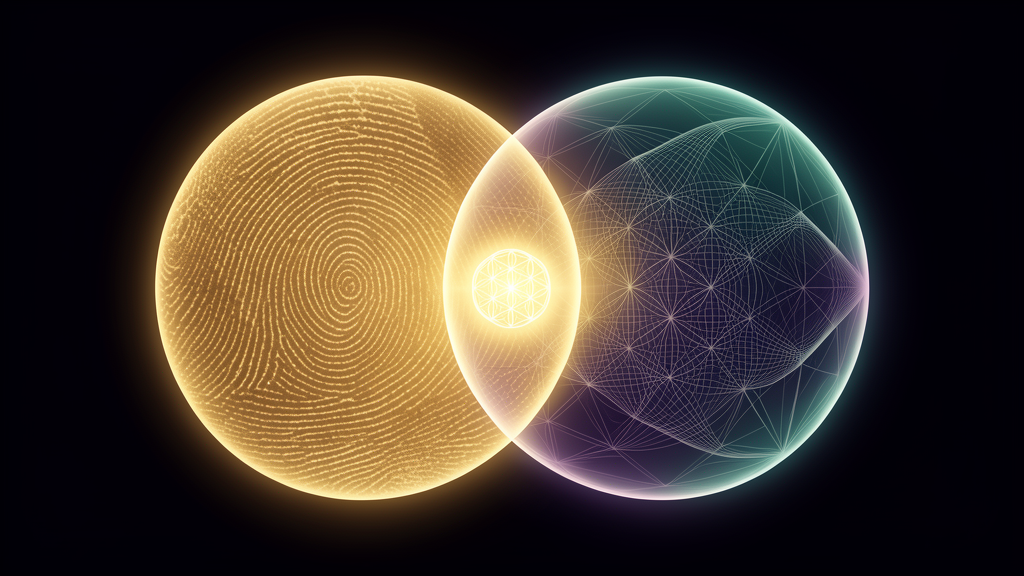
It was, if I'm honest, a beautiful argument that you couldn't do anything with. You couldn't hand it to a skeptic. You couldn't turn a knob and watch it work. So the paper got filed, published years later on a health website, and it sat there for three decades like a seed with no soil.
Why it took thirty years and a detour through medicine
Here's the part I've come to find almost funny. I didn't abandon that question when I went into health. I lived it. GreenMedInfo — all those thousands of studies, the whole argument that the body heals itself when we stop obscuring it — was the same conviction wearing work clothes. That the living whole is real. That the reductive, view-from-nowhere picture of the body leaves out the most important thing. That healing is remembering wholeness.
I was making the philosopher's argument in the one arena where people could feel it in their own flesh: their health. The seminar and the clinic were the same room. I just didn't have the language yet to say so out loud.
And then, recently, the soil finally arrived — from the most unlikely direction I can imagine: an old, disreputable pattern-language called astrology. Not the horoscope-column kind. I mean the raw geometry underneath it — the question of what happens if you take a birth-moment and treat it purely as a pattern of angles, of waves, and ask whether that pattern holds still or changes depending on where you stand to measure it.
When I built the tool to test that, something happened that stopped me cold. The pattern does change depending on your standpoint — measurably, and in exactly the way my thirty-year-old paper had predicted it should. The wild wager of my twenties had, without my planning it, become something you can turn with your own hands and watch on a screen.
The question I couldn't answer at twenty became an instrument I could build at fifty.
What I'm not claiming
Let me be as clear as I know how, because this is where trust is either kept or lost, and I would rather lose your interest than your trust.
I am not telling you the stars control your fate. I don't believe that, and the tool I built has spent as much of its energy refuting pretty ideas as confirming them — including some of my own favorite hypotheses, which I've published as failures, on purpose, before any success. I hold a hard line I call the waterline: what is genuinely measurable gets marked as measurable, what is structural gets marked as structural, and what is interpretation — meaning offered as resonance, never as proof — gets marked plainly as interpretation. A portrait, never a forecast. A mirror, never a script.
What I am claiming is smaller and, I think, far more durable: that the view from nowhere is a choice, not the only truth — and that it has a measurable cost, which is your location, your standpoint, your embodied here-and-now. The body knows something the god's-eye view throws away. I can finally show that with numbers instead of only insisting on it with words.
That's the whole journey, compressed: from a student's love of a hard idea, through a life spent defending the wisdom of the body, to an instrument that lets you see the thing I've believed all along — that the felt and the measured, the sacred and the scientific, were one word before we split them, and can be made whole again.
Heal. Whole. Holy. I've been chasing that single root my entire life. I just took the long way home.
The Copernican Return
If this letter opened the door, here is the room. The full essay tells the whole story — Copernicus, Descartes, Husserl's scandal, and the instrument you can turn with your own hands — and reads it on two American lives, Walt Whitman and Edgar Cayce. It goes deeper, but it starts exactly where you now stand.
Read the full essay →