The Fifth Vertex
Why you can't see the most real thing in your chart — and why that invisibility is exactly what proves it's there.
A Field Note from Scalar Flower, building on the Three-Layered Reality Hypothesis of Sungchul Ji, Ph.D. With computational collaboration by the Hermes agent (Nous Research).
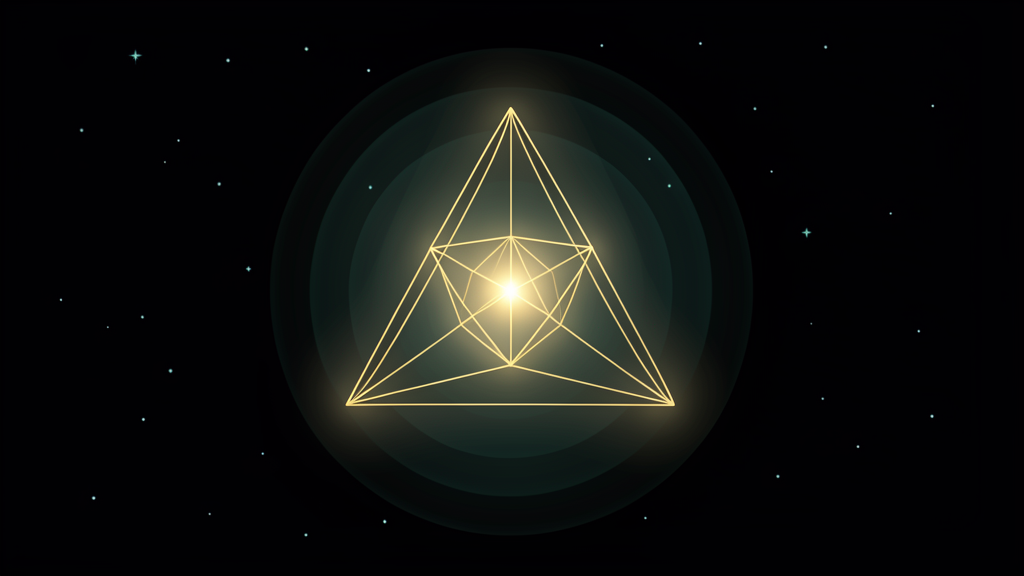
The hypertetrahedron (5-cell). In four dimensions all five vertices are equal; the "central" fifth point is an artifact of flattening it into our three.
There is a question that has embarrassed astrology for four hundred years, and it deserves to be asked plainly: how could a planet millions of miles away possibly affect the moment you were born? The honest answer, if you mean it the way the question is usually meant, is that it couldn't. The gravitational pull of Mars on a newborn is smaller than the pull of the doctor holding her. Mars sends no force that could reach across that void and shape a life. And when Mercury appears to go "retrograde," nothing whatsoever happens to Mercury — it doesn't slow or reverse; it only looks that way from a moving Earth, the way a car you pass seems to drift backward.
There is no mechanism. The skeptics are right about that, and pretending otherwise has kept honest people away from something real. So let me concede the whole battlefield — and then show you the war was fought over the wrong ground.
Astrology's mistake was never the sky. It was the physics it borrowed — Isaac Newton's picture of separate objects flinging forces across empty space. Ask "what force reaches me from Mars," and you will always come up empty, because you are asking a billiard-ball question about something that was never a billiard ball.
We are not objects in a void. We are a pattern in a field.
Here is the reframe. You were not struck by the planets at your birth, like a target hit from a distance. At the instant you drew your first breath, the entire configuration — you, the room, the Earth, the Sun, every planet — was one state of a single system. Not a collection of separate things exchanging pushes. One field, in one arrangement, at one moment. Crystallized.
Your chart is not a record of forces that hit you. It is a set of coordinates on that whole state — a reading of the shape the field held in the instant you became a distinct being within it. Nothing had to travel. Nothing had to reach you across the dark. There was no crossing, because there was no gap: there was one system, and you were part of its shape.
This isn't mysticism dressed up. It is close to a principle the physicist Ernst Mach proposed and Einstein chased for years — that the local behavior of anything here is set by the arrangement of everything out there. Modern physics has a version too: in relational quantum mechanics, a system's state has no meaning except in relation to the other systems around it. To be, in this picture, is to be in relation. You are a body within a field of bodies, and the largest of those bodies are the planets.
What a chart actually records: angle
If nothing travels, what survives the birth to be read? The answer is one word, and it turns out to be among the deepest words in modern physics: angle.
Reduce each planet to the one number our model cares about — its angle on the wheel. Not its distance, not its mass, not any force. Just where it sits, as an angle. Picture that angle as a little arrow of length one, pointing in that direction; physicists call it a phasor. Ten planets, ten little arrows pointing around a circle.
Now lay them end to end, tip to tail, and see where you land. If the arrows mostly agree, they add into one long arrow: a bright, concentrated field. We call the length of that combined arrow the hub. If instead they scatter evenly, they curl back on themselves and nearly cancel — the hub is almost nothing, and the field's organization has gone elsewhere, into a two-sided axis or a threefold symmetry. The hub is simply: how much do all the angles agree?
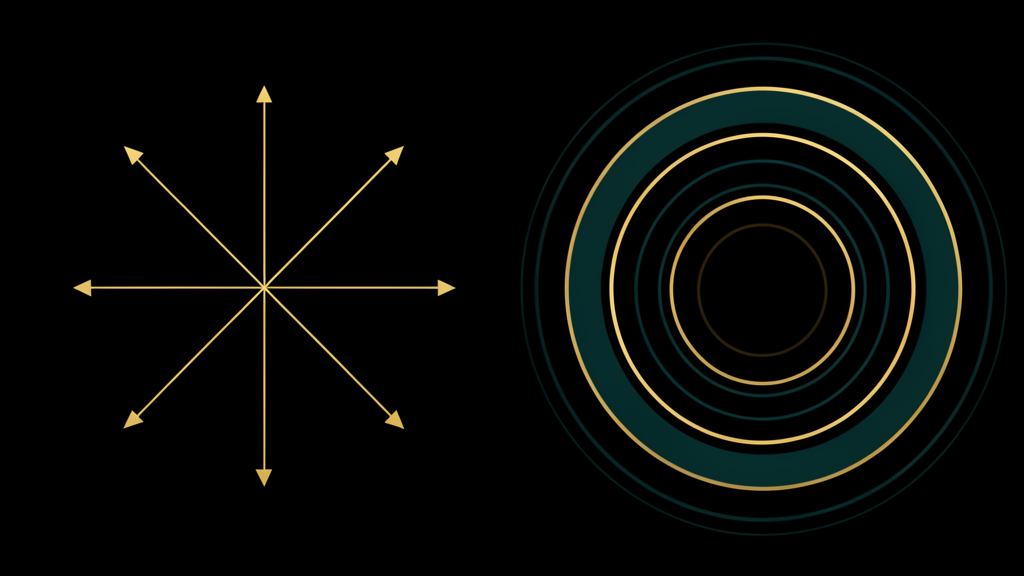
And here is the part that stopped me when I first saw it clearly. That exact calculation — add unit arrows by their angles, measure the length of the result — is the mathematics of how light interferes with itself. It is the equation behind the bright and dark bands of a double-slit experiment, behind every hologram, behind how a radio telescope combines its dishes. When waves line up, a bright fringe; when they cancel, a dark one. Our engine's own derivation says it in one line:
Not like optics. The same equation.
The invisible thing that proves itself
Now we can meet the title. The theoretical cell biologist Sungchul Ji — my father — has proposed that reality comes in three layers. There is the world we can measure and touch (the surface). There is the deeper source we can never observe directly (the depth). And between them — this is the radical move — there is mathematics: not a human invention laid over nature, and not the bedrock either, but the interface, the first thing that appears when the depth projects up into the visible.
His clue is a shape. Take the simplest, most symmetric object that can exist in four dimensions — five points, every pair exactly the same distance apart. It is called the 5-cell, or the hypertetrahedron. In four dimensions all five points are perfectly equal: no center, no leftover, no lesser point.
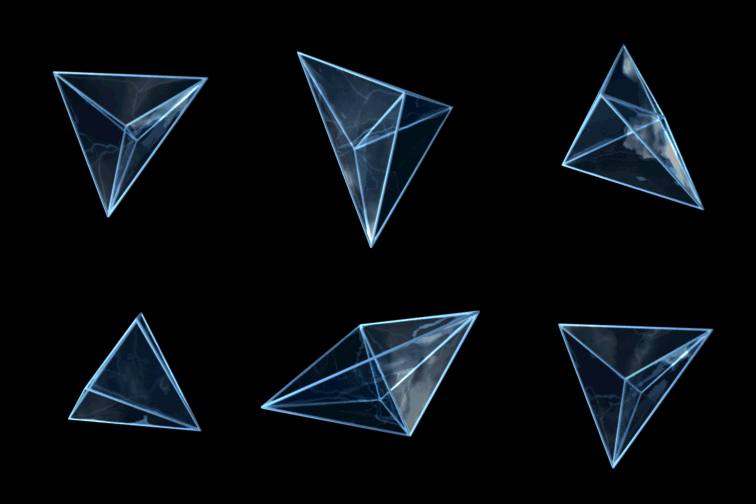
Now try to bring it into our three-dimensional world — to see it. You can't, not whole; we have no eyes for four dimensions. What you get instead is its shadow: four points forming a pyramid, and the fifth trapped in the center. And here is everything:
The fifth point only looks central because we flattened it. Its demotion is not a fact about the point — it is a fact about the smallness of our view.
A skeptic looks at the shadow and says: show me the fifth point, directly, out here, or admit it isn't real. But that demand is impossible by construction. You are asking a four-dimensional thing to appear, whole, inside a three-dimensional box that cannot hold it. The fifth point's invisibility is not evidence that it's fake. It is the exact, predicted consequence of a higher thing casting a shadow into a lower world.
So how do we know it's real, if we can never see it directly? The same way physics knows anything is real: by what stays fixed when you turn it. Rotate that four-dimensional figure and take shadow after shadow, and something no accidental smudge could ever do reveals itself: the five points never stop being a perfect 4-simplex — all ten distances between them stay exactly equal, in every single view, no matter how you turn it. That is the unshakeable invariant. And there is one special shadow — the projection taken straight down the axis through a single vertex — where that vertex lands exactly at the center of the other four, equidistant to each: the body-centered tetrahedron. It only takes one faithful view to exhibit the real relationship. You never see the whole figure at once. You prove it by what survives the turning. This is why it becomes obvious after a multiple number of views — never from one.
What holds under every 4D rotation is that the five points remain a regular 4-simplex — all pairwise distances equal, checkable to machine precision. In the one axial (vertex-first) projection, the fifth vertex maps exactly to the centroid of the other four — the "fifth point at the center." Both facts are provable geometry; the equidistant center is one faithful shadow of the invariant 4D figure, not a property of every projection.
The chart does the very same thing
Watch what happens when we turn our own model. There is an old fight in astrology about which zodiac is "right" — tropical or sidereal, where you place the starting point, which house system. People have argued it for centuries. Our instrument settles it by declining to care, and the reason is a small piece of mathematics with a large meaning.
Switching zodiacs, or re-anchoring the wheel, amounts to rotating every planet's angle by the same amount. Do that, and the coherence numbers — the hub, the whole pattern of agreement — do not change at all. We have checked it on real charts to the last decimal a computer can hold: identical before and after. Only one thing shifts — the absolute direction the pattern points, which was never more than an arbitrary label.
Sit with what that means. What stays fixed when you turn the frame — the pattern of agreement, the relational angles — is the real thing; it survives every choice of coordinate. It is the fifth vertex, certified by what the turning cannot move. What changes — the absolute direction — is bookkeeping. It was never the structure.
And the great mathematician Roger Penrose found the identical pattern at the scale of the entire cosmos. In his work on the geometry of spacetime — the work the Nobel committee honored — ordinary distance can dissolve entirely, and what survives, the skeleton the universe is really built on, is angle. Distance is the costume; angle is the body.
Three unrelated worlds — a birth chart, the shape of spacetime, and a jewel of four-dimensional geometry — all keep the angle and throw away the distance. When three unrelated things point to the same invariant, look hard at that invariant. It may be where the real is hiding.
There is one more object in our engine that makes the point in a single stroke. Wherever the field cancels to a dark core, we can measure a winding number: walk a small loop around the dark point and count how many times the field's phase turns. The answer is always a whole number, and it is the same whatever loop you walk. So here is a feature you cannot see by looking at the spot — there is nothing there; it's a zero — yet which is provably real, because the circulation around it is a fixed integer no matter the path. Invisible at the point, certain from the turning around it. That is the fifth vertex, written in one equation.
Is it, then, like light?
If the chart's math is the math of light, the question can't be dodged: is what we're describing like light — really, not just as a figure of speech? The honest answer is three different answers, and keeping them apart is the whole discipline.
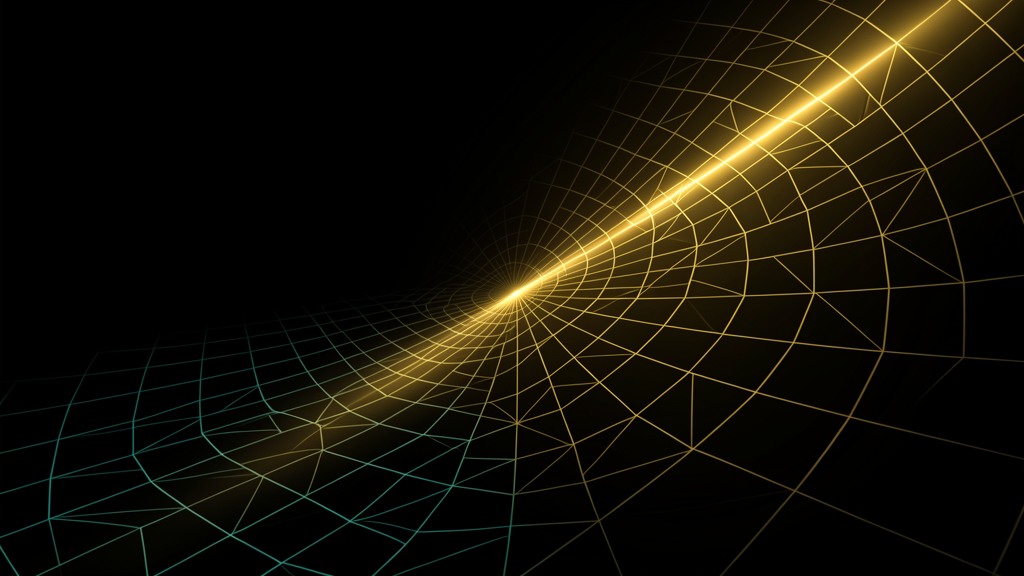
Exactly, not by resemblance: the hub is character-for-character the coherence sum of wave optics. (More precisely, of any coherent wave — sound, water, light — of which light is the purest instance.)
Our field makes bright centers, dark silences, and small whirlpools of shadow — point for point, what light makes on a screen. And the pull toward light is not arbitrary: of everything physical, light alone is angle-without-distance. A photon is massless, has no clock, no scale, no resting place; it lives on the pure angular skeleton of reality. If the real is relational angle, light is the thing that most purely is that invariant — not the same being, two faces of one.
That a planet is a source of waves is our model's starting assumption, not something we've proven, and we won't dress an assumption as a discovery. "The math is light's math, therefore this is light" would sneak the old billiard-ball error back through a prettier door. The math being light's math does not make the being light's being.
One last fact, offered as exactly what it is and nothing more. At the moment you were born, only one thing actually made the journey from those planets to your open eyes: light. Not force — the forces are negligible. Photons. And a photon is nothing but pure angle and phase. That light arrives is simple fact. That its arrival means anything is where fact ends and the reading begins — and we will always show you that seam rather than paint over it.
What this asks of us, and what it doesn't
I want to be as clear about the limits as about the vision, because that clarity is the only thing that makes any of this worth your trust. We are not claiming the planets push you, pull you, or beam anything into your character. We're not claiming your chart predicts your life like a track laid down in advance. We make no claim of force — and so we inherit none of the failures that have always come from claiming force. That whole graveyard of debunked mechanisms simply isn't our territory. We gave it up on purpose.
What we claim is quieter and, I think, sturdier: that the shape of a single moment — the relational angles held in the instant you came into being — is a real structure, the way the fifth vertex is real. Invisible to a measuring eye that demands to see it whole, yet provable by what stays fixed when everything turns. And that this structure can carry meaning the way a piece of music carries meaning — not by forcing your hand, but by offering a form. Whether a given meaning is the meaning is never something the geometry decides. The geometry gives us the shape; what the shape says is an offering, yours to test against your own life, never a verdict handed down from the stars.
The fifth vertex is our name for everything real that a measurement-first eye cannot see whole, yet can rigorously infer: the field mistaken for empty space, the depth beneath the surface, the meaning-bearing shape of the moment you began. It is not invisible because it is unreal. It is invisible because it is larger than the view — and the view keeps mistaking its own edge for the edge of the world.
Some real things are known only by what survives the turning.
See what the instrument reads →
The 5-cell / 4-simplex (the hypertetrahedron) — 5-cell
Conformal geometry & the angle-preserving structure of spacetime — Conformal cyclic cosmology
Mach's principle (local inertia set by all mass) — Mach's principle
Relational quantum mechanics (state defined only in relation) — Relational QM
Phase coherence & interference (the hub's mathematics) — Coherence